Tag Archives: Bible study

Contradiction or Difference?

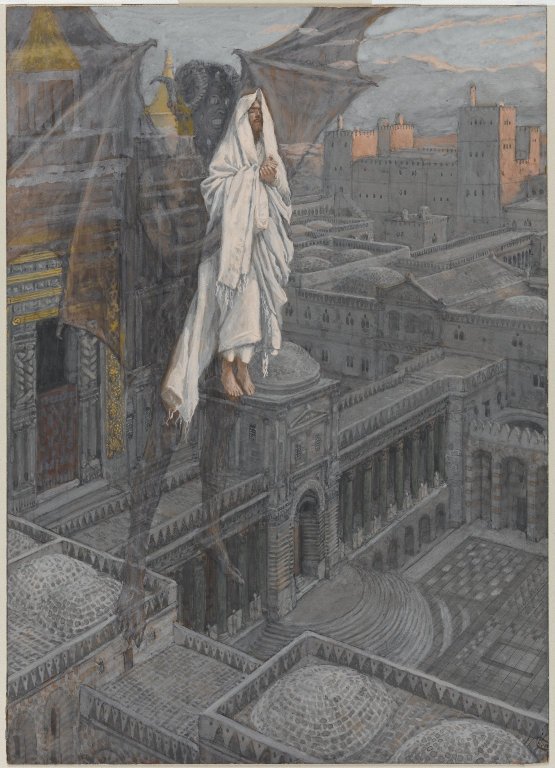
Jesus carried up to a pinnacle of the Temple, by James Tissot , a watercolor between 1886 and 1894. Was Jesus taken up to a pinnacle on the Temple prior to being taken up to a high mountain and shown the kingdoms of the world, or is the order reversed? Does the chronology really matter?

Jesus carried up to a pinnacle of the Temple, by James Tissot, a watercolor between 1886 and 1894. Was Jesus taken up to a pinnacle on the Temple prior to being taken up to a high mountain and shown the kingdoms of the world, or is the order reversed? Does the chronology really matter?

The sermon this past week was on the Temptations of Jesus. I noticed that in comparing Matthew’s version with Luke’s version that there is an apparent discrepancy in the chronology. I asked my small group what they thought of the discrepancy:  “Does this impact how you view the Bible?”

You probably know the story: Early in Jesus’ public ministry, He spends forty days in the wilderness and after being exceedingly hungry, He was tempted by the devil. Mark simply records the basics (Mark 1:12-13). But Matthew and Luke spell out the order of events of the three temptations. Both Matthew (Matthew 4:1-11) and Luke (Luke 4:1-13) start with the first temptation suggesting that Jesus turn the stones to bread. However, the order of the next two temptations between Matthew and Luke are reversed. Matthew’s second temptation is where the devil takes Jesus up to the pinnacle of the temple, urging Him to throw Himself down and trust the angels to catch Him, and the third temptation is where Jesus is taken to a very high place, challenging him to worship the devil in exchange for sharing power. Luke, on the other hand, switches the chronology, putting the “pinnacle of the temple” last, prior to being taken up to a high mountain and shown the kingdoms of the world.
Continue reading

Bible Genome

Bible Genome

Map of Direct Citations in the Bible

What Scriptures were most influential to the writers of the Bible?  Who cited whom? Which writers were most schooled in Scripture?  Which Gospel writer referred the most to other Scriptures?  How big a role did Revelation play in their thinking and teaching?  How about Genesis and Job?  How are the parts of the Bible connected?  Which books appear to have been written at the same time?

From God To Us Revised and Expanded: How We Got Our Bible by Norman Geisler and William Nix is a foundational text for those interested in the topic, and I can highly recommend pretty much anything by Dr. Geisler (more on that in a future post).

“Jesus and New Testament writers amply illustrate their belief in the full and complete inspiration of the Old Testament by quoting from every part of the Scriptures as authoritative, including some of its most disputed teachings. The creation of Adam and Eve (Matt. 19:4–6), the destruction of the world by a flood, the miracle of Jonah and the great fish (Matt. 12:39–40), and many other incidents are quoted authoritatively by Jesus. No part of Sacred Writ claims less than full and complete authority. Biblical inspiration is plenary.”
Geisler, Norman L.; Nix, William E. From God To Us Revised and Expanded: How We Got Our Bible. Moody Publishers.

Continue reading


Daniel WallaceDr. Dan Wallace has another outstanding post on Bible translation. His work and research are refreshingly real, and he clearly communicates what the Scripture tells us—and what it does not.

Daniel B. Wallace's avatarDaniel B. Wallace

There’s an old Italian proverb that warns translators about jumping in to the task: “Traduttori? Traditori!” Translation: “Translators? Traitors!” The English proverb, “Something’s always lost in the translation,” is clearly illustrated in this instance. In Italian the two words are virtually identical, both in spelling and pronunciation. They thus involve a play on words. But when translated into other languages, the word-play vanishes. The meaning, on one level, is the same, but on another level it is quite different. Precisely because it is no longer a word-play, the translation doesn’t linger in the mind as much as it does in Italian. There’s always something lost in translation. It’s like saying in French, “don’t eat the fish; it’s poison.” The word ‘fish’ in French is poisson, while the word ‘poison’ is, well, poison. There’s always something lost in translation.

But how much is lost? Here I want to explore…

View original post 1,508 more words


Your Move

Chess

How are you doing with your decision-making?

I have a long daily commute, with lots of time to fill running the Interstates of eastern Virginia.  Four months ago Veracity’s bass player, Clarke Morledge, got me into podcatching, and life hasn’t been the same since.  It’s definitely getting to me—there have been several times lately when I’ve been happy to be stuck in traffic.  Really.  I plug my iPhone into the car stereo and dive into a world of wonder, mentally shielded from the wacky races occurring all around me.  On-demand theology, philosophy, apologetics, interviews, sermons, and some of the world’s finest teaching.

If you need a how-to primer, check out our previous post on Podcasts & Podcatching, and give your spiritual life a real booster shot.  Try it, really.  If you want some great sources of Podcasts, check out Veracity’s Top 10 Scorers.

So What’s the Point of This Post?

OK, now that we have the mechanics out of the way, let’s get to the content.  One of my favorite (free) podcast subscriptions is Andy Stanley’s Your Move. Continue reading


Cherry Picking Kierkegaard

The Coffee Gathering Pombo

“La tertulia del café de Pombo” by José Gutiérrez Solana, 1920

Generally I’m more apt to hang out with grill-in-the-driveway, figure-it-out-yourself, change-your-own-oil, workaday kind of guys than intellectuals. When I was younger and thought I knew what was important, I developed an anti-intellectual prejudice that continues to the present day. But as Tim Keller says, “You cannot be a Christian without using your brain to its uttermost,” so game on.

Many of us have a tendency to read Bible passages simplistically, without empathizing or thinking beyond the sacred page. Teachers like Michael Card encourage reading “at the level of our imaginations,” but that takes time and work.

Take the story of the testing of Abraham in Genesis 22 for example.  Danish philosopher, theologian, and Lutheran ethicist Søren Kierkegaard thought about the anguish that Abraham felt while walking for three days to Mount Moriah to sacrifice Isaac.  To Kierkegaard this is not a simple story to be read dryly or mechanically from one punctuation mark to the next.  Kierkegaard thought about the huge weight being placed upon Abraham’s conscience, and posited ideas about the teleological suspension of the ethical.  This isn’t (actually) a post about Kierkegaard, but just to help set the background, here are a few of his quotes: Continue reading