
Martin Luther King Jr.’s “Mountaintop,” saturated with Scripture, the night before his death is chronicled by Justin Taylor at the Gospel Coalition, including a recording of the full speech. Here is the last minute of that speech:
The Easter Effect
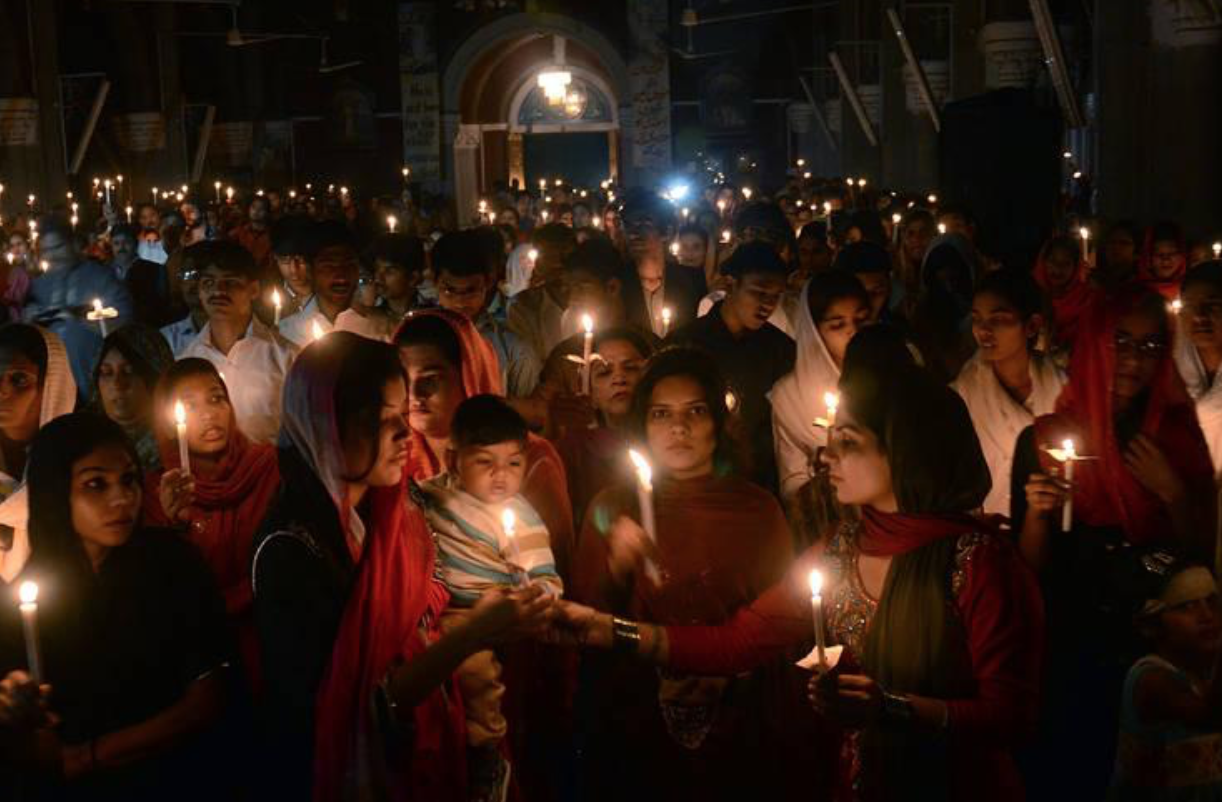
Pakistani Christian worshipers during an Easter Mass in Lahore, 2015. PHOTO: LIGHTROCKET/GETTY IMAGES (as in the Wall Street Journal article)
Several Veracity readers came to me on Easter Sunday and asked me about a recent Wall Street Journal article, “The Easter Effect and How it Changed the World” (behind a paywall), by a Catholic intellectual, George Weigel. Weigel’s argument is that the event of Christ’s resurrection, so inspired, so disturbed, and so invigorated the world of the Roman empire, that it eventually led to Christianity’s effectively taking over the Mediterranean basin within just a few centuries. Weigel published a briefer essay along the same lines in the journal First Things in 2016 (no paywall).
In the First Things essay, I disagree with Weigel’s judgment that the popularity of the New Atheism of the likes of Richard Dawkins has “just about expired.” I only see the trend continuing to erode the cultural landscape, though in a more subdued manner, until the church recaptures the imagination of the “Easter effect.” This caveat aside, I recommend Weigel’s thoughts to you.
If you are interested in this theme, of how the “Easter Effect” radically changed the world, even to the present day, you can explore this idea in a couple of books that treat this topic in-depth. Weigel was partly inspired by the work of Baylor University sociologist, Rodney Stark, in his 2012 The Triumph of Christianity: How the Jesus Movement Became the World’s Largest Religion. You can read a review of the book by Scott Wenig, of Denver Seminary.
In a similar vein, the infamously skeptical, UNC Chapel Hill scholar Bart Ehrman recently released The Triumph of Christianity: How a Forbidden Religion Swept the World. What is remarkable about Ehrman’s book is that even though he is decidedly an agnostic, he nevertheless finds the impact of the claims to Christ’s Resurrection to be of tremendous historical significance. So, even though Ehrman does not believe the Resurrection to be true, he admits that something indeed happened, following Jesus’ death, that led to the radical transformation of the Roman empire. Charlotte’s Reformed Theological Seminary president, Michael Kruger, reviews Ehrman’s book.
HT: Paulette Parker
Resurrection Day!!

St. John’s Church in King William County, Virginia, one of the many historic, colonial era churches, where the altar always faces East.
If you drive around parts of rural Virginia, the state where I live, you will find a number of churches built in the pre-Revolutionary War era. Nearly all of these old churches have one thing in common: the church altar faces east. The great, historic cathedrals of western Europe do the same.
Why? In Mark 16:1-2, we read that Jesus’ women disciples went out to the tomb to anoint the dead body of Jesus with spices, at sunrise, only to find out that Christ had already risen. As a result, Christians have historically associated the Resurrection with the sun rising out of the east, in hopes that believers will one day share in that very same Resurrection that Jesus experienced, some 2,000 years ago. Many churches even today continue this tradition by having sunrise services on Easter morning. In fact, the word for Easter has the same root from which we get the English word for east.
Now some try to overly complicate this by associating Easter with having pagan origins, a tale which can be easily debunked (see here, here, and here). But, if it makes people feel better, just substitute the Scriptural Greek word pascha, transliterated from the Hebrew word for passover, as used by the Eastern Orthodox, or call it “Resurrection Day.” Whatever.
The point is: Do not get hung up on a word like Easter. Instead, please focus on what the concept behind the word means. Christians celebrate Jesus’ Resurrection from the dead, because it gives us the great hope, that one day, we too will inherit Resurrected bodies. For a quick five-minute summary on the meaning of Resurrection Day, Easter, or Pascha, here is Bible scholar Ben Witherington.
In the meantime, let us celebrate remember the meaning of Resurrection Day: HE IS RISEN!
Did Jesus “Descend into Hell?” (Explained in 3 Minutes)
So, what did Jesus do between his death on Good Friday and his Resurrection on Sunday morning? The early church had a line in the earliest known creed, the Apostles Creed, which reads “He descended into hell,” according to the 1662 version of the Book of Common Prayer, the version familiar to most English readers.
Most Christians who affirm this creed, and believe it, recite this line without thinking much about what it means. Other Christians refuse to recite this part of the creed, believing that this line is not in alignment with the Bible. So, what’s story with the whole “descended into hell” stuff? Is it in the Bible or is it not?
The CredoHouse, out of Oklahoma, develops fantastic educational resources geared to help average Christians gain a handle on advanced theological concepts. I highly recommend them for use in adult Sunday School classes. In this 3-minute video snippet, Michael Patton, the lead instructor at the Credo House, does a great job succinctly tackling the subject that would probably take hours to sufficiently unpack.
The key controversial verses behind the “He descended into hell” clause are mainly Acts 2:31, 1 Peter 4:6, and 1 Peter 3:18-20, leading many Christians to traditionally believe in the so-called “Harrowing of Hell,” when Jesus preached to the souls that died previously to the appearance of Christ upon the stage of world history. Listen to how Michael Patton summarizes other various viewpoints.
The Heart of the Gospel: The Death of Christ (Explained in 90 Seconds)
As Christians remember the darkness that covers Good Friday, let us prepare ourselves for the light of Christ’s Resurrection.
I am not always encouraged by how he interacts with other points of view, on non-essential doctrines, but in this 90-second video, promoting his latest book, California pastor John MacArthur draws out a key verse from Isaiah 53, to explain the heart of the Gospel, the death of Christ. The only thing I would tweak would be to clarify that the Son of God was in complete union with the Father, such that the Father and Son fully gave together, to satisfy the requirements to deal with sin, and reconcile us to God.
Feel free to share our book…

Join the Conversation
Clarke Morledge on On David Bentley Hart’s… 
Recovering from Deli… on The Churching of Women? Tazria-Metzora (Lev.… on The Churching of Women? Clarke Morledge on Paul’s Early Visits to J… Childbirth in the ea… on The Churching of Women? Clarke Morledge on Paul’s Early Visits to J… Gary Beaty on Daniel’s Seventy Weeks… Our Father Prayer -… on Why Different Christians Recit… Clarke Morledge on The Council of Nicaea Demythol… Clarke Morledge on From Genesis to Junia: An Hone… Clarke Morledge on From Genesis to Junia: An Hone… Clarke Morledge on From Genesis to Junia: An Hone… Clarke Morledge on From Genesis to Junia: An Hone… Clarke Morledge on From Genesis to Junia: An Hone… Clarke Morledge on Is the Apostle Paul Being Anti…


 Veracity