
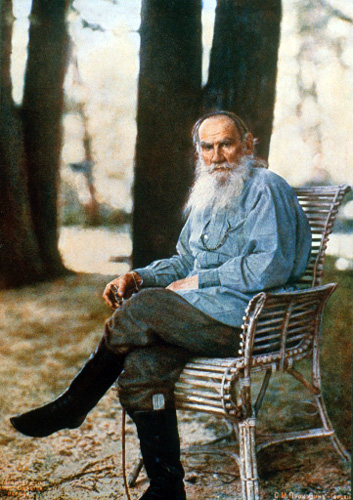
Leo Tolstoy, Russian apostle of non-violence, in Yasnaya Polyana, 1908, the first color photo portrait in Russia. (credit: Wikipedia)
“The kingdom of God cometh not with observation: Neither shall they say, Lo here! or, lo there! for, behold, the kingdom of God is within you” (Luke 17:20b-21, King James Version)
Is this the best translation of what Jesus was really teaching? Here is a good lesson as to why it pays to use a modern translation of the Bible, and compare with other translations.
As a young Christian, I struggled with the concept of Jesus’ teaching on the “kingdom of God.” Is God’s kingdom ever, in a sense, something inward, something that can not be seen? Sure, God’s kingdom is about the rule and reign of God in our lives, but is it in any way, a call to look within your yourself for the truth?
For example, Leo Tolstoy, the great 19th century Russian novelist, wrote a whole book about it: The Kingdom of God is Within You. Tolstoy rejected what he considered to be the “mystical” tradition of his Russian Orthodox state church, famously arguing for the principle of non-violence, as the summary of the ethics of Jesus Christ. Tolstoy’s prose has deeply inspired people, such as Mohandas Gandhi, in his efforts to overthrow British rule and assert Indian independence, in the mid-20th century.
But in doing so, in an odd twist of irony, Tolstoy himself left behind all institutional forms of Christianity, dismissing much of the supernatural reporting of miracles in the Bible, for his own kind of mystic individualism. Tolstoy viewed the Sermon on the Mount to be in conflict with the Nicene Creed, the ancient church affirmation of core, fundamental Christian doctrines, such as the Triune nature of God and the deity of Christ. Tolstoy felt forced to choose the former over the latter. Tolstoy had become disenchanted with a state sponsored church, that encouraged passivity towards evil, by encouraging intellectual adherence to a set of abstract beliefs, at the expense of living out the ethics of Jesus.
While I felt drawn to Tolstoy’s ethic of non-violence, and his critique of shallow faith, built on mere intellectual adherence to Christian beliefs, I was still uneasy about his outright dismissal of historic, orthodox theology. In today’s terms, minus his anti-supernaturalism, Tolstoy’s views came dangerously close to a kind of New Age, “roll your own” type of spirituality.
I remember reading from the King James version (above), as well as my old, “trusty” NIV 1984:
- Once, having been asked by the Pharisees when the kingdom of God would come, Jesus replied, “The kingdom of God does not come with your careful observation, nor will people say, ‘Here it is,’ or ‘There it is,’ because the kingdom of God is within you.” (Luke 17:20-21)
Mmmmm…. The way my mind worked, as I appreciated the teachings of Leo Tolstoy, was that this meant that the kingdom of God had some type of mystical presence inside the believer, Leo-Tolstoy-style. At least it seemed that way. What made me a little hesitant, though, was that this was the ONLY passage in the Bible that described the kingdom of God with such internalized language. But, if the Bible even had one verse like this, I figured, I might as well go for it.
Fast forward nearly twenty years later … Today, nearly all modern translations reject this English reading as inadequate, if not misleading. Here is the ESV rendering (below), and the NIV 2011 is pretty close:
- Being asked by the Pharisees when the kingdom of God would come, he answered them, “The kingdom of God is not coming in ways that can be observed, nor will they say, ‘Look, here it is!’ or ‘There!’ for behold, the kingdom of God is in the midst of you” (Luke 17:20-21)
You might get a footnote that exchanges “in the midst of you” with the older “within you,” or another, improved alternative, “within your grasp.” Nevertheless, the prevailing current view is that the kingdom of God is “in the midst of you.” But the point is that improvements in modern translation demonstrate that God’s kingdom can not be so easily turned into a mystical, inward, New-Age-type of experience. A note for the online NetBible, regarding the historical context for these verses, are worth considering:
- [“In your midst”] is a far better translation than “in you.” Jesus would never tell the hostile Pharisees that the kingdom was inside them. The reference is to Jesus present in their midst. He brings the kingdom. Another possible translation would be “in your grasp.”
The truth of the kingdom of God was within the grasp of the Pharisees, but they were unable to observe or detect it, even though Jesus was right there in front of them. Contrary to the popular tendency to pluck verses of Jesus out of thin air, the context of this passage suggests that the Pharisees were not “Spirit-filled” believers, who should look introspectively to find the truth. Instead, the emphasis is on Jesus as the truth, and how He confronted the Pharisees, the religious leaders of the day, with their unbelief.
Likewise, for us today, the kingdom of God also concerns our relationship with the Jesus who confronts us, and not some “fake Jesus” that we can easily internalize and control. We can become so filled with self-righteousness that we become unable to observe the reality of the kingdom of God, right there in front of us. Sadly, it is temptingly easy to project our own inward thoughts, wishes, fantasies, and desires, onto our frame of mind, and pretend that God is revealing supposed “truth” to us. Far too often, the popular call to “look within yourself” to find out “who you really are,” is more about spiritual narcissim than having an encounter with Jesus, who calls us to follow in obedience.
True, the Holy Spirit does indwell in the heart of the believer (Romans 8:9), so there is, in a sense, a mystical element to our faith. Jesus, through the Holy Spirit, does live in every Christian. So, broadly speaking, you could get away with the older “the kingdom of God is within you,” as a possible application for believers today, in that we can trust in the Holy Spirit’s leading.
But it is a translation not without its limitations, particularly within the historical context of Jesus’ confrontation with the Pharisees. We still need the external check of the Word of God, to make sure we do not float away into some supposedly superior mystical realm, that leads us to have thoughts and opinions that contradict the Scriptures. To put it another way, the only “Jesus” that we can know is the one presented to us in the Bible, and not some creation of our own fertile imagination, however well-intentioned. Our beliefs about Jesus, like His divine status within the Godhead, can not be so easily dismissed as controllable abstractions, without undermining the very call of radical discipleship, that Jesus demands of us.
Sadly, Gnostic texts like the Gospel of Thomas have a field day with phrases like “the kingdom is inside you,” , thus giving the wrong-headed idea that a knowledge of the Gospel is like having some special, esoteric knowledge of God, that only the spiritual “elite” can have. Genuine, orthodox, historic Christianity suggests otherwise. Real experience of the kingdom of God can be had by anyone who has a relationship with Jesus, and not only by self-proclaimed, spiritual “super-Christians,” who supposedly have an inside-track to God.
As someone who considered himself a Christian, Leo Tolstoy was not exactly “New Age,” in the way we think of it today. But he did have an unfortunate gnostic streak running throughout his writings. Leo Tolstoy was right to challenge a state church, that had completely subverted itself as a pawn to a totalitarian, oppressive government. But by setting in opposition the ethics of Jesus against the core, supernatural beliefs of historic Christian faith, Tolstoy has left us with a false dichotomy that has continued to confuse his admirers, almost two centuries later.
Thankfully, modern English Bible translations are trying to correct that false dichotomy.
——————————————————————–
Patheos blogger Mark Roberts, a few years ago, put it this way: “If the Pharisees want to find the kingdom, Jesus says, they should look, not into their own sinful hearts, but right in front of their eyes, at Jesus himself, at his words and works.” New Testament scholar Larry Hurtado chimes in with the scholarly reason as to why more recent Bible translations have changed their wording for this passage. There is a dissenting view by Roman Catholic scholar Ilaria Ramelli, who argues for the traditional translation of this verse, that so captivated Leo Tolstoy, but I do not know of any other scholars who follow her.





 Veracity