I may not totally jive with every statement Andy Stanley makes in his preaching, but I am totally on-board with his apologetics strategy. In sum, the message of the Christian faith, is driven first and foremost by an event, and not a text. We begin not with a perfect Bible, but rather, with the evidence of the Resurrection of Jesus. Some of the friends in my church call this the “Easter Effect,” whereby almost the entire Roman Empire, in the first centuries of the church, was converted to Christianity on the basis of the claim of the Risen Jesus. We get our understanding of the Bible’s authority from the Risen Jesus, and not vice-versa.
For if Jesus never rose from the dead, our confidence in the Bible means absolutely nothing. But because Jesus did rise from the dead, the Bible comes to us as God’s Word, and means everything to the follower of Jesus.
In other words, it is not enough to say, “the Bible says it, I believe, and that settles it.” Rather, “I believe the Bible, because it is true.” There is a big difference.
Give it a listen, and let me know what you think. Do you think I am wrong about this? Is Andy Stanley on target, or is he veering off the mark? Veracity has covered Andy Stanley before on several occasions (#1, #2, #3). The audio starts about 20 seconds in.
Tsar Nicholas II and family, in 1913 (credit: public domain)
One hundred years ago today, Russian Tsar Nicholas and his family were executed by the Bolsheviks. The legacy of the Romanovs remains in dispute to this day.
The staggering losses suffered by the Russians, during World War One, prefigured the end of the dynasty. But critics say that Nicholas, and his family, were inept, and insensitive to the plight of the people. The Russian Orthodox Church, on the other hand, declared the Romanovs to be Christian saints, in the year 2000.
No matter what you think about the Romanov legacy, what came after that was pretty horrifying. It was the end of so-called “Christian Russia.” Under the eventual Communist leader Joseph Stalin, somewhere between 8 to 20 million people lost their lives, depending on who is counting, one of the great tragedies of atheism run amok in the 20th century.
Trying to get the “big picture” on the Book of Psalms? The good folks at The Bible Project have a 9-minute video, that walks you through what the Psalms are all about.
R.C. Sproul (1939-2017), on camera, recording one his many Ligonier conference sessions, back in 1985.
R.C. Sproul, who died in 2017, was one of the world’s most beloved Bible teachers. What a lot of people do not know, is that he held to a rather unconventional view of the “End Times.”
Most evangelical Christians today, at least in America, hold to some form of futurism, when it comes to prophecy regarding the “last days,” as taught in the New Testament, particularly with respect to the Book of Revelation. Futurism is the view that most of the prophecies regarding the “last days” have yet to be fulfilled. For example, events like the so-called “Rapture” of the church, the coming of “Antichrist,” and the “Great Tribulation” are events that will happen sometime in the future, along with the Second Coming of Christ and the resurrection of the dead.
R. C. Sproul, on the other hand, offered what he called a “minority report,” with respect to the “last days.” Sproul favored a view known as preterism, which simply means “past.” A preterist is simply someone who believes that most of the prophecies for the “last days” have already been fulfilled, mainly in the first century.
However, some people get confused as to what preterism really means. In his book and audio class, The Last Days According to Jesus, R. C. Sproul makes a distinction between what is called partial preterism and full preterism. Sproul adopts the particular view of partial preterism, which teaches that nearly all of the “last days” prophecies were already fulfilled in the first century on the church, EXCEPT for primarily the Second Coming of Christ and the resurrection of the dead, which are still off in the future.
This is contrast with the idea of full preterism, or what some call hyperpreterism, which bizarrely teaches that even the Second Coming and the resurrection of the dead already happened, in the first century of the church. Uh…. how did we miss that? Well, this erroneous idea is why full preterism is considered to be a heresy, rejected by all orthodox-believing Christians.
So, why does R. C. Sproul believe that more Christians should reconsider partial preterism as a legitimate view of the “last days?” The main reason is concerning Christian apologetics.
Prominent skeptics and critics of Christianity, from the famous British mathematician, Bertrand Russell, to the UNC Chapel Hill evangelical-turned-skeptic religion professor, Bart Ehrman, have believed that the New Testament predicted that the “end of the world” would come within the lifetime of the apostles. But, of course, as we all know, that did not happen. Therefore, these critics of Christianity therefore claim the Christian faith to be false. Critics, like Russell and Ehrman, have shaken the faith of many, less-than-grounded Christians for well over one hundred years.
Where do they get this idea? The charge comes from examining the very words of Jesus, as found in Matthew 24. In this passage, Jesus is giving a sermon on the Mount of Olives, commonly called the “Olivett Discourse,” whereby he describes events that many say have the sense of predicting the end of the world. “You will hear wars and rumors of wars” (v. 6), “there will be famines and earthquakes in various places“(v.7), “lawlessness will be increased, the love of many will grow cold” (v.12), and “they will see the Son of Man coming on the clouds of heaven” (v. 30).
With the yet-future exception of the Son of Man coming on the clouds, these sound like the conditions we experience almost on a daily basis in post-modern America, and across the globe, and countless sermons I have listened to link these signs with an expectation of Christ’s near return.
But the controversial verse is found just before the end of the sermon:
” Truly, I say to you, this generation will not pass away until all these things take place.“(Matthew 24:34 ESV)
So, if Jesus is teaching that everything will be fulfilled in “this generation,” would it not make sense that everything should take place within the lifetime of Jesus’ first disciples? Is not this the most literal and straight forward reading of the text? Bertrand Russell and Bart Ehrman certainly think so.
Therefore, since the end of the world did not happen in the first century, Jesus must be dead wrong.
If Jesus was wrong about the “last days,” then why trust Jesus with anything?
Ah, this is where a study of Christian apologetics might prove to be very useful, and why R. C. Sproul offers his “minority report.”
Most futurists answer the charges of the critics by proposing some creative alternatives to the straight-forward interpretation of “this generation.” Perhaps “this generation” is another way of describing the church, as a movement, that is still continuing to this day. Others suggest that “this generation” is actually referring to the “generation” sometime in the future, whether it be our own, or a future generation, when Jesus will return. My old copy of the 1984 New International Version translation of the Bible contained an italicized note, equating “generation” with “race.” In other words, Jesus might have simply said “this [human???] race will not pass away until all these things take place.” Others say this “race” is the Jewish race, in terms of the continued ethnic identity of Jews throughout history.
Perhaps.
While many Christians find such alternative interpretations convincing, R. C. Sproul finds these arguments to be weak. They tend to play right into the hands of skeptics and critics who believe that such Christians, who believe these alternative interpretations, are simply trying to wiggle themselves out of the blatantly obvious.
But what if much of the prophecies given in Matthew 24 were actually fulfilled in the first century, just as Jesus literally said? Other particular aspects of the prophecies, that do not strictly fall under the purview of Matthew 24:34, are still yet to be fulfilled, sometime in the future. One clue comes from the beginning of the sermon:
” Jesus left the temple and was going away, when his disciples came to point out to him the buildings of the temple.But he answered them, “You see all these, do you not? Truly, I say to you, there will not be left here one stone upon another that will not be thrown down.”“(Matthew 24:1-2 ESV)
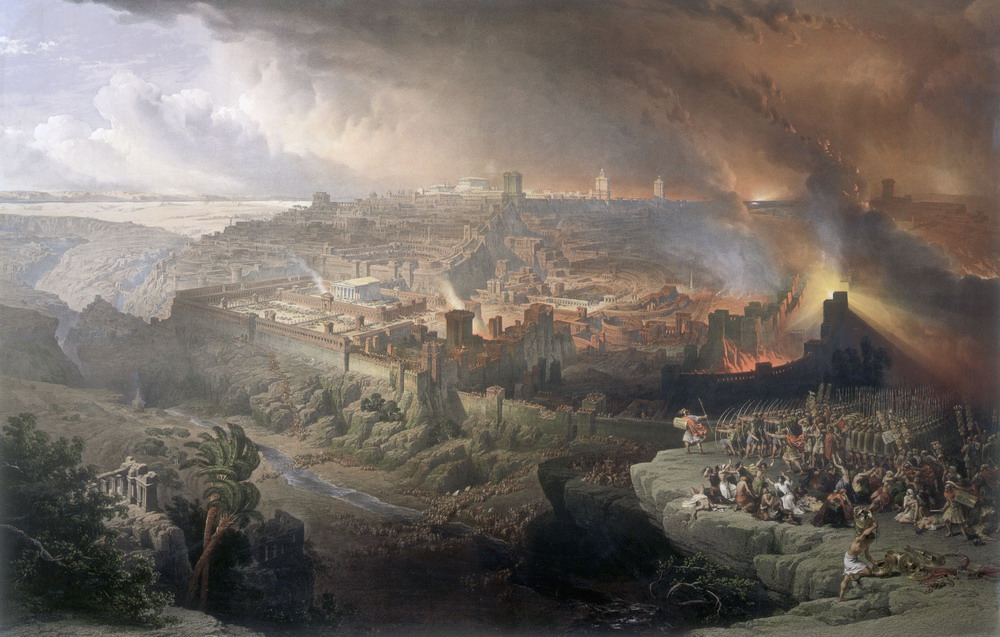
The destruction of Jerusalem by the Romans in 70AD — a painting by David Roberts (1796-1849). Is this what Matthew 24 is talking about? Or is it the “end times,” or perhaps, somehow, both???
Here, Jesus is most probably referring to the destruction of the temple in Jerusalem. One of the most well attested historical events, in antiquity, was the destruction of the Temple, in the year A.D. 70. If the connection can be made, it would seem obvious that Jesus was really predicting an event that literally happened within the lifetime of many of his first disciples!
R. C. Sproul argues that this line of prophetic evidence could be one of the most powerful proofs for defending the integrity of Jesus and the validity of the Christian faith. Nevertheless, R. C. Sproul realizes that his “minority report” is a position he takes, without requiring dogmatic assent by other Christians, as most other evangelical Christians are more familiar with prophecy interpretations offered by futurist Bible teachers.
I only offer a brief overview of partial preterism in this blog post, as there are other pieces to the New Testament prophecy “puzzle” that need to be put together before the whole argument of partial preterism makes sense. I would highly recommend R. C. Sproul’s book or the audio/visual teaching class on the same topic, The Last Days According to Jesus, available at Ligonier Ministries.
After listening to the audio of the class myself, I walked away with two key ideas:
First, we as Christians should keep an open mind as to how we think about the “End Times,” and how everything fits with Jesus’ Second Coming, and not rush off with excitement every time we hear about so-called “Blood Moon” prophecies or the exotic “Mysteries of the Shemitah,” that supposedly signal the “last days.”
Secondly, we should extend some sympathy to the skeptical non-believer, who has probably heard more than their fair share of “Jesus-is-coming-back-this-year!” stories that have never, ever materialized. So, when a friend tends to roll their eyes, whenever someone talks about Jesus’ return, we might want to think about a different approach to our friend’s skepticism (You could try this out, as an example: Apologist Michael Licona offers a disarming conversational model as to how to approach this topic with a non-believer).
Whether you agree with R. C. Sproul or not, you will find him to be a very engaging and learned teacher of the Bible.
. . . . . . . . . . . . .
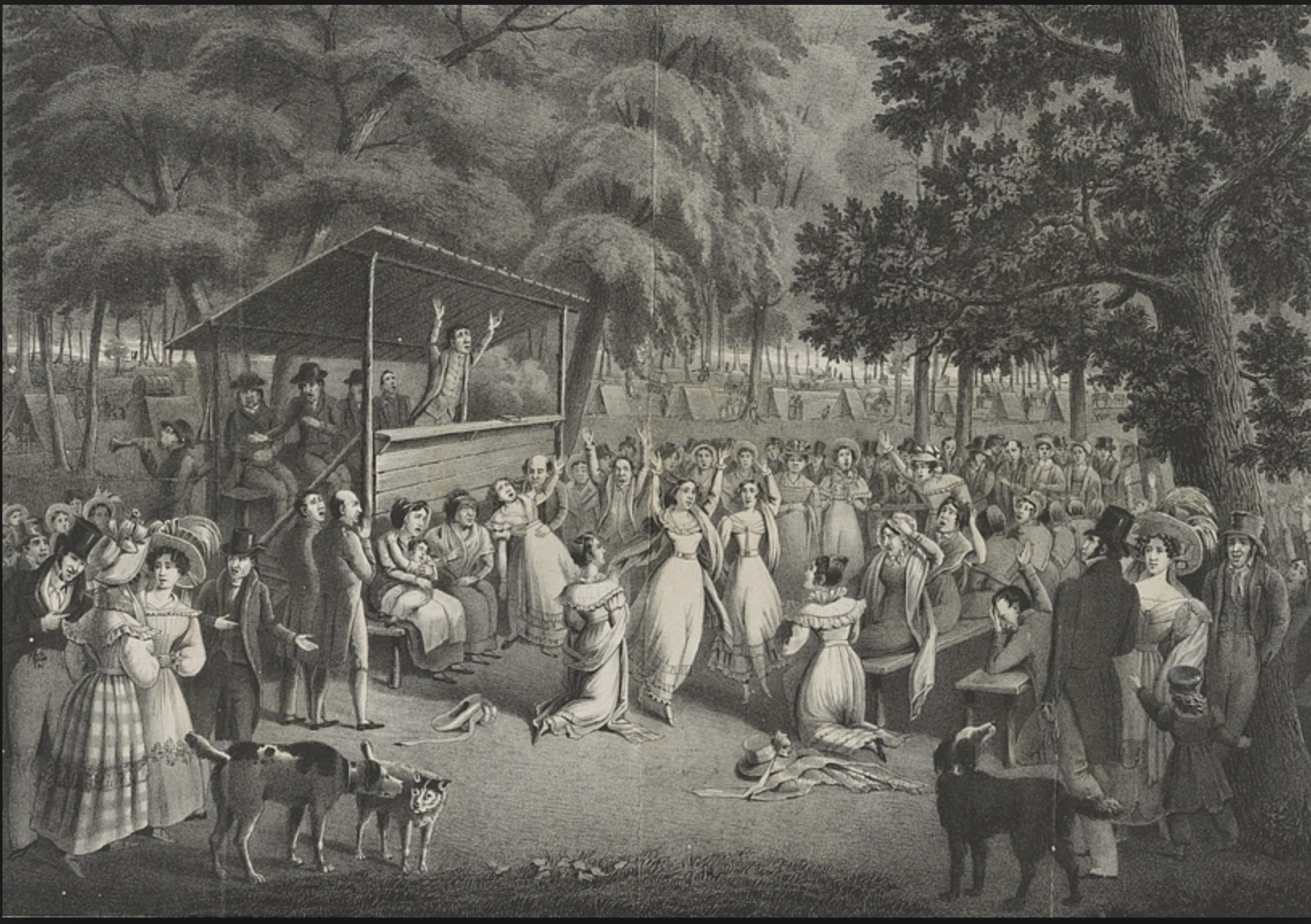
Sinners gathering on the “anxious bench,” during the American Second Great Awakening, in the early 19th century. The “anxious bench” was the forerunner to the modern “altar call” (Click to enlarge).
It is a feature of historic evangelicalism. The preacher has finished his message. The organist begins playing “Just As I Am” softly in the background. The preacher invites the sinner to come forward to the front of the church, where someone is there to pray for them, to make a decision for Christ.
This is a typical example of an “altar call.” It is a well-known tradition practiced in thousands of churches. So, why are some pastors hesitant to make an altar call?
Is the altar call … even Scriptural?
Before anyone can answer those questions fully, it helps to relay a story from church history. Every church has their traditions. But it does not mean that every Christian knows where those traditions come from… Continue reading





 Veracity