The so-called “inter-testamental” period, that 400-year period between completion of the Old Testament and the beginning of the New Testament, is nothing but a black-box to the majority of evangelical Christians. As the story goes, Malachi, the last book of the Old Testament, was the last of the great Jewish prophets, before John the Baptist appears at the dawn of the New Testament period. Israel was without an inspired prophetic voice during this 400-year void.
The problem with this narrative is that it suggests that nothing of any substantive theological value was happening during that time. Nothing could be further from the truth.
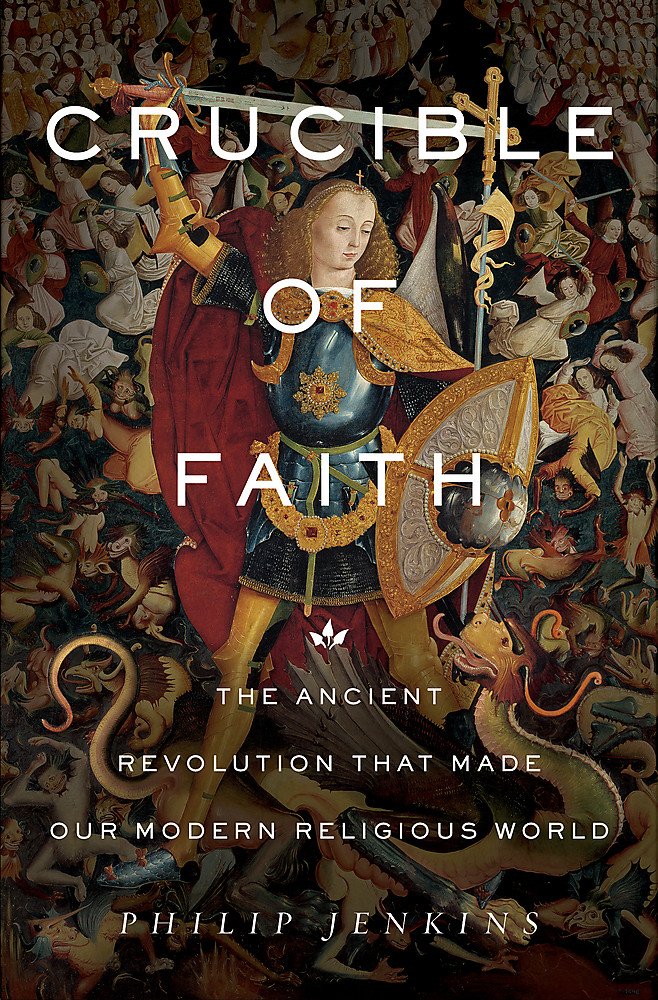
It was during the era of Second-Temple Judaism, after the Temple was rebuilt following the Babylonian exile, when the subsequent invasions by the Greeks, the Seleucids, and the Romans, completely reshaped the world inhabited by the people of the Hebrew Scriptures. Respected Baylor historian, Philip Jenkins, has written a popular-level, sweeping history of the time, Crucible of Faith: The Ancient Revolution That Made Our Modern Religious World, that necessarily fills in the gap. Crucible of Faith makes for a fascinating read, but it can be unsettling at certain points. Jenkins’ work both strikingly illuminates the radical, Judeo-centric and often neglected developments of thought that created the theological culture that Jesus of Nazareth lived in, while inadvertently at times casting a shadow of doubt over the inner workings of progressive revelation in the Bible (if one is not careful).
Jenkins has written widely on topics related to Christian history, including a book that I highly recommend and that I read a few years ago, The Lost History of Christianity: The Thousand-Year Golden Age of the Church in the Middle East, Africa, and Asia–and How It Died. Lost History is a fascinating survey of the much ignored churches of the Christian East, extending from the Middle East to Africa and Asia, during the first millennium of Christianity, that once dominated the Christian world, only to be crushed underneath the rise of Islam, and other Christian-opposing elements in Asia.
Jenkins’ more recent book from 2017, on the era just prior to the birth of Jesus, Crucible of Faith, was one of the last books I finished reading in 2020, and it has left me thinking more and more about it. Aside from my review of Tom Holland’s Dominion, this is my most in-depth book review of the year, … and the most challenging to write.
Truth-telling is essential to the cause of proclaiming the Gospel of Jesus. For if an unbelieving world can not regard Christians as trustworthy people, why would they even bother to listen to us, when we speak about Jesus?
Events of late in the Christian world have brought me much despair. But some recent news have given me a ray of hope.
Serious accusations against Christian leaders should not be taken lightly. We should uphold the reputations of leaders, as best as we can, and not jump to conclusions. Furthermore, it must be acknowledged that all of us have skeletons-in-the-closet, that we need not always publicize. Everyone falls short of the glory of God, and we should extend grace towards others, as much as possible, so that relationships can be healed and integrity maintained.
But that being said, when a Christian leader or organization presents a story, that does not jive with the available evidence, then that warrants a measure of skepticism. An initial act, that might lead to disgrace is one thing. But when a concerted effort is made to cover-up such an act, the lack of trust associated with the cover-up effort is infinitely more damaging than the original transgression itself. When this type of behavior is exhibited by Christian leaders, and the organizations that support them, then this is a clear case where the celebrity cult of personality has eclipsed whatever good the ministry might be doing.
It took courage for Dr. Baker-Hytch to write such a letter, and that courage gives me some hope that integrity is still something to yearn for. Let us pray that RZIM will make good on their promise to pursue truth, take Dr. Baker-Hytch’s letter to heart, and do the right thing immediately.
Time-honored practice that sparks memories, in celebration of the coming of the Lord, who brings Eternal Life…. or… insidiuous smuggling in of paganism into Christian homes? (credit: US Forest Service)
As someone who has kept ornaments I made back in kindergarten, if I had heard this, back when I was a kid, it might have soured me a bit on Christianity. But in the age of social media, the debate over Christmas’ supposed pagan origins, and that of the Christmas tree in particular, seems never ending. A favorite Bible “prooftext” given for this view is from the King James Version of Jeremiah:
Thus saith the Lord, Learn not the way of the heathen, and be not dismayed at the signs of heaven; for the heathen are dismayed at them. For the customs of the people are vain: for one cutteth a tree out of the forest, the work of the hands of the workman, with the axe. They deck it with silver and with gold; they fasten it with nails and with hammers, that it move not (Jeremiah 10:2-4 KJV).
Well. Well… I guess I should toss that adorable tree into the fire, with that sentimental “Christmas mouse” ornament I once made. Right?
The irony of this mentality is that it is a variation of an argument some atheists use to discredit Christianity, that Christmas was merely an invention of “the church,” political propaganda used to create a new form of paganism, a “copy cat” faith borrowed from the ancient Mithra cult, with a Jewish veneer pasted over it, squashing other forms of paganism, in order to unite the Roman empire.
I always find it bizarre when both certain fundamentalist-type Christians, as well as certain hyper-atheists, manage to gang up together to fight against some Christian practice that was originally designed to point us towards Jesus. But is there a better way to understand this passage of Jeremiah, that more accurately reflects the original context of the Biblical author? Continue reading
Is climate change just a hoax, or is it real? If it is real, what can be really done about it, without killing the world economy?
Hugh Ross, president of Reasons to Believe, and evangelical apologetics ministry focused on the dialogue between science and faith, tackles a topic that often generates more heat than light. However, in Weathering Climate Change: A Fresh Approach, Ross does what the subtitle says, he takes a fresh approach that will both surprise and educate readers.
Will the ostrich be able to delay the impact of global climate change? According to Christian apologist Hugh Ross, in the contentious debate over “global warming,” the ostrich may provide more help to us than draconian and unpopular carbon credit schemes.
Before reading Weathering Climate Change, I made the rather common assumption that today’s relative climate stability has been around for much of earth’s history. It is just something that we take for granted. But Hugh Ross brings up data point after data point to demonstrate that such an assumption is completely false: For most of earth’s history, the world’s climate has ranged wildly in terms of global mean temperature. In other words, climate instability has been the norm in God’s creation.
Hugh Ross takes an Old-Earth Creationist view, that the earth is some 4.34 billion years old, as opposed to the view of a 6,000 to 10,000 year old earth, advocated by Young Earth Creationists. Ross contends that during the vast length of time of earth’s multi-million year history, particularly as we approach the current age, cyclical periods of global warming followed by ice ages of global cooling have always been up and down, up and down.
His point is to show that the development of an advanced technological civilization would have been impossible if all of these factors had not lined up perfectly. Furthering the argument that Ross made in Improbable Planet, we live on a planet that has been fine-tuned for human existence, under the most optimal conditions. Ross attributes this to the providential hand of God, that God would provide just the right complex set of factors to make modern human civilization possible.
Did humans just get lucky with this recent 9,500 year-long anomaly of climate stability? Or was it a product of a Mind? It is difficult to imagine how all of this came together at the right time, without a Creator God superintending the whole process. In comparison, a Young Earth view of creation fails to appreciate as much the marvelous precision it took for God to give us the exact conditions necessary for human civilization to flourish, at exactly the right time in earth’s history…. and that human flourishing is good news!
The bad news is that this current period of climate stability can not last forever, according to the research that Hugh Ross summarizes for the reader. Human efforts can either accelerate the shift towards the climate instability, or slow down the transition, but human engineering alone can not make the climate stable on a permanent basis.In other words, global climate change is real. It is not a hoax. That is just the way the world is. To place our hope in this world alone is futile, as compared to putting our hope assuredly in the God of the Bible.
With that context in mind, Hugh Ross points to evidence showing that humans are primarily responsible for the current acceleration of that shift towards climate instability. Over the past 70 years, the near 1 degree in Centigrade increase in the global mean temperature, has almost wiped out the 1 degree Centigrade drop in temperature, experienced during the prior 9,500 years. Human activity, through pronounced use of carbon-based fuels, are only making a catastrophic, though quite natural situation more likely to arrive sooner, rather than later. But there is some basis for hope, in that Hugh Ross believes that certain steps can be taken to slow down this acceleration, and delay the inevitable.
But what will eventually happen, if nothing is done to slow the acceleration? Misleading information suggests that global climate change will ultimately melt nearly all of the planet’s ice and raise the typical daytime temperature across the globe to intolerable levels. Yet as Hugh Ross describes it, the global temperature will eventually hit a peak, before dropping dramatically, and plunging the earth into another ice age. In other words, in the long run, global cooling poses a greater threat than global warming. So, if you fear rising sea levels alone, you might want to rethink that. That is only part of a more difficult problem.
Nevertheless, there are steps that can be taken that are “win-win” for us all, in contrast to the type of draconian solutions proposed by climate alarmists, that often elevate the young voice of activist Greta Thunberg. While such environmentalist ideas are well-meaning, public resistance to such drastic proposals will greatly impede their adoption, and only increase skepticism about climate change. Ross believes that there are a variety of solutions that humans can adopt that will simultaneously benefit the environment, while still allowing our high technology civilization to flourish. Here are just a few examples:
Replanting the Sahara Desert. Many find it hard to believe, but the Sahara region of North Africa once was the primary agricultural source of food; that is, the “bread basket,” for the ancient Roman empire. But deforestation of the Sahara greatly expanded it into the vast desert region that exists today. By giving North Africans incentives to stop stripping vegetation on the edge of desert and replanting those edges with vegetation, it would go a long way towards increasing the amount of carbon dioxide that could be absorbed from the earth’s atmosphere, back into living plants.
More efficient lumbering. Instead of clear-cutting forests in the Amazon to make for more inefficient pasture land, incentives can be given to have smarter practices of thinning out forests, allowing newer growth to absorb more carbon dioxide and taking down older growth that releases carbon dioxide into the atmosphere, as that older growth decays.
Replace the production of cow beef with ostrich, as a primary source of red meat. Cows inject a lot of methane into the atmosphere, whereas ostriches contribute little methane. Incentives can be given to encourage ostrich farming, which actually consumes far less pasture land than cows do. Ostriches also consume roughly a third less resources, in terms of water, as compared to cows.
These are all innovative ideas that are rarely discussed on public forums for addressing the climate change crisis. Why do we not hear more about such fresh approaches to climate change? Perhaps we need to recalibrate the conversation, and move away from endless, heated debates over carbon credits, that only the super-wealthy in the West would be willing to afford.
Kudos go to Hugh Ross for helping Christians and non-Christians alike think through new ideas that will help us to be better stewards of God’s good creation. Admittedly, ideas such as moving to an ostrich-primary meat system from a cow-primary meat system are difficult to advance when ostrich meat prices are nearly three times as much as cow meat prices. However, with the encouragement of ostrich farming, the price of ostrich meat should come down enough, that it would offset other, more-costly mechanisms designed to reduce humanity’s carbon footprint.
Instead of fixating on repeated debates about wind and solar power versus carbon consumption, what if we were to move beyond those discussions and talk more about solutions that are rarely mentioned in the international media, such as better forest management, and how to expand ostrich farming?
When God created Adam, the Lord placed him in the garden to work it and to keep it (Genesis 2:15). It is very tempting for us to ignore God’s command to care for the earth, when faced with environmentalist extremism in our day that worships the creation as opposed to the Creator. When we give into that temptation, it is like being like an ostrich and putting our head in the sand.
But what if there are better solutions? What if we should be like the ostrich, in a different way? What if we were to start to eat the ostrich instead? After all, as nutritionists like to tell us, “you are what you eat.”
How should we be like the ostrich?
Dr. Hugh Ross was featured as part of a worship service at Grace Church in St. Louis, via Zoom, followed by a period of Q&A:






 Veracity