Time for another English Bible translations update!!
I did one of these back in 2020, but some fairly big news stories warrants another installment for this year. First, some might have heard that BibleGateway.com has removed the Passion Translation from its website. I found the following meme on Brent Niedergall’s biblical studies blog that made me chuckle, based on the Star Wars theme:
The Passion Translation Controversy
What was all of the fuss about? Well, the Passion Translation, advertises itself as “a modern, easy-to-read Bible translation that unlocks the passion of God’s heart and expresses his fiery love—merging emotion and life-changing truth.”
Well, a number of Bible scholars and pastors think otherwise. The Passion Translation has been popular among a number of charismatic and Pentecostal Christians, written by a missionary who has faithfully served for the Gospel in Latin America for many years, Brian Simmons, who claims to utilize the original languages, Hebrew and Greek, and … wait for it … Aramaic, to produce the English text. While we can commend the good natured intent, the problem with the “Aramaic” part is that relatively little of our ancient original sources for the Bible are actually found in Aramaic. It makes one wonder what the publisher means by “Aramaic.”
As a paraphrase, the Passion Translation has a lot of interesting ways of freshening up the text. But as British pastor/teacher Andrew Wilson puts it, the problem is that the Passion Translation is marketed as a translation, when it really should be called a paraphrase. The promotional materials claim: “Recent biblical scholarship has begun tracing many of Jesus’ teachings back to an original Aramaic source. Some even argue the original Greek manuscripts were translations of even more original Aramaic sources.” Wilson contacted Australian theologian, Michael Bird, who was cited as an authoritative source for this claim, and Wilson’s way of telling it is quite colorful:
‘I actually followed this up with Mike Bird, and his response was short and to the point; I won’t quote it, but it was effectively Australian for “I don’t think this person is correct.”’
Probably the bigger news this year concerns the recent update to the New Revised Standard Version (NRSV) for 2021/2022, marketed as NRSVue, or NRSV Updated Edition. The NRSV is the endorsed Bible of the National Council of Churches, and the NRSV is pretty much the standard in mainline circles and in academia.
The older NRSV comes from a completely reworked version of the 20th century mainline standard translation, the Revised Standard Version (RSV), which was put together starting in the late 1940s with the New Testament, followed by the finished Old Testament being published in 1952 (some did not like the RSV then). After World War II, the National Council of Churches was known as the American wing of the World Council of Churches, resulting from a renewed emphasis in the ecumenical movement and world evangelization, after military servicemen were scattered all across the world, fighting in World War II. Since then, the National Council of Churches (NCC) appears to have drifted to the left theologically, as conservative evangelical churches kept their distance from the NCC. Along with that was skepticism among many evangelicals towards the NCC standard bearer Bible, the RSV….. despite the fact that one of my favorite professors in seminary loved the late 1980s edition of the RSV.
By the late 1980s, it was felt that the RSV was getting a bit “long in the tooth,” so the NCC bagged it. Interestingly, the conservative evangelical book publisher, Crossway, picked up the copyright of that old RSV, made some changes more suitable for conservative readers, and released a new Bible, the English Standard Version (ESV). While the venerable King James Version (KJV) and the New International Version (NIV) still remain the most popular Bible translation for conservative evangelical Christians, support for the ESV appears to be gaining more and more as the years go by.
The NCC decided to go with a different approach and came out with the NRSV in 1989, which became controversial for its use of “gender-neutral language.” In partnership with the Society of Biblical Literature, the NRSV Updated Edition (NRSVue) was finished in late 2021. A massive 10,000 substantial edits were made to the original NRSV, with 20,000 minor revisions, many of them described in this paper put out by the publisher. The NRSVue is destined to become the mainline standard Bible translation, superseding the previous NRSV. Here is a short sample of some of the changes:
changes “slave woman” to “enslaved woman” (Galatians)
changes “wise men” to “magi” (Gospel of Matthew)
changes “demoniacs, epileptics and paralytics” to “people possessed by demons or having epilepsy or afflicted with paralysis” (Gospel of Matthew)
adding capitalization to Jewish High Holy Days
changes “servant-girl” to “female servant” (Mark 14:69)
Do not let the reference to “mainline” scare you immediately, as the NRSVue is really one of the most competent translations available (… although there is a catch, as I will note in a moment). In my Bible reading, I like to compare popular evangelical Bible translations, like the ones I love, such as the English Standard Version (ESV), the New International Version (NIV), and the Christian Standard Bible (CSB) with the NRSV, … and now the NRSVue. In many ways the NRSV/NRSVue actually offers a more word-for-word sense of what the text is saying, in some cases. I frequently use the Harper Collins Study Bible, which uses the NRSV, to see if the NRSV will keep some of the other translations honest.
Nevertheless, the catch with the NRSVue is there is still an interpretive bias that peeks through every now and then, which tends to be progressive, appealing to its more liberal National Council of Churches constituents. More and more progressive elements have made their way into the new NRSVue. For example, The Institute on Religion and Democracy posted a pretty scathing review of the new NRSVue.
The most controversial example comes from the Updated Edition’s revision of 1 Corinthians 6:9-10:
Do you not know that wrongdoers will not inherit the kingdom of God? Do not be deceived! The sexually immoral, idolaters, adulterers, male prostitutes, men who engage in illicit sex, thieves, the greedy, drunkards, revilers, swindlers—none of these will inherit the kingdom of God.
The highlighted phrase “men who engage in illicit sex” is more ambiguous, as compared to the same phrase found in something like the Christian Standard Bible (CSB): “males who have sex with males.” The CSB rules out all sexual relationships between males, whereas the NRSVue leaves a door open. Is it therefore possible for men to have non-illicit sex with one another, and that still be okay in the Apostle Paul’s mind? On the other hand, other passages in the new NRSVue that deal with the same topic are more traditional, like Romans 1:27:
… and in the same way also the males, giving up natural intercourse with females, were consumed with their passionate desires for one another. Males committed shameless acts with males and received in their own persons the due penalty for their error.
Did God forbid Adam and Eve to include hamburger in their diet?
Many vegetarians and vegans would agree with that. But an even broader group of Christians today believe that Adam and Eve’s restricted diet demonstrates that there was no animal death before Adam and Eve sinned in the Garden. Young Earth Creationists, whether they be vegetarians themselves or not, claim that in God’s good Creation there would be no animal suffering or death. This all changed once Adam and Eve fell from God’s grace. It was not until the time of Noah and the Great Flood that humans were finally allowed to expand their diet to include the eating of meat.
But Adam and Eve were not the only ones required to have such a restricted diet. Visitors at the Creation Museum in Kentucky have at times taken a photo of a sign that asks, “What did dinosaurs eat?” Unlike what you see in all of those Jurassic Park movies, T-Rex would not have been a carnivorous, meat-eater. Instead, he would have feasted primarily on perhaps flowering plants.
No Animal Death and Suffering Before the Fall: Rationale for Adam and Eve’s Vegetarianism?
There are many arguments advanced by Young Earth Creationism, but this argument about “no animal death before the Fall,” which leads to the corollary belief that Adam and Eve were vegetarians, is probably the strongest argument in favor of a Young Earth Creationist interpretation of the Bible.
After all, it really is hard for many to imagine how God could create the animal world, and then allow for animal death and suffering to exist, and still call such a creation “good.” It is reasonable to conclude that God’s good plan for the redemption of humanity would also include a solution for the suffering experienced in the created world of the animals. As the Apostle Paul tells us:
For the creation waits with eager longing for the revealing of the sons of God.For the creation was subjected to futility, not willingly, but because of him who subjected it, in hopethat the creation itself will be set free from its bondage to corruption and obtain the freedom of the glory of the children of God.For we know that the whole creation has been groaning together in the pains of childbirth until now (Romans 8:19-22 ESV).
The argument is summarized by Ken Ham, the President of Answers in Genesis, on a rainy Kentucky day by a graveyard:
How are men and women to relate to one another, in the church and in the family?
When we read the Bible, we find various statements about men and women that seem to be at odds with one another. Galatians 3:28 sees no distinction between male and female, whereas 1 Timothy 2:12 seems to place a restriction on women that men do not have, when serving in the church. 1 Corinthians 7:1-5 has Paul saying that husbands and wife share mutual rights with one another, whereas Ephesians 5:22-33 suggests some type of priority husbands have in relation to their wives, in terms of who submits to whom.
What is a biblically faithful Christian to do with this? Select a certain group of texts has having priority over others, thus having a “canon within the canon” approach to Scripture, …. or find a way of integrating the whole of the Scriptural material?
A debate rages among evangelical Christians as to how to resolve the tensions that various Scriptural passages like these present to us. On the one side are the egalitarians, who sense a profound embarrassment over anything in the Bible that appears to be misogynistic, and thus emphasize the equality between men and women. For egalitarians, the liberating message of Jesus for women takes center stage. On the other side are the complementarians, who recognize gender equality, but who refuse to shy away from those passages that might suggest otherwise. Complementarians instead see such difficult passages as offering clues into the complementary relationship between male and female. Instead of embarrassment, complementarians see a beauty being expressed in the gender complementarity of the Bible.
It is important to say at the outset that Christians of good faith, can and indeed do disagree on these matters. Nevertheless, the positions we do take on how male and female relate to one another do have an impact on both marriages and the structure of a local church, and in how we think about gender more generally.
For the vast majority of secular-minded people in the West today, any traditional Christian perspective on women is considered strange or weird, at best, or misogynistic or inherently oppressive, at its worst.
In many respects, church history does not have the most stellar record when it comes to dealing with the abuse and degradation of women. Far too often, women have been treated as second-class citizens in the Christian movement. On the other hand, it also could be argued that the Christian faith has been the primary catalyst affirming the value and contributions of women, a reality that most sophisticated Westerners today simply take for granted. Christianity has led to the most vital protections for women, and the most uplifting force supporting women, more than any other movement in world history. While this issue has an impact on how Christian churches and marriages function, it also has an impact on Christian apologetics, and how nonbelievers hear the Gospel message. So, the question stands: Which narrative best represents the message of the Bible for women? One of abuse and degradation, or one of affirmation and honor?
Despite recent advances for women, a most pressing concern in our postmodern world is the decline of the traditional family. The joy of having a mother and a father, who stay together until the death of one of them, is a vanishing characteristic throughout much of Western culture. Living in blended families has become more of the norm, rather than the exception. The definition of marriage keeps changing. The number of Americans who live alone keeps rising every year. Yet in the words of Dallas Theological Seminary’s Sandra Glahn, for men and women, “we need one another.” A rediscovery of Scripture’s vision for women, and how they relate to men, and vice-versa, must also address a theology of the family, which is in considerable crisis today in the West.
Christians today are divided over understanding what the Bible teaches regarding how men and women are to relate with one another in the church and the home. We need to have better good faith conversations among professing believers, as to how best work through what we find in God’s Word, and act in obedience accordingly. Scripture teaches that men and women are both created equally in the image of God, and yet are distinct from one another. Nevertheless, egalitarian Christians emphasize the former, and complementarian Christians emphasize the latter. For readers unfamiliar with this topic, I would suggest starting your journey into this topic with this introductory Veracity blog post, linked here, from 2019.
Two Books in the Complementarian/Egalitarian Conversation
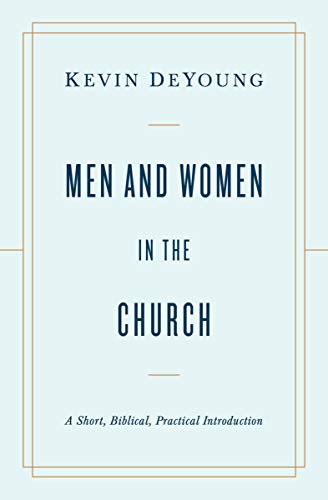
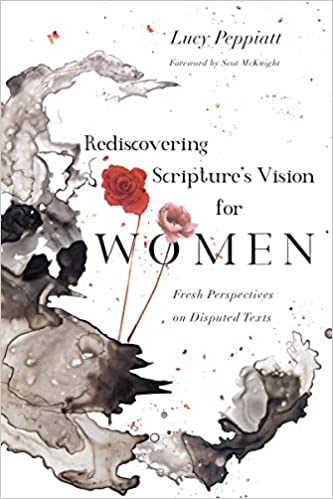
This year, I endeavored to read two books in this conversation, one by a complementarian, Kevin DeYoung, Men and Women in the Church. The other book, the focus of this review, was authored by Lucy Peppiatt, a theologian and Principal at the Westminister Theological Center, in the U.K. She has written an insightful set of expositions of Scripture, along the lines of an egalitarian theological framework, in her Rediscovering Scripture’s Vision for Women: Fresh Perspectives on Disputed Texts. A charismatic evangelical, Lucy Peppiatt lectures in systematic theology, and serves as a lay minister in the Church of England. Many readers sympathetic to an egalitarian point of view have recommended Lucy Peppiatt to me, as representing perhaps the most mature, balanced argument defending this perspective currently in print.1
The intended audience for Peppiatt’s work is targeted towards those thoughtful Christians who hold to a traditional, complementarian view, what she calls a “heirarchialist” view, who are willing to consider a change in perspective regarding the teaching of Scripture. However, the book is also for egalitarians nervous as to whether or not the Bible actually teaches egalitarianism. For several disputed passages, the issue comes down to whether a distinctive teaching is prescriptive for all times and all places, versus being descriptive, possessing a set of instructions for a particular first century, cultural setting. Unfortunately, a more sacramentalist approach, which looks for concrete ways for regarding men and women as fully equal within the sight of God, and yet relating to one another in the church and in the family in non-interchangeable ways, is not sufficiently interacted with in Peppiatt’s work. To put it briefly, Lucy Peppiatt succeeds in admirable ways to make her case for what she calls a “mutualistic” view of relations between men and women, while still coming up short in certain specific and crucial areas. Continue reading
Most evangelical Protestants, particularly in the United States, know very little about the Eastern Orthodox faith. What they do know is often jumbled together with their understanding of Roman Catholicism. Likewise, many Eastern Orthodox remain unfamiliar with Protestant beliefs.
A lot of that is changing as Eastern Orthodoxy grows in America, with high profile conversions from evangelical Protestantism to Orthodoxy, ranging from apologist Hank Hanegraaff to Christian author Frederica Mathewes-Green. Other well known Eastern Orthodox Christians (or those with appreciative Eastern Orthodox backgrounds) include columnist Rod Dreher and the controversial radio personality Eric Metaxas.
Unlike the Christian West, where Protestantism split from the Roman Catholic Church, about 500 years ago, Eastern Orthodoxy has no exact equivalence of a Protestant Reformation in its history. Essentially, Roman Catholicism and Eastern Orthodoxy constituted one unified church for basically a thousand years, until these movements both split from one another officially in 1054 C.E. But, what exactly makes Eastern Orthodoxy different from evangelical Protestantism?
Father Josiah Trenham shows how Eastern Orthodoxy and Protestant evangelicalism differ from one another, offering a look at what Protestants can learn from Eastern Orthodox Christianity.
A Church Built on Rock… or Sand?
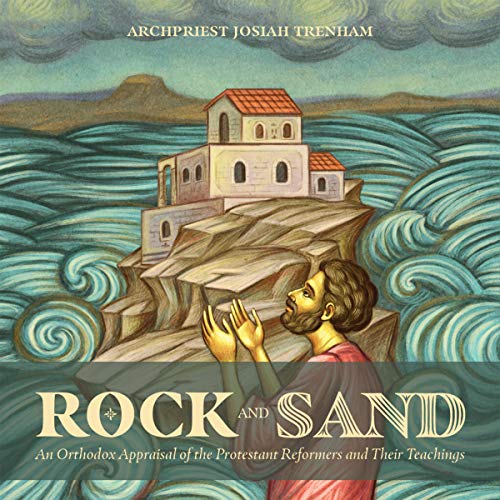
Father Josiah Trenham, an Antiochian Eastern Orthodox priest in California, has written a book, Rock and Sand: An Orthodox Appraisal of the Protestant Reformers and Their Teachings, that helps readers answer this very question. Trenham was raised in a conservative Presbyterian church, eventually following the teachings of Ligonier Ministries founder, R.C. Sproul. But partway through his seminary training, Trenham came to see what he saw were weaknesses in the evangelical Protestant tradition, and he was received into the Antiochian Eastern Orthodox church and eventually became a priest there in 1993. Today, he runs a popular YouTube channel, Patristic Nectar.
Rock and Sand: An Orthodox Appraisal of the Protestant Reformers and Their Teachings was written primarily to help Eastern Orthodox believers understand the roots of Protestantism, but I found it a helpful guide, as an evangelical Protestant myself, to understand the differences between the two traditions. As indicated by the title, the aim of Rock and Sand is to show that Eastern Orthodoxy is built on rock whereas Protestantism is built on sand. It is worth exploring how Father Trenham makes the case for Eastern Orthodoxy.
Trenham recalls a quote made by Martin Luther, when he was first publicly challenged by the papal legate Cardinal Cajetan in 1519, “The truth lies with the Greeks,” meaning the Eastern Orthodox. Trenham acknowledges that Luther had the most Eastern Orthodox-ish view of sanctification among the early Reformers, grounding the Christian life in our union with Christ, thus aligning towards the Eastern Orthodox understanding of theosis. Trenham warmly accepts Calvin’s measured view of the End Times, that avoids endless speculation derived from the Book of Revelation, and judges that Calvin “maintained a brilliant Christocentric hermeneutic” of Scripture. Very few Protestants today even know that Luther, Zwingli, and Calvin positively affirmed the perpetual virginity of Mary, which agrees with Eastern Orthodox teachings.
Yet in other ways, Father Trenham does not shy away from showing where the Protestant Reformers fell short in comparison to the Eastern Orthodox. At various points, he focuses on certain details that expose the more odd and embarrassing side of the Reformers. Little did I know that Martin Luther argued against certain traditional views of incest, by allowing for Christians to marry their first cousins. Trenham uses Luther’s, Melancthon’s and Martin Bucer’s awkward approval of Philip of Hesse’s bigamy as an unflattering illustration of the Protestant Reformers willingness to compromise with the political powers of the day, in order to gain the favor of the state.
Father Trenham also zeroes in on some of the more idiosyncratic views of certain Reformers, to illustrate the failure of sola scriptura as a coherent doctrine, from his perspective. He blasts the Reformers, like Martin Luther and Ulrich Zwingli, for their failure to agree upon the nature of the Lord’s Supper, the central act of worship throughout the entire history of the Christian church. Both Luther and Zwingli believed that the “plain reading of the text” clearly taught their respective views, despite the fact that they contradicted one another. This argument supports Trenham’s contention that only a church guided by the light of tradition, upheld by a college of bishops, apostolic succession, and ecumenical councils can prevent a Christian community from falling prey to idiosyncratic interpretations of the Bible, that will inevitably cause church splits, an endemic feature of nearly all Protestant churches.
Father Trenham illustrates that the evangelical Protestant prejudice against church tradition is even reflected in some popular Bible translations. For example, the Greek word paradosis is used in the Bible regarding “tradition” in two senses. In the negative sense, “tradition” refers to the man-made traditions of the Pharisees, which Jesus exposed as hypocrisy, as in Matthew 15:3. But it also has the positive sense of “tradition” in other contexts, where “tradition” is in reference to what Christians are to pass down from one generation to the next generation, as in 2 Thessalonians 2:15. Unfortunately, the popular NIV translation for years has translated this positive sense of paradosis very differently as “teachings,” instead of “traditions.” Thankfully, more recent translations, such as the ESV and the CSB, correctly translate this as “traditions”: “So then, brothers, stand firm and hold to the traditions that you were taught by us, either by our spoken word or by our letter.” At least the NIV does mention “traditions” as a possible translation, in a footnote, for those who bother to notice. Nevertheless, among many Protestant evangelicals, some reading habits are hard to break.
An Eastern Orthodox Appreciation for Infant Baptism
In his argument against the Anabaptists, Father Trenham gives a very coherent defense of infant baptism, against all forms of “credobaptism”; otherwise known as “Believer’s Baptism.” He demonstrates that the practice of baptizing infants is in continuity with the Old Testament practice of male infant circumcision. However, whereas circumcision was the primary marker for membership in the Old Covenant of the Jews, it has now been replaced by the practice of baptism in the New Covenant. In other words, baptism carries forward the original Old Testament concept of covenant membership to include Jew and Gentile, male and female, and slave and free, as grounded in the New Testament (Galatians 3:25-28).
Interestingly, Father Trenham argues against the Protestant insistence that salvation is primarily an individual act, and his case for infant baptism is used to buttress his more communal understanding of salvation. The repeated experience that entire households were baptized in the New Testament, even though only one member of the household professed faith initially, calls into question the claim that “Believer’s Baptism” is the clear teaching of Scripture. In the case of the conversion of Lydia (Acts 16:11-15), the passage tells only of Lydia’s conversion and no one else in her household. Nevertheless, everyone in Lydia’s household was baptized. In the case of the conversion of the Philippian jailer (Acts 16:25-34), the passage tells only of the jailer’s conversion and no one else in his household. Nevertheless, everyone in the Philippian jailer’s household was baptized.
Is it possible that the other members of Lydia’s household had become believers at that time, and the text never tells us? Yes, but it is also possible that there were infants in Lydia’s household, who were baptized. Is it possible that the rejoicing of the Philippian household in the jailor’s conversion signaled their own faith in Christ? Yes, but it is also just as likely, if not more so, that they all became believers after their baptism, and not before. The Bible’s silence on this issue, in these two cases, is profound. The argument presented by Father Trenham is something that most Protestant proponents of “Believer’s Baptism” rarely address.
On occasion, Father Trenham makes some rather suspect claims about the Protestant Reformers, but these are very rare. He states that John Calvin taught a very clear doctrine of double predestination, but that some of his closest followers after him did not, such as Theodore Beza. This is highly problematic as many Protestant students of Calvin suggest that Theodore Beza developed Calvin’s doctrine of predestination in greater detail and force than did Calvin himself, who relegated the doctrine of predestination to a lesser position in his Institutes of the Christian Religion.
One of the more interesting features of Father Trenham’s book is a summary retelling of the history of dialogue between the Protestant Reformers and the Eastern Orthodox, a topic often completely ignored among historians of the Reformation. Lines of communication between the early Lutherans and the Eastern Orthodox led to a fruitful dialogue between both sides, despite their ultimate disagreements. Cyril Lucaris, an Eastern Orthodox patriarch and theologian in the late 16th and early 17th centuries, urged other Eastern Orthodox theologians to study in Western Europe at Protestant universities, in hopes of stimulating a reunion of the churches. Lucaris was even rumored to have written a confession of faith along Calvinist lines, yet Father Trenham vigorously denies that Lucaris was the real author of such work.
The Achilles Heel of the Protestant Evangelical Movement
The most stinging critique of Protestantism comes in Father Trenham’s chapter on “Evangelicalism”:
Many modern Protestants do not even recognize themselves as the heirs of the Protestant Reformation. The most vibrant and demographically explosive forms of Protestantism are so ahistorical, so radically detached from the historic Christian ethos that an organic association even with their own Protestant lineage is too much of a chronological and dogmatic commitment. For many of these Protestant Christians the only relevant history of Christianity began with the history of their own particular congregation or even the history of their particular preacher and no tangible connection to the Christian past is considered essential. What matters to them is that their spiritual experience is real, not that their spiritual experience is in harmony with that of their forebears.
Ouch. That really hurt. That paragraph alone was the most griping of Rock and Sand.
It pretty much explains my own encounter with evangelicalism, particularly that of the megachurch variety. The relatively ahistorical character of evangelicalism is responsible for the absurd notion that those who wish to defend any 2,000 year old teaching of the church bears the burden of proof for its defense, as though a Bible believer today can simply read something in the Scriptures and declare such tradition to be false, with very little evidence to show for it. This is nothing more than Protestant hubris that devalues the importance of church history.
Evangelicalism brings in the numbers, and reaches a lot of people for Jesus, something that I celebrate (as does Father Trenham), but it does so at the cost of producing a relatively shallow form of faith, that does not always weather well when the storms of doubt trouble the soul. The contemporary “ExEvangelical” deconstruction trend in some circles serves as evidence for that deficiency within Protestant evangelical subculture. Eastern Orthodoxy has its own skeletons in the closet, but that paragraph above from Father Trenham about my own tradition hit me like a two-by-four across the skull.
Alas, Some Hesitations Regarding Eastern Orthodoxy
Rock and Sand does not address this, but it would have been helpful to touch on some of the problems internal to Eastern Orthodoxy, as a means of self-critique. Ongoing disputes concerning the Protestant doctrines of sola scripture, sola fide, and sola gratia, not withstanding, there are other reasons why many Protestants still wrestle the Eastern Orthodox tradition. Despite the enumerated strengths of the book, and Protestants wrestling with the implications of sola scriptura, the Eastern Orthodox have their own struggles with schism, mostly along ethnic, even nationalistic lines.
Perhaps the primary deficiency of Rock and Sand is the underlying polemical nature of the book, casting serious doubt on the possibility of the reunification of the East and the West. An appendix in the book includes the records of several attempts towards Eastern Orthodox and Protestant reconciliation, including the 1672 Confession of Patriarch Dositheos, at the Synod of Jerusalem, and the more recent 1912 effort by American Episcopalians and Saint Raphael of Brooklyn, the first Eastern Orthodox bishop to be consecrated on American soil. to dialogue with one another. Sadly, none of these efforts have born lasting fruit in favor of ecumenism.
Rock and Sand: An Excellent Resource for Understanding the Differences Between Protestantism and Easter Orthodoxy
However, in his defense, Father Trenham does seek to be charitable, broadly throughout the book, and frankly his critique of Protestantism is not that far off the mark. In an age where evangelical Protestants have the unceasing propensity towards the division of churches, while simultaneously making awkward pleas for “unity,” it is quite understandable why Eastern Orthodoxy offers a refreshing appeal towards disaffected Protestants who desire to take the best of their Protestant evangelical background and make the move towards of Eastern Orthodoxy, with its extraordinary reverence, and holistic integration of worship and theology, which is so often absent in many Protestant circles today.
My own interest in Eastern Orthodoxy comes from a growing sense that the “agree to disagree” posture of popular evangelicalism, that dominates the greatest segment of megachurch American Protestant Christianity, is extremely difficult to sustain over the long term. Many evangelical churches adopt a very broad concept of handling “disputable matters” in the church, but there is not always a very cohesive understanding as to what the New Testament’s teaching on “disputable matters” even means. Many evangelical churches are extremely weak in catechizing (or teaching) their members about the basics of the faith. Then, when certain persons growing up in evangelical churches later fall away from their faith upbringing, those who remain lament the fact, but they often do not know what to do about it, because they lack the historical perspective offered by older traditions like Eastern Orthodoxy, or even Roman Catholicism.
Eastern Orthodoxy, on the other hand, finds no attraction to this kind of evangelical populism, that ignores the lessons of church history, particularly of the early church. A worship experience in an Eastern Orthodox church is wonderfully awe-inspiring, rich in symbolism and mystery, rooted in centuries of tradition, whereas the typical evangelical megachurch formula of singing a bunch of songs, followed by a TED-talk-style sermon, often lacks depth. Eastern Orthodoxy is not perfect, and some Eastern Orthodox doctrines and practices may have a quirky feel to them, but Protestant evangelicals have a lot to learn from our Christian friends in the East. Protestant evangelicals would do well to read Rock and Sand, even if they are not completely won over by all of Father Trenham’s arguments.
The Bosphorus is the body of water that divides Europe from Asia in modern day Turkey, near Istanbul. But for centuries Istanbul was known as the central home for Eastern Orthodoxy. The slogan of “crossing the Bosphorus” is today commonly used as a metaphor to describe one’s conversion from Protestant or Roman Catholic brands of Western Christianity to embrace Eastern Orthodoxy. A read through Father Josiah Trenham’s Rock and Sand will help Protestants like myself to rethink their own faith experience, and it even might provide the impetus for some to make that journey to “cross the Bosphorus.”






 Veracity