A Year of Biblical Doubting #2

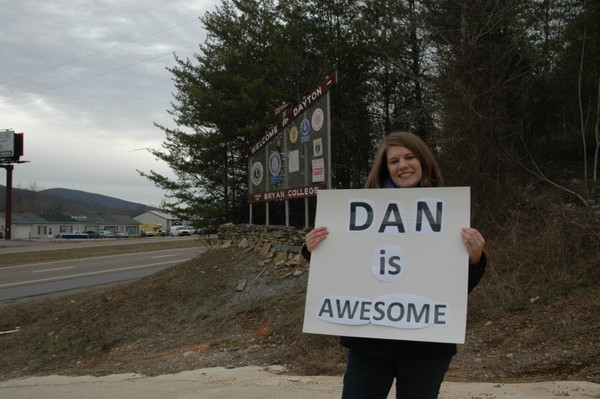
In verse 23, a "Proverbs 31" woman is described as someone whose husband "is respected at the city gates". Here, blogger and author Rachel Held Evans praises her husband "Dan" at the Dayton, Tennesse welcome sign.

In verse 23, a “Proverbs 31” woman is described as someone whose husband “is respected at the city gates”. Here, blogger and author Rachel Held Evans praises her husband “Dan” at the Dayton, Tennessee welcome sign.

Perhaps I am not qualified to write  about this?   After all, I am a guy, and I have no clue what really goes on with women.  Just ask my wife. But the topic of “biblical womanhood” comes up from time to time, and it concerns all of us in the Body of Christ.

A. J. Jacobs wrote a New York Times best seller a few years ago, The Year of Living Biblically, about his humorous, tongue-in-cheek attempt to follow all of the Bible literally for one year. In like manner, Rachel Held Evans titled her second book, A Year of Biblical Womanhood: How a Liberated Woman Found Herself Sitting on Her Roof, Covering Her Head, and Calling Her Husband “Master”. Here she recounts her story of spending an entire year trying to follow the Bible as literally as possible as a woman in every intricate detail. Along the way, she interviews other women who try to follow a particular pattern of “biblical womanhood”. What you do not find in the book generally winds up on her popular blog. We introduced Rachel Held Evans here on Veracity not too long ago. How well did her one year experiment go? What is Rachel Held Evans wanting to say?
Continue reading

Alone Yet Not Alone, Limited Release

Alone Yet Not Alone is an independent Christian film being released in theaters on June 13, 2014 for a limited run.  Originally released in 2013, the film became controversial due to an Oscar nomination for best original song, sung by Joni Eareckson Tada, that was later rescinded.

Alone Yet Not Alone is based on a novel of the same name written by Tracy Leininger Craven. It is based on the true story about a pair of Craven’s ancestors, German immigrant girls who were captured at the Penn’s Creek Massacre of 1755 by Delaware native Americans during the French and Indian War.  Of the few reviews that I have found, one from the Dove Foundation was a  very positive complimentary review, while the other was very much less receptive,  like this second-hand one from a fairly disillusioned, former Christian reconstructionist home schooler.

The film was a fairly low-budget project, put together outside of Hollywood, which partly explains the very low exposure to theaters nationwide. A lot of great films never make it to the top of the popular culture radar because they lack the budget.  Part of the movie was filmed in Williamsburg, Virginia (check out the shot of Jamestown in the trailer below). Even if the film turns out to be less than spectacular for movie goers, I still think that it is important for Christians to support movies with Christian themes in movie theaters.  Otherwise, you are pretty much stuck with a lot of the relatively uninspiring entertainment we mostly have now. Movie theaters are coin-operated entities, so if the demand for good Christian films is high enough, it will encourage the production of more professional (larger budget), higher quality films with biblically-faithful themes.

If you are interested in supporting these type of Christian films, the best way to show your support and get the film release on June 13 at a theatre near you, you should consult sites like these to reserve tickets.


Why Doubt Can Be A Good Thing (An LDS Faith Example)

Plumb LineNot everyone struggles with doubt… and that in many ways can be a good thing.

But for people who think they have absolute certainty in their faith, it is very tempting to pounce on others who ask questions. All sorts of unintended consequences can then happen. For folks who go on and ask questions anyway, there are times where it can get them into trouble. Just ask Rachel Held Evans.

Sadly, the problem is, if left unchecked, doubt can lead people down a road that takes them to places far away from faith in the God of the Bible.   As Martyn Lloyd-Jones put it, the problem with the human condition is not simply that humankind is sick. The problem is that we are in rebellion against God. Unfortunately, runaway doubt leaves us with no one but ourselves to look to, and it merely imprisons us in our own rebellion.

This being the case, it is understandable why so many Christians wish to discourage doubt completely. Just have faith. Just have faith. But I would contend that this is wrong-headed. Sometimes doubt can be a good thing, too.  Just ask “Doubting Thomas” (John 20:24-29).

Here is what I mean: Thomas doubted the resurrection of Jesus, but the Lord did not immediately rebuke him. Instead, He invited Thomas to put his finger into the nailed scarred hands. The resurrected Jesus had a real, physical body. He was not some spirit without a body. The Bible preserves this story for us as further evidence for the truth of Christ’s bodily resurrection.

However, sometimes faith can be presented in a way that looks good at first, looks solid, but upon closer examination, it is built on the wrong foundation. There are more than a few of us humans who do recognize our rebellion from God, and so we run to God, in the arms of faith. But the “faith” we cling to with such certainty is itself confused, the terminology gets all muddled, and the knowledge of truth suffers. We think we are being obedient, but that obedience fails to measure up to the plumb line of God’s Word.

Indeed, doubt can easily misdirect us. But a misdirected faith can also take us in the wrong direction.  If our faith is not firmly planted in the truth, we can easily persuade ourselves that what we believe is true is consistent with the Jesus of the Bible, when in fact, we are only confused as to the object of our faith. Here is a good recent example of what I am talking about.

Continue reading


Bobby Conway: Contending for the Faith

Dear friends, although I was very eager to write to you about the salvation we share, I felt I had to write and urge you to contend for the faith that was once for all entrusted to the saints.
Jude 3, NIV84

Clarke has been sharing quite a bit lately, through posts and comments, about religious pluralism and related topics. (Incidentally, one of my all-time favorite posts by Clarke is this one on particularism and the wideness of God’s mercy.)

Religious pluralism is a difficult and tattered topic. There are lots of recent bestsellers stirring up great controversies, but the song remains the same. There is no end to the number of writers who want to reinvent Jesus and conform Christianity to some type of “fair for all people” standard.

But do we really have that liberty? Would that liberty even make sense?

The Apostle John recorded in John 13:35 that the world will know we are His disciples if we love one another—so why can’t that be the bottom line on the Christian faith?  We should just love each other and everything will work out. You know, love wins. But…there are stern and passionate condemnations throughout the New Testament about not giving away the Gospel and the importance of contending for the faith that was entrusted to us. It all depends upon how we understand ‘love’.

This issue hits close to home for me. A friend from church recently told me how impressed he is with Rob Bell. While I can understand on a secular basis how Rob Bell’s teaching (‘doctrine’) appeals to a wide audience, given the plumb lines of Scripture it seems to me an insidious theological cancer. Our understanding of God is like a 20-year-old Oldsmobile? Really?! This is not a debate between creationists about how to interpret science and the Bible to determine the age of the earth. Nor is it a debate about Calvinism vs. Arminianism, nor whether baptism is a sacrament or an ordinance. It’s much more important than those questions. Why?

Here’s an excellent piece of on-topic teaching from Dr. Bobby Conway that lays out why it is so important to understand the Doctrine of Hell. It’s also a powerful example of why doctrine and theology matter.


A Year of Biblical Doubting #1

Rachel Held Evans first book.  She's young, church-going.... and not very sure about her faith.   Does she represent the future of "evangelical Christianity"?

Rachel Held Evans first book. She’s young, church-going…. and not very sure about her faith. Does she represent the future of “evangelical Christianity”?

How do you handle doubt? Some want to shove it under the rug. Some, frankly, never really go through serious periods of doubt. Others wallow in their confusion. Some simply rebel as an escape mechanism. Others are driven to God’s Word, study, prayer, and fellowship to find answers. Where do you go when you begin to second guess everything, if you ever do?

Part of what we are trying to do with Veracity is to provide tools to help folks to get into God’s Word so that God’s Word can get into us. What resources are available that can equip us to better understand our faith so that we can better serve the Lord in our worship and witness? However, there are times where doubt can plague us in our spiritual journey and threaten to derail us spiritually. Perhaps an explanation about the Bible we once heard no longer makes sense anymore. Or is there some assumption that we have made about the Christian life that no longer appears to be working? Perhaps we expected God to do something and things did not turn out the way we think it should.

Doubt is an enormous topic to tackle in a single blog posting. So I will be content for now to give you a partial case study.
Continue reading