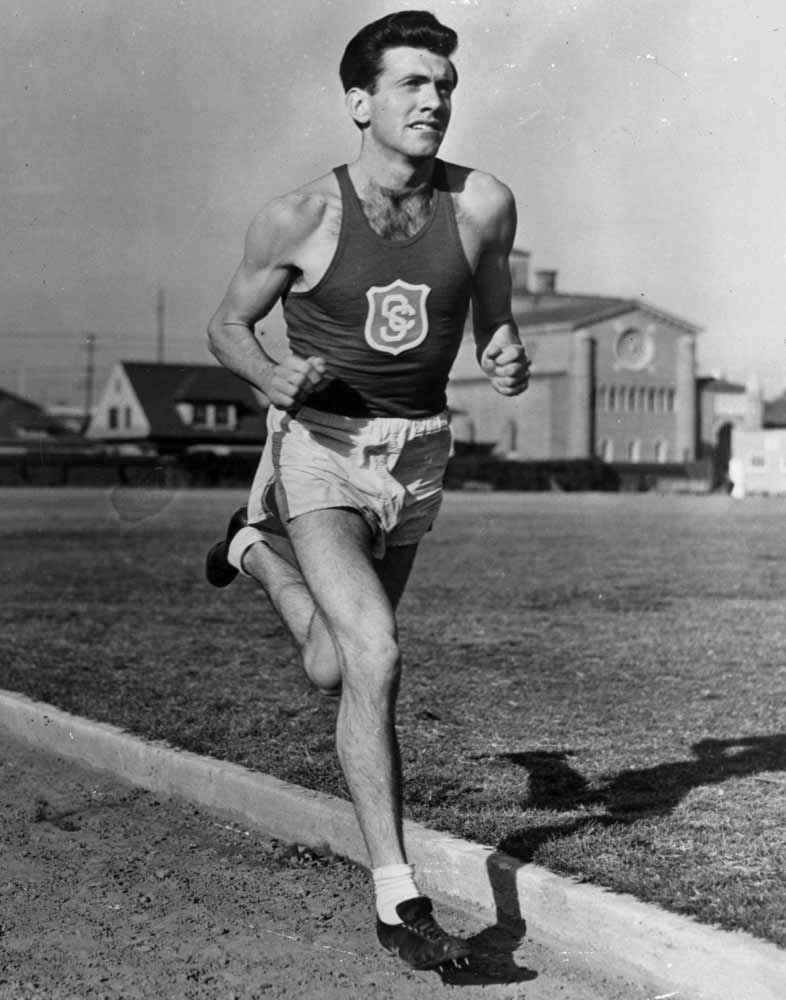
Louis Zamperini. Restless young man, U.S. Olympic runner, war hero, and sinner in need of grace who helped to define the era of Billy Graham (early publicity photo)
It was 1949 in Los Angeles. The conservative Christian community had pulled together to put on a multi-week revival under a big tent, featuring a then relatively-unknown Billy Graham. By the end of week three, the organizers were unsure if the revival meetings were to continue. Despite a massive publicity campaign with flyers and newspaper ads, attendance had been rather so-so. Graham and the leadership team decided to pray, asking for God’s guidance on what to do. After much prayer, they decided to go ahead and extend the meetings a few more weeks. But had they done the right thing?
Several weeks later, on week five, a well-known celebrity made his way into the revival tent. Louis Zamperini grew up a restless teenager and became a juvenile delinquent. To give his life some focus and meaning, Zamperini took up running. Eventually, he earned a spot on the United States Olympic team in 1936 in Berlin. World War II dramatically changed his life, where he was shot down over the Pacific and suffered terribly as a Japanese prisoner of war. When Zamperini came back home after the war, his life kept falling apart. After struggling with marriage problems, alcohol abuse, and horrific post-traumatic stress, he entered that revival tent that one evening. He gave his life over to the Lord Jesus Christ, and he spent the rest of his life serving Him.
Zamperini’s conversion to Christ had helped to give Billy Graham and his team a sense of confirmation that extending the revival a few more weeks was the right thing to do. For Graham, the Los Angeles revival gave him international exposure and influence that has continued to last today into Graham’s twilight years.
But what I find even more fascinating is how Zamperini’s story also helps to tell the story of Billy Graham and the generations of believers who have come under his influence. The intersection of Zamperini with Billy Graham was a critical watershed moment for American evangelicalism in the 20th and early 21st centuries. Here is a summary of some correspondence between Graham and Zamperini before Zamperini’s death.
I would be curious to know from other Veracity readers what you have thought of the book and the movie.
HT: John Paine, for the Luke Zamperini story about the Christian faith element in the movie.
Dr. Daniel Wallace provides impressive scholarship to rebut Newsweek’s recent assault on Christians, Christianity, and the Bible. Read the Newsweek article first–it makes some interesting statements that are not without value. That they are out of balance with an informed and studied appreciation of the Bible is, however, the signature of a patently anti-Christian agenda. Snake handlers, Pat Robertson, Rick Perry, the GOP…talk about stereotypes! Really, Newsweek?!
Every year, at Christmas and Easter, several major magazines, television programs, news agencies, and publishing houses love to rattle the faith of Christians by proclaiming loudly and obnoxiously that there are contradictions in the Bible, that Jesus was not conceived by a virgin, that he did not rise from the dead, ad infinitum, ad nauseum. The day before Christmas eve (23 December 2014), Newsweek published a lengthy article by Kurt Eichenwald entitled, “The Bible: So Misunderstood It’s a Sin” (http://www.newsweek.com/2015/01/02/thats-not-what-bible-says-294018.html?winst=1419500836501&of=2831396). Although the author claims that he is not promoting any particular theology, this wears thin. Eichenwald makes so many outrageous claims, based on a rather slender list of named scholars (three, to be exact), that one has to wonder how this ever passed any editorial review.
My PDF of this article runs 34 pages (!) before the hundreds of comments that are appended. Consequently, I don’t have space…
“The Church no more gave us the New Testament canon than Sir Isaac Newton gave us the force of gravity. God gave us gravity, by His work of creation, and similarly He gave us the New Testament canon, by inspiring the individual books that make it up.”
J. I. Packer, God Has Spoken: Revelation and the Bible, 3rd ed.
“We should not imagine a committee of church fathers with a large pile of books and these five guiding principles before them when we speak of the process of canonization. No ecumenical committee was commissioned to canonize the Bible.” Norman L. Geisler and William E. Nix, From God To Us Revised and Expanded: How We Got Our Bible
One of the great misconceptions about Christianity involves the canonization of the Bible (that is, deciding which books comprise the whole, inspired, holy Scripture). For whatever reasons, people tend to imagine some sort of ecumenical process—dragging out over several centuries—where well respected officials in the early and medieval church came together and decided which books were in and which books were out. But as we can see from the quotes above from three of the most conservative Bible scholars, church councils did not produce the Bible.
Ecumenical Councils
Conservative Christian scholarship disallows any notion that ecumenical councils somehow selected the Bible from a list of candidate documents. But there were ecumenical councils, lots of them, so what role did the councils play in the canonization of the Bible?
First, recognize that church councils were necessary for the governance and order of the church. The precedent was set at the Council of Jerusalem in Acts 15, attended by the apostles themselves. There were heresies and challenges to Christian doctrine. There were matters of church discipline and orderly worship that had to be addressed. There was confusion about Gnostic teaching and guidelines for living. Later there would be questions about which books and letters belonged in the canon of Scripture—and which did not.
Shortly after the legalization and state patronage of Christianity within the Roman Empire, the church began to hold ecumenical councils. The first was called by Constantine the Great on May 20, 325 at the Royal Palace in Nicaea. The focus of the Nicene Council was the divinity of Jesus and the clarification of the Trinity. It produced the Nicene Creed, which was later amended to be close to the Apostles Creed. (Sidebar—Did Jesus descend into hell? Here’s a brief discussion about this controversy.) Contrary to modern misconceptions—perpetuated by Dan Brown in The Da Vinci Code—Constantine did not determine the New Testament canon and the First Council of Nicaea did not even address the topic of the canon of Scripture.
Over the following centuries, there would be many more ecumenical councils and synods, continuing through to the present day. Which meetings are recognized as ‘ecumenical‘ depends largely upon denominational perspective. 19th century church historian and theologian Philip Schaff documented the canons of Seven Ecumenical Councils between 325 and 787 CE (which he defined as “councils which have always, and still do, receive the unqualified acceptance of both East and West”):
The First Council of Nicaea,
The First Council of Constantinople,
The Council of Ephesus,
The Council of Chalcedon,
The Second Council of Constantinople,
The Third Council of Constantinople, and
The Second Council of Nicaea.
Philip Schaff meticulously documented the canons of the historic ecumenical councils of the Christian church.
However, history is replete with other councils that are not accepted as ecumenical by the Eastern and Western churches (‘Eastern’ meaning Eastern Orthodox, and ‘Western’ meaning Roman Catholic and other denominations that developed in Europe). For example, the Synod of Hippo (393 CE) and 3rd Council of Carthage (397 CE) produced authoritative lists of the sacred scriptures. Later, the Council in Trullo (also called the “Quinisext Council,” 692 CE) ratified the canons of these councils—but did not specifically state the list of books considered to be divinely inspired. So why didn’t everyone accept the canons of Hippo and Carthage as ecumenical? As you might imagine, church politics had a lot to do with it—and still does. Hippo and Carthage did not have wide representation from the church as a whole and were heavily influenced by Augustine of Hippo, as later critics would argue.
Page 885 of Schaff’s text contains the list of canonical scriptures from the Council of Carthage. This list includes the Apocrypha in the Old Testament but clearly identifies the 27 books of the New Testament. (We’ll explore the Apocrypha in a future post.)
The canons of the ecumenical councils make for dry reading in parts, not unlike reading the formal minutes from a business meeting where much discussion is reduced to a few statements. Nevertheless, check out the canons of these councils as recorded in Schaff’s monumental work. In addition to the seven ecumenical councils, he also documented the records from other councils, including Hippo, Carthage, and Trullo. Much of what these clergymen dealt with is now irrelevant. Troublesome heretics have long ago died, many of the controversial theological and doctrinal problems have faded in time, and frankly no one cares about how to handle “him who persuades a slave to leave his master under pretence of religion.” When you read the canons, it becomes clear how challenged the Christian church was over matters large and small—and how pious many of these councils must have been.
‘Orthodox’ Christianity
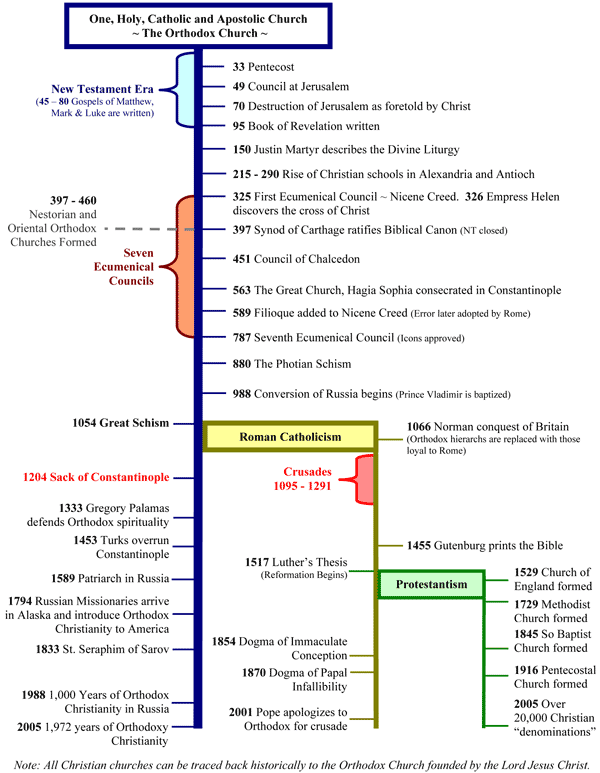
Over the centuries since the Ascension of Jesus Christ, the church found more issues to debate, and more reasons to divide. Rather than serving to unite believers, later ecumenical councils proved to be dividing mechanisms by laying out denominational distinctions.
As shown in the timeline on the right, the Christian church remained essentially united through the early councils. Then, one word (Filioque) caused the Great Schism of 1054 and the ‘orthodox’ church began splitting into more and more denominations.
So…in all the deliberations of the historic synods and councils of the early and medieval Christian church, Christians cannot find agreement on the canon of Scripture. The scholars quoted at the beginning of this post seem to be justified in the strength of their statements. Church councils did not produce or canonize the Bible.
Think about it. Is it reasonable to believe that God would inspire holy Scriptureand that it would then need to be ratified by church councils before being recognized as such?
If we rule out the deliberations of church councils as the deciding authority, how then can we know what books comprise the canon of holy Scripture? We’ll take that up in our next post on this topic…
Can We Trust the New Testament Canon?
…but in the meantime, here’s a brief interview with Dr. Michael Kruger that addresses that very important question.
American cultural icon every December, dangerous pagan tradition, or Christian pastor in southern Turkey in the 4th. century who exemplified a love for the poor by following the way of Jesus?
Growing up as a little kid, my mother left a big chocolate chip cookie out on a plate in front of the living room fireplace one Christmas Eve. When I woke up the next morning, the cookie was half-eaten, with crumbs unmistakably left on the plate.
When I came to having personal faith in Christ in high school, I looked back on the childlike belief in Santa Claus as a type of feel-good fairly tale. Jesus was the “real thing” while this jolly “Saint Nick” figure was simply a product of cultural imagination… merely an urban legend.
It must have been my dad who ate part of that cookie.
In the contemporary era of the so-called “War on Christmas,” Christians have faced the awkward challenge of what to do with “Saint Nick.” Secularists for years had suggested that old “Saint Nick” was simply a pious invention having no relevant historical basis. Roman Catholics and Eastern Orthodox Christians, however, have argued that Saint Nicholas was indeed a real historical figure from the 4th century, and so only vaguely related to the “ho-ho-ho” North Pole type glamorized by the old 1931 Coca-Cola ads. Evangelical Protestants, who tend to frown upon the veneration of saints, have sought to distance themselves somehow from Saint Nick in different ways, some even dismissing the history of the original figure as being of pagan origin (just as some secularists still do). Indeed, perhaps one of the reasons why the ancient Saint Nicholas evolved into the jolly guy with an obesity problem driving a bunch reindeer around in a sleigh filled with merchandise from Target and J.C Penny’s is because the majority of American Christians since the 19th century have been reluctant to associate with the practice of venerating dead saints.
Various attempts have been made in recent years to rehabilitate the true history of the original Saint Nicholas and get at what Paul Harvey called “the rest of the story.” Campbell University’s Adam C. English has probably done the most thorough research into Saint Nicholas to give us the detailed scoop. In The Saint Who Would Be Santa Claus, argues that the evidence shows that actually the original “Saint Nicholas of Myra” did come from 4th. century southern Turkey, serving as a Christian pastor and a popular bishop who advocated for the poor. Beyond that, the exact details get a bit murky. Continue reading
They said that the war would be over by Christmas…
This Christmas marks the 100th anniversary of the so-called “Christmas Truce” between the German and British armies along the Western Front during the “Great War.” When the fighting began in August, 1914, both sides were expecting a fairly quick outcome. But by the time the bitter cold of December set in amid the muddy trenches near the Marne River, devastated by terrible casualties resulting from the horrors of modern warfare, it became clear that the bloody end was still some years away.
But why the war in the first place? As Baylor University historian Philip Jenkins argues in the The Great and Holy War: How World War I Became a Religious Crusade, the typical narrative offered by secular historians, that the war was basically a great imperial contest among European colonizing empires, fails to adequately and fully explain what happened. Jenkins maintains that “the First World War was a thoroughly religious event, in the sense that overwhelmingly Christian nations fought each other in what many viewed as a holy war, a spiritual conflict” (Wall Street Journal book review, by D. G. Hart, June 6, 2014, but also consider this review from Reformation21).
Prior to the war, the majority of Christians were optimistic about the future spread of the Gospel changing societies for the better, an essentially postmillenial view of the “End Times.” But after these supposedly “Christian nations” of the world had managed to annihilate millions of people, at least indirectly all in the “name of God,” the mood and perspective of many Christians began to change. A type of pessimism took over, so it should come as no surprise that the great “Christian nations” of Europe would eventually enter a steady decline towards apostasy. It was as though the “War to End All Wars” had compromised the witness of the church. But what was not so evident at the time was that in the aftermath of the war, the spread of the Gospel would increase rapidly across the “Global South”, where the Christian faith continues to expand even today all across Africa, Asia, and Latin America.
Is there anything we can learn from all of this?
For me, the event during that war that most captures the contradictions and the absurdity of “Christian nations” fighting one another, while still offering a glimmer of hope, is in that unusual truce between the German and British armies that lasted for several days beginning Christmas Eve, 1914. What started off as German soldiers singing Christmas carols to one another became a type of peaceful interchange between the warring parties.
The truce would turn out to be brief, as the fighting renewed just a few days later… Charlottesville, Virginia folk singer, John McCutcheon, tells the tale of the Christmas Truce: