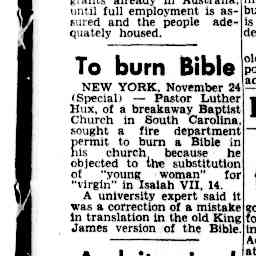
The media coverage of the burning of the RSV, the “Revised Satanic Version” of the Bible. From the November 25, 1952 edition of the Courier Mail, Brisbane, Australia. Luther Hux made quite a news splash all over the world.
“Behold, a virgin shall conceive and bear a son,and his name shall be called Emman′u-el” (Matthew 1:23 RSV)
Therefore the Lord himself will give you a sign. Behold, a young woman shall conceive and bear a son, and shall call his name Imman′u-el. (Isaiah 7:14 RSV)
Bible Burning
“Luther Hux knew full well that the RSV was unholy, and accordingly he announced his intention to burn a copy of the new Bible,” so reports historian Peter Johannes Thuessen, from his In Discordance with the Scriptures: American Protestant Battles over Translating the Bible (p.96). Hux, a North Carolina Baptist pastor, had recently received a copy of the new “Revised Standard Version” of the Bible, published that year in 1952. In his fury over what he saw as a “mistranslation” of Isaiah 7:14, Luther Hux was determined to make a show over this “Bible burning” in front of as many press reporters as possible. Isaiah 7:14 is the famous prophecy of the virgin birth, as referenced by the Gospel writer Matthew. All previous English translations of this verse referred to a “virgin,” not a more generic “young woman,” as the new Revised Standard Version had done. Thuessen continues:
On the night of 30 November Hux delivered a two-hour oration and then led his congregation from the white-frame Temple Baptist Church into the cold autumn air, where every member received a small American flag. Climbing onto the bed of a waiting truck, Hux held aloft a copy of the RSV on which he had written the word “fraud.” Instead of burning the whole book, however he ripped out and ignited the page bearing Isaiah 7:14. “This has been the dream of modernists for centuries,” he shouted, ” to make Jesus Christ the son of a bad woman.” (p. 97)
Burning part of a Bible? It would hardly register a blip on the 24-hour news cycle at CNN today. But back in 1950s North Carolina, the “Buckle of the Bible Belt,” you just did not do things like that.
Well, at least he was being patriotic about it.
But what if Luther Hux was right? Was the Revised Standard Version (RSV) a fraud? Was the RSV, from Hux’s own word’s, “the Master Stroke of Satan?”
I am not approving of “Bible burning,” but actually Luther Hux was onto something. What Hux did not know at the time is that he had stumbled upon an issue that has puzzled Bible scholars now for decades,… if not centuries. Continue reading
As a way of closing out the year 2015, I thought I would highlight what I thought were some of the most thought-challenging blog posts and news articles of 2015, and why. Some caution is in order, as several of these posts can be disturbing to read. Nevertheless, they are important because the stories conveyed by the authors have ramifications for how we as followers of Jesus practice our faith in our world today.
Graeme Wood’s article in The Atlantic, What ISIS Really Wants, helps to shatter the myth that the aims the Islamic State of Iraq and the Levant having nothing to do with genuine Islam. Sure, moderate Muslims are repulsed by ISIS, but if you study their agenda to re-establish an Islamic caliphate, then you will recognize that the motivation behind ISIS comes straight out of a literalistic reading of the Koran.
As discussed here on Veracity, numerous media outlets reported on the statement made by Wheaton College faculty member, Larycia Hawkins, that Christians and Muslims worship “the same God,” that led to her being placed on administrative leave. The incident revealed tensions within the church, in view of the recent problems with terrorist attacks by radical Islamic groups, and the future status of 4 million Syrian refugees flooding the world. How should Christians relate to people from Islamic cultures?
National Geographic‘s Maureen Orth, in her front-cover article on the Virgin Mary shows just how seriously the Roman Catholic Church takes miracles associated with appearances of the Mother of Jesus. Is there a problem when people look to such “signs and miracles” to guide their faith, or does such a dependence on such things undermine the principle of the all sufficiency of Scripture alone to guide us towards the Truth? How do you discern the difference between a genuine miracle of God and a fake? The first reported sighting of Mary goes back to 40 A.D…. while she was still alive.
In a somewhat related story, Christianity Today‘s Bob Smietana investigates the connection between royalties from the popular evangelical worship song, “How Great is Our God,” and a church leader in the Nashville area who is under a cloud of suspicion regarding prosperity doctrine teachings and sexual abuse. There appears to be fine line between faithfulness to the Gospel and careening off a spiritual cliff (UPDATE: 12/31/15)
Rod Dreher, a Christian blogger, writes in the American Conservative that the recent debates over LGBT rights means that the “American way of life” is on a collision course with traditional, orthodox Christianity. The culture wars, as we have known it, are over, and the battle for hearts and minds is in the up-and-coming generation of youth in our churches. Christians need to rethink how to go about biblical discipleship in a rapidly shifting culture, including considering the so-called “Benedict Option.“
Ever wonder who popularized terms like “anorexia,” “PTSD,” and “biopolar disorder” in the modern vocabulary of psychology? Look no further than Robert Spitzer, the psychologist intellectual who died on Christmas Day, 2015, in this piece written by Amy Argetsinger for the Washington Post. Spitzer helped to steer the psychology profession to declare that homosexuality was not a psychological disorder in the 1970s. In the early 2000s, his work took a different turn, declaring from one of his studies that reparative therapy could actually cure homosexual orientation, which served as a very promising sign to the growing “ex-gay” evangelical Christian movement. However, this conclusion was later rescinded by Spitzer’s own reevaluation in 2012. Later that same year, Exodus International, the largest “ex-gay” evangelical Christian ministry in the world, closed its doors, following Spitzer’s revised conclusion that reparative therapy not only fails to help people in most cases, but that it can also cause great psychological harm. A growing view among evangelical Christians, while still believing in the Bible’s opposition to same-sex behavior, now agrees that reparative therapy is to be avoided, according to this article by Jonathan Merritt for The Atlantic.
And to top it off…. the biggest NON-stories for 2015… drum roll please….. the prophecy non-fulfillments regarding the Four Blood Moons and the Mystery of the Shemitah predictions…. ZZZZZZ…. surprise, these two were sleepers!!
A few of the above stories can get you a bit depressed. Here are few antidotes to the pessimism that indicates that God is doing some incredible things in our world today. May we be ever mindful of God’s providential care in the New Year!
And one of them, an expert in religious law, asked him a question to test him: “Teacher, which commandment in the law is the greatest?” Jesus said to him, “‘Love the Lord your God with all your heart, with all your soul, and with all your mind.’ This is the first and greatest commandment. The second is like it: ‘Love your neighbor as yourself.’ All the law and the prophets depend on these two commandments.” [Matthew 22:35-40 NET]
Now an expert in religious law stood up to test Jesus, saying, “Teacher, what must I do to inherit eternal life?” He said to him, “What is written in the law? How do you understand it?” The expert answered, “Love the Lord your God with all your heart, with all your soul, with all your strength, and with all your mind, and love your neighbor as yourself.” Jesus said to him, “You have answered correctly; do this, and you will live.” But the expert, wanting to justify himself, said to Jesus, “And who is my neighbor?” Jesus replied, “A man was going down from Jerusalem to Jericho, and fell into the hands of robbers, who stripped him, beat him up, and went off, leaving him half dead. Now by chance a priest was going down that road, but when he saw the injured man he passed by on the other side. So too a Levite, when he came up to the place and saw him, passed by on the other side. But a Samaritan who was traveling came to where the injured man was, and when he saw him, he felt compassion for him. He went up to him and bandaged his wounds, pouring oil and wine on them. Then he put him on his own animal, brought him to an inn, and took care of him. The next day he took out two silver coins and gave them to the innkeeper, saying, ‘Take care of him, and whatever else you spend, I will repay you when I come back this way.’ Which of these three do you think became a neighbor to the man who fell into the hands of the robbers?” The expert in religious law said, “The one who showed mercy to him.” So Jesus said to him, “Go and do the same.” [Luke 10:25-37 NET]
It is difficult at times to write about the application of Christian doctrine to our lives without getting cynical. We try very hard to avoid sounding off on Veracity. But, I have to admit that the self-absorption with American politics that we see in the media is disturbing. In a world full of suffering—that desperately needs the Gospel of Jesus Christ to be applied in relief efforts—we are drowning in a sea of political rhetoric that panders to isolationists and preys upon their fears. Don’t agree? Turn on any news program and count the minutes devoted to American politics. Also, while you’re watching, keep track of the minutes devoted to the four million refugees inside and fleeing Syria.
The Crisis in Photographs
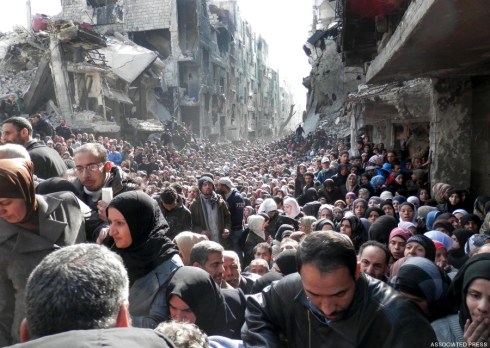
A sea of hungry, haunted faces looks out from a massive queue that snakes through the bombed out Yarmouk refugee camp in southern Syria. In the photo, taken on January 31, 2014 in Damascus’ Palestinian refugee camp, men, women, and children were in line for aid that included desperately needed food and medical supplies. There were more than 18,000 people in the Yarmouk camp, and many were starving to death.
Syria – Save the Children
Migrants are escorted through fields by Slovenian police and the army as they walk from the village of Rigonce to Brezice refugee camp in October, 2015. (Photo by Jeff J. Mitchell/Getty Images)
Millions of Syrians escape an apocalyptic civil war, creating a historic crisis.
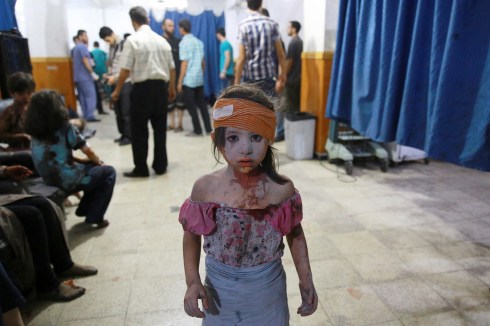
A wounded Syrian girl stands in a makeshift hospital in the rebel-held area of Douma, east of Syria’s capital of Damascus, following shelling and air raids by Syrian government forces on August 22, 2015. At least 20 civilians were killed, and another 200 wounded or trapped in Douma, a monitoring group said, just six days after regime airstrikes killed more than 100 people and sparked international condemnation of one of the bloodiest government attacks in Syria’s war.
A paramilitary police officer investigates the scene before carrying the lifeless body of Aylan Kurdi, 3, after a number of refugees died and others were reported missing when boats carrying them to the Greek island of Kos capsized near the Turkish resort of Bodrum on September 2, 2015. The tides also washed up the bodies of the boy’s 5-year-old brother Ghalib and their mother Rehan on Turkey’s Bodrum peninsula. Their father, Abdullah, survived the tragedy.
A Dutch volunteer tries to comfort a migrant moments after arriving aboard a raft at a beach on the Greek island of Lesbos on October 23, 2015.
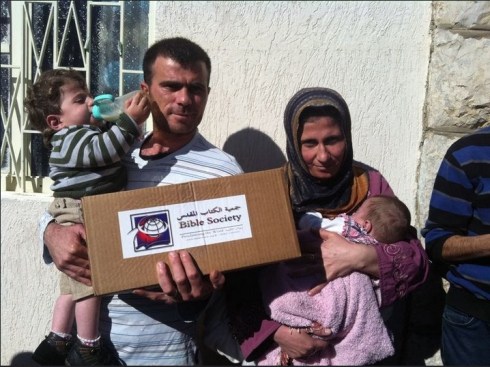
A Syrian refugee family with a Lebanon Bible Society aid package. The Bible Society provides aid for around 3,000 Syrian refugee families.
Pastoral Comment
After publishing this post, one of our astute readers called the following video to our attention. Pastor Max Vanderpool of Generations Community Church in Kentucky hit the nail on the head. We need to wake up and be vocal about what is happening. We need to be part of the solution, not part of the problem. The world is full of hatred and fear and self-absorption. Get involved. Show some compassion. That’s what Jesus would do!
What Can We Do?
Here are four organizations that provide aid to Syrian refugees, and others in the Middle East, in the name of Jesus Christ. Please consider clicking the links below to learn more about them and their relief efforts. Please use the donate links to make your year-end charitable contributions to show that you understand Jesus’ teaching in Luke 10:25-37.
Simeon, an elderly Jew, had received a promise from the Holy Spirit that he would not die before laying eyes on the Messiah. So when Mary and Joseph bring the child Jesus to the Temple for the purification, specifically the Jewish consecration of the first born male, pidyon haben, Luke 2:22-28, Simeon took Jesus into his arms and uttered the Nunc Dimittis, named after the first phrase in Saint Jerome’s Latin translation of the Bible, the Vulgate (Luke 2:29-32), translated here by the English Standard Version:
“Lord, now you are letting your servant depart in peace, according to your word; for my eyes have seen your salvation that you have prepared in the presence of all peoples, a light for revelation to the Gentiles, and for glory to your people Israel.”
Johann Sebastian Bach wrote a cantata, Ich habe genug, meaning in English, “I have enough,“which was first performed in Leipzig in 1727. Bach’s text is only loosely based on Luke’s text, but it conveys the meaning intended by Luke rather well: God had kept His promise to Simeon.
I have enough; I have taken the Savior, the hope of the Gentiles, into my yearning arms. I have enough; I have seen him, my faith has held Jesus to my heart; now I desire but even today to depart with joy from here. I have enough!
French opera soloist, Natalie Dessay, sings the Aria from Bach’s classic work, from the German:
Ich habe genug. ich habe den Heiland, das Hoffen der Frommen, auf meinen begiergen Arme genommen; ich habe genug! Ich hab ihn erblickt, mein Glaube hat Jesum ans Herze gedrückt, nun wünsch ich noch heute mit Freuden von hinnen zu scheiden. Ich habe genug!
Behold, the Messiah, the Savior, has come! Merry Christmas, from your friends at Veracity.
Jesus’ purification in the temple serves as a Scriptural model for the increasingly popular practice of “baby dedication” in many of today’s evangelical churches. Other posts in this blog series, based on the “Gospel in Song” preaching this year during Advent in the local church where I worship, include the Magnificat, the Benedictus, and the Gloria.
Here is a great example: When Jesus met the woman at the well in Samaria in John 4, He was quite clear in saying that Samaritan theology did not line up exactly with traditional Jewish belief. The Samaritans (still) worship God, believing that Mount Gerizm is the proper place for such worship. Traditional Jewry has always focused on the Temple in Jerusalem instead. Jews would purposely avoid Samaritan lands because of the latter’s heterodoxy. But notice how Jesus, who purposely passes through Samaria, approaches the woman:
“Woman, believe me, the hour is coming when neither on this mountain nor in Jerusalem will you worship the Father.You worship what you do not know; we worship what we know, for salvation is from the Jews.But the hour is coming, and is now here, when the true worshipers will worship the Father in spirit and truth, for the Father is seeking such people to worship him. God is spirit, and those who worship him must worship in spirit and truth.”(John 4:21-24 ESV).
I just do not see Jesus falling for the modern, popular tendency for the “sound-bite” theologies of the politically-correct: “Samaritans and Jews worship the same God,” nor the opposite, bigotry-sounding to some, in this day and age: “Samaritans and Jews do not worship the same God.” Instead, Jesus proclaimed the truth, but he did it in a way of great wisdom that built a relationship of trust with this woman, and she recognized Jesus at the Messiah.
If only some of our Christian leaders and theologians on both sides of issues like this were to show such restraint and wisdom. You can be theologically correct and still miss an opportunity to demonstrate love and solidarity with those, like the Syrian refugees, who are marginalized, for the sake of the Gospel. Likewise, on the other side, one need not resort to confusing or misleading theological statements for the sake of avoiding the appearance of bigotry. For the most part, I will leave it to the reader to make such judgments as appropriate (for the content linked below).
So, do Jews and Samaritans worship the same God? How about Christians and Jews? Do they both worship the same God? What does one mean by the “same” God? These questions are not so easy to answer. No matter what your “take” on all of this is, we should probably take our cue from Jesus as to how we approach the current debate over whether or not Christians and Muslims worship the “same” God.
Miroslav Volf speaks at Wheaton College in 2011, summarizing the main argument from Allah, A Christian Response. While I am very sympathetic to Volf’s purposes, I found his retelling of the Crusade sack of Jerusalem versus Saladin’s capture of the Holy City to be historically problematic, a sign that illustrates other problems in his theological framework. It is no wonder that professor Hawkins finds herself caught up defending a sophisticated, nobly hopeful, yet still somewhat confused, narrative. I also recommend Dr. Imad Shehadeh’s review of Volf’s book. (Nevertheless, I HIGHLY agree with Volf that read as literature, William P. Young’s The Shack, might be helpful, but when read as theology, the book is nothing but pure heresy).
It appears that Professor Hawkins and Wheaton College have some ground to cross before an amicable solution can be reached, if possible. From the sound of Wheaton College’s latest statement, there is a communication gap between the two parties, and the involvement of the secular media has complicated matters. Theological discussion is hard work, folks.










 Veracity