Do Atheists Just Suppress the Truth in Unrighteousness?

Greg Koukl is an apologist with Stand to Reason ministries. In the following 3-minute video clip, Greg tries to answer the question, “are atheists just suppressing the truth in unrighteousness?” From Greg’s reading of Romans 1:18-32, it is not just “atheists” for whom the question can be asked. Anyone who is not a believer in Christ would fall within this category.

Does Greg’s video get at the idea that Paul is trying to communicate here? Watch the video, read Romans 1:18-32, and let me know what you think.

NOTE: For those who want a little more background into this challenging passage of the Apostle Paul’s, you should be aware that Paul’s critique of pagan idolatry in Romans 1 is rooted in the Jewish theological perspective of his day. Sometime within 200 years prior to Paul ‘s writing his letter to the Roman church, an unknown Jewish writer penned the so-called “Wisdom of Solomon,” part of the Greek Septuagint, as well as part of what many Protestant Christians call the “Apocrypha.” In the Wisdom of Solomon, the writer extols the virtues of wisdom grounded in the worship of the True God of Israel, and contrasts this with the idolatry of paganism just as Paul does. Note the striking parallels in Romans 1 with Wisdom 13 and 14.


The Eagle and Child in All of Us

And let us hold unwaveringly to the hope that we confess, for the one who made the promise is trustworthy. And let us take thought of how to spur one another on to love and good works, not abandoning our own meetings, as some are in the habit of doing, but encouraging each other, and even more so because you see the day drawing near. (Hebrews 10:23-25, NET)

image

Outside Christ Church College, Oxford. One of the most beautiful and profoundly ‘magical’ places we have ever been. Scenes from Harry Potter movies were shot here. Albert Einstein, John Locke, John Wesley, Lewis Carroll, and 13 of the 26 Prime Ministers from Oxford studied here. Carroll’s Alice in Wonderland was inspired here, and Alice was the daughter of the Dean of Christ Church.

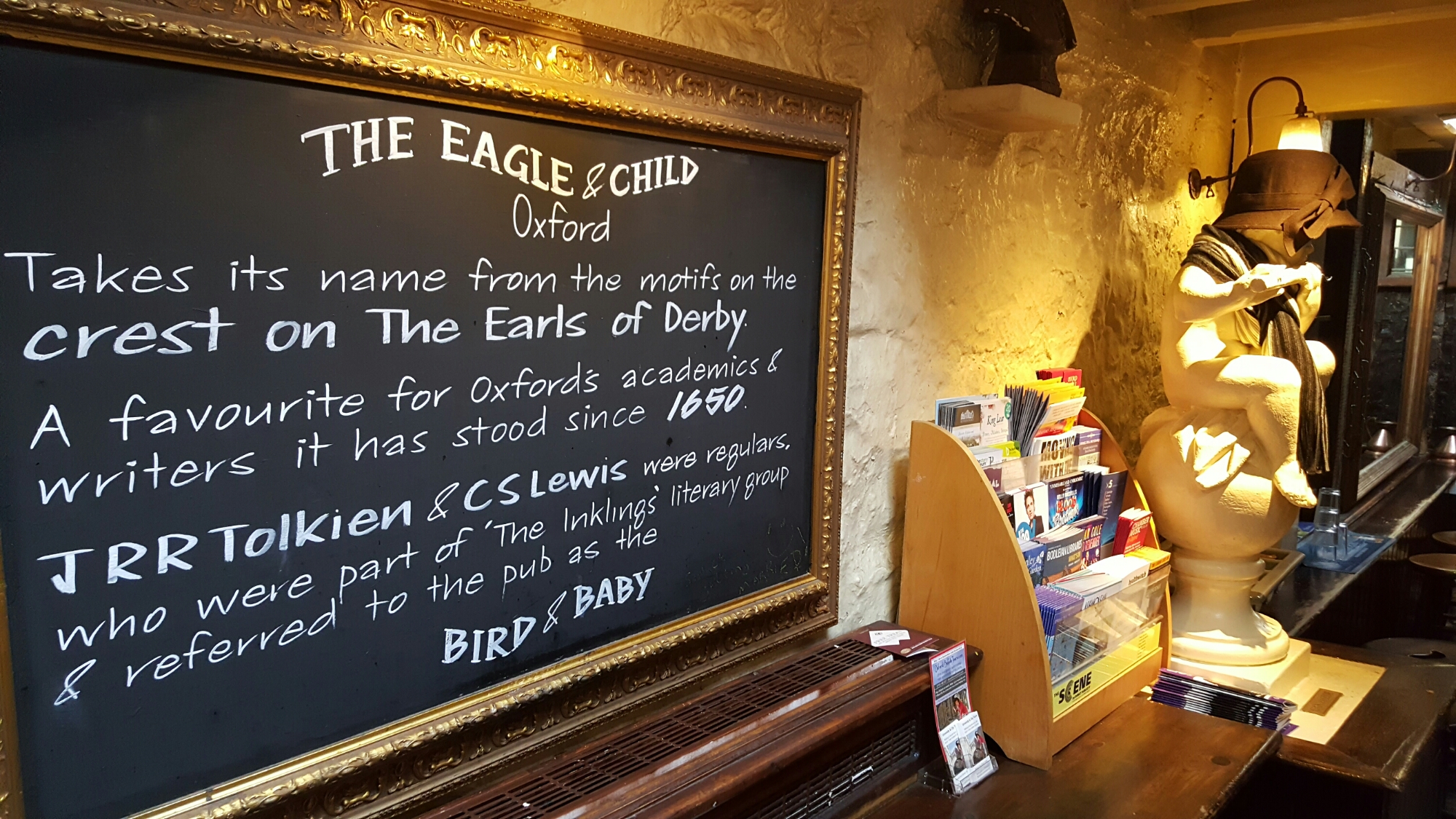
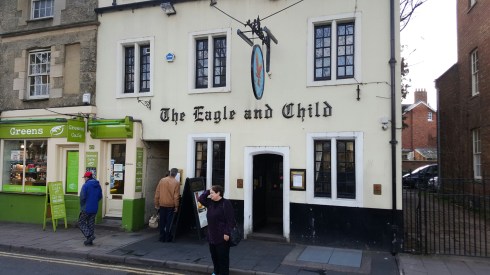
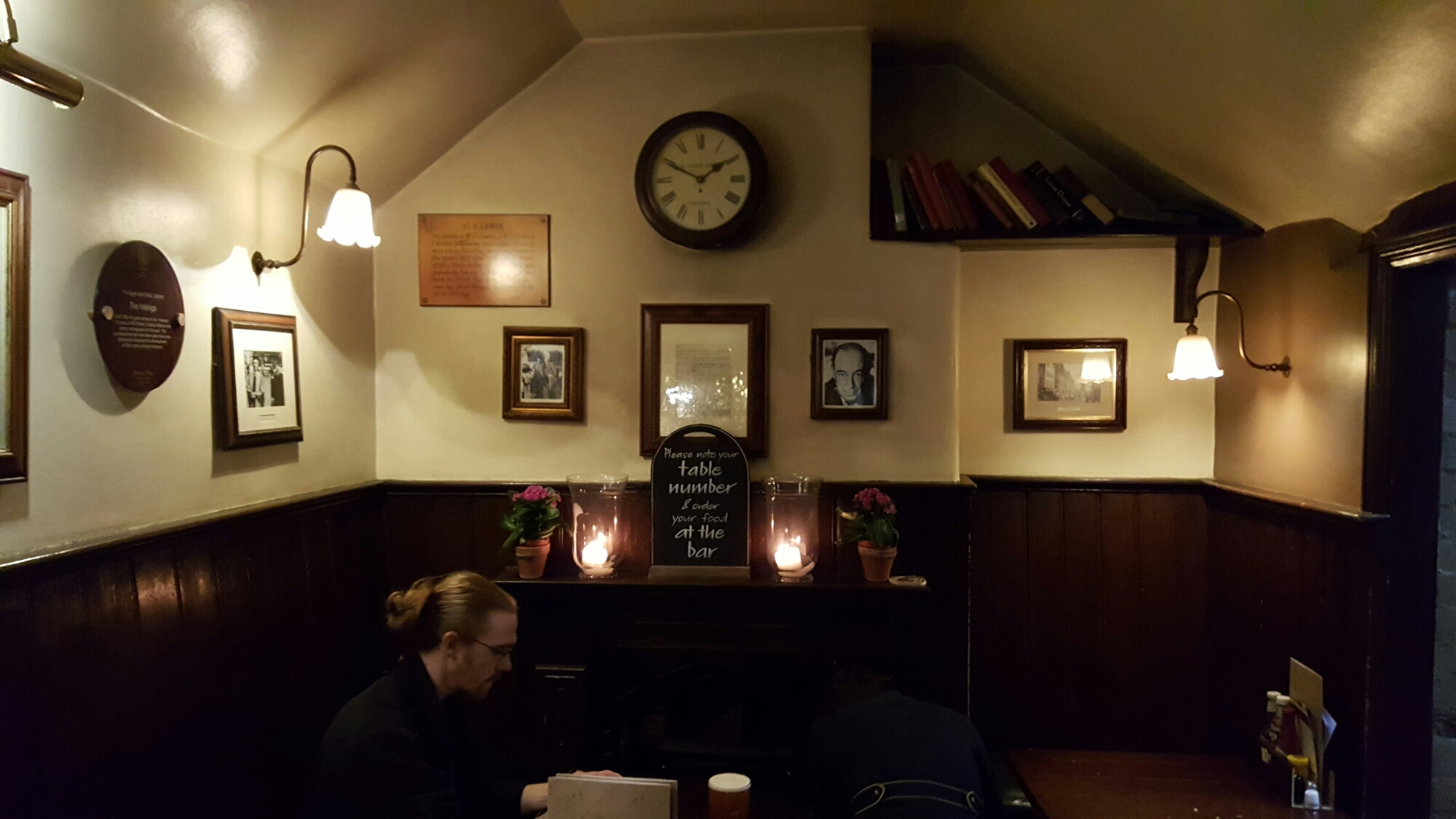
Yesterday, Marion and I travelled to Oxford and had a late lunch in the renowned Eagle and Child pub, where a group of famous Christians met regularly to encourage one another. We sat in the same nook where J.R.R. Tolkien, C.S. Lewis and others discussed ideas that shaped some of the most significant English literature to come out of the twentieth century. I couldn’t help feeling a little exuberant, so I took a few snaps with my cell phone and sent them off to friends and family.
image

I really didn’t want to write this post. I’ve never read any Tolkien. I’m no C.S. Lewis scholar. I find it difficult to read Lewis’ philosophical theology, preferring instead to listen to his books using Audible. His writing is undeniably brilliant and packed with words that connect the intellect to our faith. But as Dick Woodward once told me, “C.S. Lewis made things complicated, but I spent my entire ministry trying to make them simple—so people would understand.” One of the great wonders of the Christian Faith is that it works on both very simple and very complex levels.
image

image

Tuesday mornings at the Eagle and Child pub. This is where Tolkien, Lewis and others sat. The Gloucester sausages and steak and ale pie were quite good. We were late for lunch, so it wasn’t too crowded.

When Clarke received our photos from the Eagle and Child, he prodded me, reluctantly, into writing this post. But it occurred to me while sitting in the Eagle and Child that I have experienced and benefitted from the encouragement of some wonderful brothers and sisters. Brothers like Dave Thompson who will send long, deep, profound emails of encouragement at all hours of the night. And Dave Rudy, who always can add to any topic I may bring up (it’s amazing how much Dave has studied and absorbed). And Rob Campbell, who is the most devotionally devoted person I have ever met (and a finer friend you could not have). And Clarke Morledge himself, with an encyclopedic knowledge of all things theological and hermeneutical (his zeal is as contagious as his heart). And Ken Petzinger, a Princeton-educated physicist who is living proof that Christians also come with extreme intellectual capacity (and who always has something current to share from his personal studies). And Dick Woodward, who was such an encourager and gifted teacher. And Iris Rudy, who is such a good listener (and who commands respect when she speaks). And Tina Campbell, who works at being the most compassionate and hospitable person I know (and succeeds magnificently). And Marion, whom I could never thank appropriately for being such a wonderful, selfless person (and in whom I continually see the Gospel lived out).

So when the writer of Hebrews states, “And let us take thought of how to spur one another on to love and good works, not abandoning our own meetings, as some are in the habit of doing, but encouraging each other, and even more so because you see the day drawing near,” l get it. I am thankful for the Eagle and Child that all of us have experienced.

image

The University of Oxford has 38 Colleges and 6 Permanent Private Halls (PPHs) of religious foundation. There are cathedrals, churches and scenes like this everywhere you turn. I hope that you can visit Oxford soon!


A Day at the Museum

Clarke referenced the Codex Sinaiticus and the Septuagint in a couple of posts last week, so Marion and I decided to hop a plane to London and have a look at the original. (That’s not exactly how things progressed, but isn’t far from the truth.)

image

We’re in London this week to learn about the Codex Sinaiticus and other artifacts that point to the veracity of the text of the Bible.

Codex Sinaiticus is one of the most important books in the world. It contains the oldest complete New Testament in existence, and dates to around 350 A.D. The Old Testament portion is a copy of the Septuagint. Codex Sinaiticus is used by scholars today to create the most accurate translations of the biblical text. The manuscript is served in high definition on the Internet, and it doesn’t take long to see how scribes painstakingly corrected the original writing. There are corrections plastered in the margins everywhere. It was obviously important for the scribes to make sure the work was as accurate as possible and up to par with the best copies of the Bible in existence at the time.

The British Library’s portion of Sinaiticus is currently on display in a special exhibit at the British Museum. We asked Clive Anderson, co-author of Through the British Museum with the Bible, if he could guide us through the exhibits. Although Clive wasn’t scheduled to conduct a tour while we were in town, he graciously agreed.

Some days are better than others. Today was the day for our tour.
Continue reading


Paul, Moses, Romans 10, and How New Testament Writers Use the Old Testament

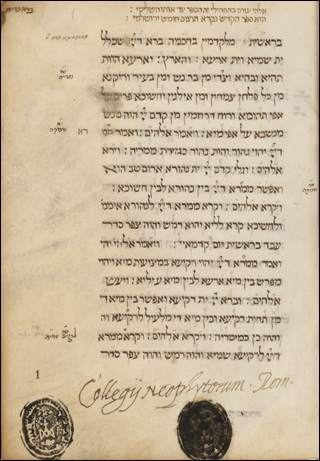
Targum Neofiti. Now online at the Vatican Library. This 2nd century Aramaic paraphrase of the Old Testament, used in Jewish worship, may hold the critical clue for how Paul references Moses in Romans 10 to teach that Christ is the end of the Law.

Targum Neofiti. Now online at the Vatican Library. This 2nd century Aramaic paraphrase of part of the Old Testament, used in Jewish worship, may hold the critical clue as to how Paul references Moses in Romans 10 to teach that Christ is the end of the Law.

I do not know about you, but I must be honest: I like reading things in the Bible that come across crystal clear. If I bump into something that forces me to dig back into some other part of the Bible, and it STILL comes across as a bit confusing, then I am like… well….uh… perhaps I should just move on to the next verse.

Sometimes (though thankfully, not every time), studying the Bible to really understand it is a lot of work. But if we are willing take the effort to do the digging, we can discover some riches that can not be had simply by skimming over the top. A classic case of this can be found in Paul’s letter to the Romans, specifically Romans 10:4-9. Paul is in the middle of making the case that God has not forgotten about the promises He made to the Jewish people, even though the Jews had confused their zealous observance of the Law of Moses (Mosaic Law) with genuine righteousness. In Romans 10:4, Paul comes to this conclusion that has intrigued students of Scripture for centuries:

For Christ is the end of the law for righteousness to everyone who believes (ESV).

What exactly does this mean? Has Christ rendered the Law of Moses meaningless? Has He in some sense fulfilled the Law? Chances are pretty good that your pastor’s library is filled with books that debate this very subject.

Then, Paul does something that is, well, frankly, a bit weird…. at least to modern readers. Check out Romans 10:5-9:

For Moses writes about the righteousness that is based on the law, that the person who does the commandments shall live by them. But the righteousness based on faith says,“Do not say in your heart, ‘Who will ascend into heaven?’” (that is, to bring Christ down) “or ‘Who will descend into the abyss?’” (that is, to bring Christ up from the dead). But what does it say? “The word is near you, in your mouth and in your heart” (that is, the word of faith that we proclaim); because, if you confess with your mouth that Jesus is Lord and believe in your heart that God raised him from the dead, you will be saved (ESV).

Okay. What is all of this talk about living by the Law, much less ascending into heaven and descending into the abyss? I kind of look at that and go, “Uh, Paul…. you could have used a clearer illustration. I have no clue what this is about.” I am a 21st century American reading a 1st century text written by a Jewish convert to Christianity, and I am drawing a blank. This is when people start to peer into their notes in their study Bibles to see if they can figure out what in the world is going on. There is lot going on here, but I want to focus on just few aspects of this curious passage that will help us to understand how the New Testament writers, such as Paul, use the Old Testament to teach their message. Do you care to dig a little bit with me?
Continue reading


Romans-1-Style Idolatry Indoctrination for Children

Okay, folks. What is wrong with the song in this video?  (Read Romans 1:25, just in case you are not sure, or see the full context in Romans 1:18-31).