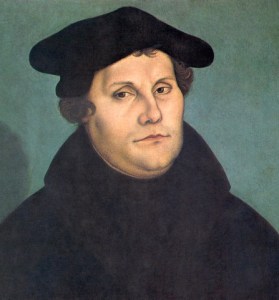
Martin Luther (1483-1546), by Cranach. Zealous champion of the Gospel, but with a horrific personal flaw (credit: Wikipedia)
“To forget the victims means to kill them a second time. So I couldn’t prevent the first death. I surely must be capable of saving them from a second death. “
“Antisemitism”, commonly understood to be the discrimination against the Jewish people, has never, ever been approved doctrine by any orthodox branch of the Christian church. After all, Jesus Himself was Jewish.
However, there have been a number of very terrible instances when antisemitic sentiment found itself promoted by a supposedly “Christianized” culture, and even supported by some practicing and prominent Christians themselves. As we continue this blog series on Christian Zionism, we take a closer look at one of the greatest tragedies in Christian history, stemming back to the famous Protestant reformer, Martin Luther. Continue reading
There is a good chance that you might be hearing quite a bit about Noah’s Ark in the near future…
Today, Answers in Genesis, will be opening a brand new museum, ArkEncounter, in Williamstown, Kentucky. Ken Ham, the visionary behind the project, believes that the story of the Bible teaches that a global flood cataclysm enveloped the earth less than 6,000 years ago. To drive home this interpretation of the Bible, Ham’s team has built a full-sized replica of the original ark, as a type of educational, Christian-themed amusement park.
Contrary to the quaint, Sunday-School description of cute giraffes sticking their heads out of the top of the ark, the primary message behind Noah and the flood is deadly serious. Humanity is sick with sin and rebellion against a holy and loving God, and apart from the Good News of Jesus Christ, we all deserve to perish underneath the waves of His holy judgment. While those who believe the Bible embrace these truths, not every believer interprets the scientific details of the flood in the same, precise manner as presented by ArkEncounter.
For example, ArkEncounter promotes the interpretation that the great mountains of the world, such as Mount Everest, were a great deal shorter just a few thousand years ago, prior to Noah’s flood. Therefore, God would not have needed five miles high of water to envelope the planet. Nor would have the animals required oxygen at such a great height, aboard the ark. This presupposes that once the great flood began to recede, a rapid series of plate tectonic movements resulted in the creation of mountains, like Everest, even though no such event is clearly described in the Bible, and no scientific evidence of such catastrophic tectonic movements has been found. Other Christians, on the other hand, believe that Noah’s flood was more local in scope to the Mesopotamian area, though sufficient enough to wipeout the then known, “world of the ungodly” (2 Peter 2:5). Such a large scale flooding event, though not global, does find support within current scientific research.
Several years ago, John Paine and I put together a bunch of posts examining the flood from a biblical point of view:
Noah, featuring the ministry of Hugh Ross and Reasons to Believe
Noah vs. Noah, more on the flood, and how Hollywood often gets the story wrong.
Also, Old Testament scholar Tremper Longman has a few blog posts, at Biologos.org, looking at the question of what is the ancient and proper literary genre of Genesis 6-9, as the key to understanding Noah and the flood. His answer, briefly? The flood story is “neither literal history nor myth.” It is something far more interesting.
Eric Metaxas, If You Can Keep It, passionately encourages our culture to consider the legacy of American exceptionalism. I like a lot of what Metaxas has to say. But does he take us down the right road theologically?
While your hot dogs are grilling and you wait for the fireworks…
There is much talk about “replacement theology” in the church today, as I am exploring in this summer’s blog series on Christian Zionism, concerning how national Israel relates to the Christian church. However, as the Fourth of July is nearly upon us, I wanted to briefly tackle a more pressing kind of “replacement theology” that dangerously threatens Christianity today. There is a disturbing trend among some Christians, who, in a sense, see the American nation as somehow “replacing” either the church or national Israel, or possibly both, within the plan and providence of God.
In If You Can Keep It, Metaxas’ reviewers note that the author makes a number of historical errors that hamper his otherwise noble thesis. One of the most egregious errors concerns a common misreading of Massachusetts Bay governor John Winthrop’s 1630 sermon, “A Model of Christian Charity.” Metaxas misreads the famous line by Winthrop, that “we shall be as a city on a hill,” to be a reference to the American nation for all time. However, the original context of Winthrop’s sermon is concerning the witness of Winthrop’s particular Christian community, going back to the teaching of Matthew 5:14. In other words, Winthrop is teaching about the church, not about America as a nation.
Think about it: By replacing the church as the “city on a hill” with the American nation, does this not radically change the message of Matthew 5:14?
Furthermore, Metaxas proclaims that Founding Father, John Adams, was a “theologically orthodox Christian.” However, an observant reader in colonial American history will know that Adams rejected a number of core tenets of orthodox Christian faith, such as the deity of Christ, the atoning work of Christ for salvation, and the belief in the Triune nature of God.2 Adams also preferred the Hindu Shastra as the best source for “orthodox” theology.
Think about it: Does remaking the great patriot, John Adams, into an honorary evangelical Christian really help Metaxas’ case? Does not this mishandling of historical data, at the very least, confuse the reader?
So, while I am very sympathetic to Metaxas’ call to virtue and the role of Christian values in public life, his reworking of some details of American history raises this disturbing question: Is Eric Metaxas promoting a kind of “replacement theology,” whereby the American nation replaces either the church or national Israel in the message of the Bible? For starters, read those two book reviews, previously linked above, read Winthrop’s sermon, or even allow Eric Metaxas to make his own case. Examine the evidence, think about it as you enjoy your hotdogs and the fireworks this weekend, and then come to your own conclusion.
Notes:
1. The Masters College is affiliated with the ministry of Southern California pastor and teacher, John MacArthur.↩
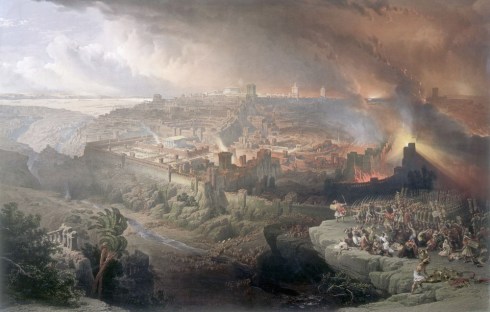
The destruction of Jerusalem by the Romans in 70AD — a painting by David Roberts (1796-1849).
In our first post on Zionism, we briefly defined what Zionism is, and gave a broad sketch of history. Here we dig deeper and look at what happened between the early Christian and Jewish communities after the destruction of the Temple in Jerusalem in 70 A.D.
The early Christian church was primarily Jewish and mainly worshipped in the synagogues. However, Christians mostly did not support Jewish efforts to rebel against the Roman authorities during the conflict leading up to and after 70 A.D., as the Temple was no longer central to the life of the Christians. Instead of fighting alongside their other Jewish brethren to repel the Romans, the Jewish Christians in Jerusalem and the surrounding area fled the city to escape the coming bloodbath, when the Romans began to take seige of the ancient, holy city. This, along with the rejection of many Jewish practices, created resentment by traditional Jews against their Jewish Christian brethren.
The increasingly predominant Gentile Christian movement eventually overwhelmed Judaism in terms of numerical growth, and then Christianity became the official religion of the old Roman empire, further marginalizing Judaism. Over time, Jewish and Christian communities had parted ways from each other. Continue reading
Is the secular nation state of Israel a fulfillment of Bible prophecy? Veracity tackles a “hot potato.”
On May 15, 1948, the modern nation state of Israel was created. Ever since then, students of the Bible have taken a great interest in the Jewish return to the Holy Land. Is this a fulfillment of biblical prophecy?
Many people are interested in events surrounding the End Times. A number of Christians say that the establishment of the Israel in 1948 is proof that God has fulfilled biblical prophecy. Other Christians are not so sure. Some even question the idea that the Scriptures teach about a literal return of Jews to the Holy Land as a modern nation state. How do we sort these difficult and complicated issues out?
Here we begin a multi-part series1 of blog postings that examines the question of the founding of the modern nation of Israel and its relationship to Bible prophecy. We will look at the history of why there was a felt need to create a Jewish state in the modern Middle East. We will address some of the events that led to the creation of this Jewish state and the conflict that resulted. We will then consider the relationship between modern Israel, Judaism, and the Christian community in the Holy Land. After that, we will survey different Christian approaches to Bible prophecy that address the role of modern Israel. Towards the end of the series, I hope to share some of my personal reflections as I have studied this issue in the Bible.
Many Christians have strong views on “Israel,” and this has forced me to dig into both Scripture and history to work this out. As you will see, I mainly offer some food for thought, as I seek to submit to the teaching ministry of the Holy Spirit, that this might become a blessing to others as they struggle in this area. I invite your feedback in the comments section, as we think together through this.









 Veracity