
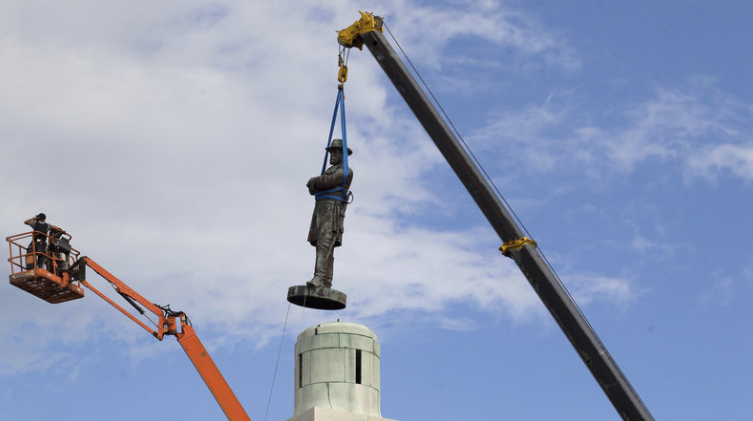
Robert E. Lee statue being removed from a New Orleans monument (credit: Scott Threlkeld/ AP)
Having recently returned from a trip to Charleston, South Carolina, I am all too aware of the tragedy of racism, and its intermingling with the story of Christianity in the American South. But I am left with a question: how are we to remember our history?
Headlines have been popping up this year, with various cities across the South, such as New Orleans, and Charlottesville, Virginia, that have been removing or planning to remove statues of Robert E. Lee, the Confederate army general, and an evangelical Christian. As might be expected, white supremacist groups, who seek to have Lee fit their agenda, are protesting such statue removals. On the other extreme, counter-protestors deface such monuments. Like the Confederate flag, such symbols mean different things to different people, and their meaning can be hijacked out of their historical context, for good, or for ill.
As long time readers of Veracity know, we regret how the Bible has been misinterpreted and misapplied to justify slavery and condone racism. Efforts to correct tragic misunderstandings of the past, by retelling forgotten stories, are essential. However, I am bothered by this recent trend of dismantling historical monuments.
A June essay in the Atlantic magazine, by journalist Adam Serwer, seeks to justify such monument removal. Robert E. Lee, Serwer argues, is not the hero or saintly figure that many defenders of Lee’s heritage seek to admire. In some ways, Serwer is correct, hence, the KKK’s ill-informed effort to make Robert E. Lee into a god. But it would serve Mr. Serwer better to take a closer look at R. David Cox’s The Religious Life of Robert E. Lee, a book on my “to-be-read” list, for hopefully a more in-depth look at Lee’s Christian spirituality, that grew from a type of nominalism; that is, Christian by name only, to a more mature evangelical faith, later in his life.
In a rejoinder essay in The National Review, Dan McLaughlin modestly, yet rightly, observes that Serwer’s efforts to attack Robert E. Lee, are more about the present, than they are the past. Robert E. Lee was far from being perfect, and though I greatly respect Lee’s example of Christian faith, I am also painfully aware of the man’s shortcomings. We should be doing more to balance the story, adding historical context, and listen to forgotten voices. But does this mean we should diminish such characters as Robert E. Lee, even with their flaws?
How quickly we as humans are prone to forget.
I see no need to explore the politics of all of this, except to say that it seems like there is a cultural trend towards trying to erase painful memories of our past.
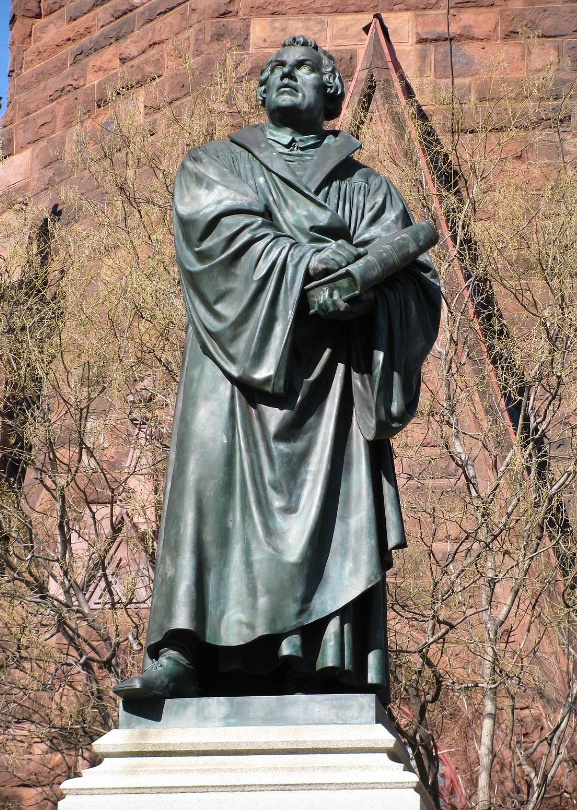
Martin Luther statue, in Washington, D.C. Beloved Protestant Reformer, but promoter of an anti-Jewish tract, later in life. Should his statue be removed next? I hope not. (credit: Wikipedia)
I even wonder what will happen later this fall, when people begin to talk more about the 500th anniversary of when Martin Luther nailed his Ninety-Five Theses, to the church door, that triggered the start of the Protestant Reformation. Surely, some press outlet will release an essay informing of us of Martin Luther’s horrid antisemitic statements he made, late in his life. Luther’s tract, On the Jews and Their Lies, was used by 20th century Nazis as a propaganda tool in their efforts to eliminate Europe’s Jews.
Not only that, but in 1525, Martin Luther infamously urged the German princes to brutally put down a peasants revolt, that left thousands of impoverished people dead. Luther’s ill-guided rhetoric, which he later regretted, helped to fuel the indignant imagination of Karl Marx years later, who described religion as being the opiate of the people, which led to other forces of extremism and violence, closer to our own time.
Could it be possible then, for people to start demanding the dismantling of Martin Luther statues, in response to Luther’s shortcomings? Where does the removal of monuments, that recall the dark side of our history, stop?
May I suggest that the Bible offers some help here.
When reading the Bible, we learn about a whole of host of people whom God used, to help introduce the world to the Messiah, Jesus Christ. In Hebrews 11, many of these names are celebrated in the “Hall of Fame of Faith.” However, all of these figures were tragically flawed. Abraham, the father of Israel, pimped his wife. Moses, who led the people out of Egypt, was a murderer. David, the greatest king in all of Israel, committed brazen adultery, arranged the death of the woman’s husband, and sought to cover up the whole matter.
Yet what strikes me about the Bible is that there is no attempt to cover up the flaws of these wayward sinners. Neither the Jews, nor the Christian church, have sought to revise the Bible, in attempt to remove the unsavory character on display. God saw fit to preserve the memory of those whom he used to achieve His purposes, including those parts that we would probably rather forget.
We live in an age where we desperately want heroes. However, unflawed heroes are hard to find. In our anger, we find it easy to point out the failures of others, particular of those in the past, but we all too conveniently ignore our own failures. The Bible gives a reason why this is the case: We are all sinful human beings, in need of a Savior (Romans 3:23). Jesus Christ, and Christ alone, is the one who can set things right. Sadly, contemporary society has a hard time recognizing the all-too pervasive impact of sin on all of us. So, we are all too willing to shove those uncomfortable things, like our own sin, under the carpet.
So, while there is a trend to remove those aspects of our history that either embarrass us, shame us, or even remind us of our shortcomings, the Bible has a lesson to teach us. Let us remember, as the Bible teaches, not only the good things that God does through human beings, but also those things that remind all of us, how much we all need a Savior, who can heal and redeem us.
For a fascinating, albeit disturbing history behind the Robert E. Lee monument in Charlottesville, you should read Brandon Wolfe’s essay.





 Veracity