Some say that this week’s solar eclipse might have been a “sign” from God, as prophesied in Joel 2:31. Get the real story about the Book of Joel from the folks at the Bible Project, with another installment of visual illustrations, for better understanding of the Minor Prophets.
Why the September 23, 2017 “Prophecy” of the “Revelation 12 Sign” is Totally Bogus

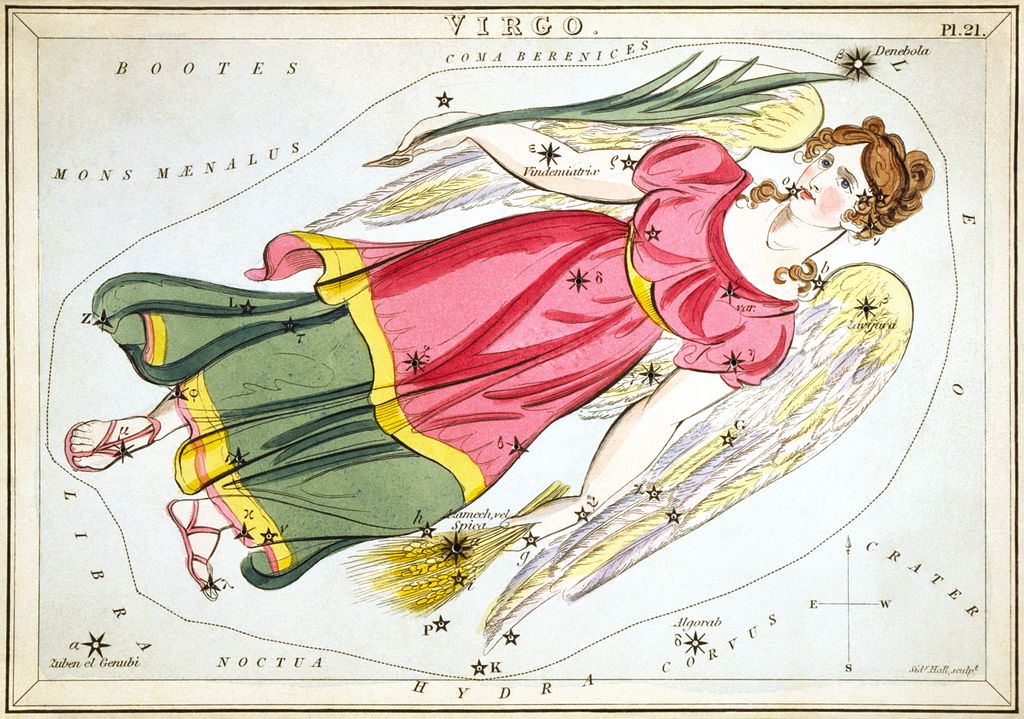
The constellation Virgo. Foreboding a fulfillment of the Book of Revelation, of the “woman clothed with the sun?” I think not.
Some folks have a bit too much time on their hands.
We had the whole four blood moons tetrad thing, a few years ago. Then we had the “mystery of the Shemitah.” Now, coming September 23, 2017, we have the fulfillment of the “Revelation 12 Sign.” Falling close to the heals of today’s, August 21, solar eclipse, across the U.S., some even see this as signaling “the Rapture” of the church.
This latest “End Times” fad has an informative writeup now on Wikipedia. Basically, the constellations Virgo and Leo, along with the sun, moon, and a bunch of planets, are going to be in alignment, and this is supposed to fulfill a kind of prophecy in Revelation 12:1-2:
- “And a great sign appeared in heaven: a woman clothed with the sun, with the moon under her feet, and on her head a crown of twelve stars. She was pregnant and was crying out in birth pains and the agony of giving birth.“(Revelation 12:1-2 ESV)
I want to get out ahead of this thing a bit and make my own prediction: NOTHING IS GOING TO HAPPEN.
Or to put it more accurately, if something prophetic is going to happen, (and it always could, as Jesus told us that the Son of Man does not even know the time), it will have nothing to do with astronomical phenomena viewed through some sketchy interpretations of the Bible. As with the four blood moons tetrad and the “mystery of the Shemitah,” prophecy predictions like this have a 100% failure rate.
This should be pretty obvious, but in our era of “fake news,” it seems like almost anything is believable. If you think I am just an unbelieving naysayer, do not take my word for it. Look into some detailed rebuttals to the whole “Revelation 12 Sign” business and get the scoop:
- Answers in Genesis Danny Faulkner. His approach to Young Earth Creationism is controversial, but he is no doubt on target with this one.
- Premillennial Bible teacher, Joel Richardson, talks a lot about an Islamic Antichrist threatening Israel, making some people scratch their heads, but his message on the “Revelation 12 Sign” is quite sober.
- My favorite here would be Logos Software’s Michael S. Heiser, host of the Naked Bible Podcast. He just tells it like it is, and tells it very briefly.
As folks today (August 21, 2017) step outside to try to catch a glimpse of the Great American Eclipse, some might want to tie this eclipse together with the September 23, “Revelation 12” sign, as predicting some type of prophetic event, warning of God’s judgment. The Bible has plenty of warnings of God’s judgment, encouraging folks to get right with God. My advice is that believers should turn those speculative conversations around, and simply take in and celebrate the wonder of God’s creative majesty on display today.
I do not plan on braving the traffic down in South Carolina today, but if anyone is planning to go to view the eclipse, in its totality, save some photos and upload them to the blog, will ya??
P.S. : Old Testament scholar Claude Mariottini has nice blog entry today examining solar eclipses in the Old Testament.
The Book of Haggai: In Five Minutes
The Book of Haggai is a short-read, only two chapters. The folks at the Bible Project, give us another installment of visual illustrations, to help us understand this particular book from the Minor Prophets.
Are Eclipses Signs from God?
Some are calling it the “Great American Eclipse,” when the moon covers the disc of the sun, racing across from Oregon to South Carolina, on Monday, August 21, 2017. The last time this happened in the U.S. was 1918. But is God trying to tell us something with this event?
Some Christians might think so, but is such a belief warranted? The Bible does report some unusual astronomical phenomena, such as the darkness that covered the earth, on the afternoon of the Crucifixion.
- It was now about the sixth hour, and there was darkness over the whole land until the ninth hour, while the sun’s light failed. And the curtain of the temple was torn in two”(Luke 23:44-45 ESV)
Interestingly, one popular Bible translation tries to tell us how this happened:
- “It was now about noon and darkness came over the whole land until three in the afternoon because of an eclipse of the sun….“(Luke 23:44-45a NAB)
A solar eclipse? While the translators of the New American Bible might be good Bible scholars, they need a refresher in astronomy. Let me explain why.
First, the movement of the moon’s shadow across the face of the earth, across a single point, travels much faster than three hours. The moon’s shadow will book across the United States, at the speed of at least 1000 mph. For example, in Columbia, SC, in the path of Monday’s total eclipse, the duration of the totality will be 2 minutes, 30 seconds.
Secondly, the timing of the lunar calendar is completely off, to support the idea of a solar eclipse. The Crucifixion happened near the time of the Jewish Passover, which happens during a full moon, midway through the Jewish month of Nissan. Total solar eclipses only occur during a new moon, when the moon’s surface facing the earth, is completely within the sun’s shadow, which is at the opposite time of the month from a full moon.
The math simply does not work. Whatever darkness happened on Good Friday, trying to tie it strictly to a natural event of a solar eclipse is pure folly. Sure, God can use these things, for His purposes, and He can produce supernatural events. But whether it be solar or lunar eclipses, or planetary alignments, caution is in order before drawing too much from naturally occurring, astronomical events.
Astrology and the Bible Do Not Mix
In the history of the church, some Christians have read too much from the “signs in the heavens.” I remember watching the movie Elizabeth: The Golden Age, just shaking my head. Queen Elizabeth, the monarch who set the theological course for the Church of England, for at least the next 400 years, consulted her astrologer, John Dee, about how her navy would fair against the Spanish Armada.
Or there is the influential colleague of Martin Luther, the German Reformer, Philip Melanchthon, who consulted astrological horoscopes, to help him decide on when to take long journeys. Even Huldrych Zwingli, the early Swiss Reformer of Zurich, dabbled in believing in various “signs and portents” in the heavens.
However, it would be anachronistic to judge Christians from earlier generations, who appropriated ideas from astrology, before the age of modern astronomy. But when some Christian leaders today, speculate on whether or not the “Great American Eclipse” is a sign of God’s impending judgment against America, it is cringe-worthy. To her credit, daughter of evangelist Billy Graham, Anne Graham Lotz, is being pretty vague, but it bothered me that she uses the prophet Joel to encourage people to look for heavenly “signs”:
- “The sun shall be turned to darkness, and the moon to blood, before the great and awesome day of the Lord comes.“(Joel 2:31 ESV)
Lotz neglects to tell the rest of the story. While the Bible does employ cosmologically rich language to refer to God’s judgment, the Bible also warns us not to look to the heavens for prophetic signposts. For the prophet Isaiah, astrology is condemned, lumping it along with all forms of occultism and sorcery:
- “12 Keep on, then, with your magic spells
and with your many sorceries,
which you have labored at since childhood.
Perhaps you will succeed,
perhaps you will cause terror.
13 All the counsel you have received has only worn you out!
Let your astrologers come forward,
those stargazers who make predictions month by month,
let them save you from what is coming upon you.
14 Surely they are like stubble;
the fire will burn them up.
They cannot even save themselves
from the power of the flame.“(Isaiah 47:12-14a)
So, for those planning on braving the traffic, to places like South Carolina, next Monday, enjoy the eclipse for what it is, a really cool display of God’s wonder and creation. It demonstrates the reliability, predictability and beauty of nature, which only a God of order and elegance can create. What a great opportunity to talk with friends about how awesome God is, as Creator!
But as for applying prophetic significance to the eclipse, as a reason why you might want to pull your money out of the stock market, to avoid financial ruin,… well, leave that to the astrologers.
Christians have other, better things to do.
Remembering Robert E. Lee, A Plodding Journey Towards Christ
The events during the “Alt-Right” rally of August, 2017, in nearby Charlottesville, are nothing but horrific and tragic. White supremacy reared its ugly head, and it surely needs to be condemned by anyone who claims to follow Jesus.
But what are we to make of the memory of Robert E. Lee, the chief, military figurehead of the Confederacy? The monument in Baltimore that was taken down last night, ascribed Lee to be a “Christian.” So, the controversy over how we should best remember the Confederacy, with their monuments, like that of Lee, is crucial, as I have written before, and it matters to people of faith.
R. David Cox, is a professor of history at Southern Virginia University, and he has written a quite helpful (and timely) book, The Religious Life of Robert E. Lee. Cox researched a treasure trove of Lee’s letters, to construct a narrative as to how Lee understood his Christian faith. A couple of examples reveal a lot of Lee’s complex relationship with God.
A Brief Overview of Robert E. Lee’s Spiritual Journey
Robert E. Lee’s father, Henry Lee, suffered a severe injury, dying when Robert was only 11 years old. Henry Lee had been a decorated officer in George Washington’s Continental Army, during the American Revolution, and was otherwise known as “Light-Horse Harry” Lee. Henry (Harry) Lee was a child of the Enlightenment. He embraced a form of Unitarianism, as his faith.
Robert’s mother, Ann Lee, had grown up in Charles City County, Virginia, at Shirley Plantation. Unlike Robert’s father, Ann had become a devout Episcopalian, a Christian with a vibrant evangelical faith. Her husband had branded Ann as an “enthusiast.”
Young Robert E. Lee, though raised in the Episcopal Church, sought to distance himself from the theological and spiritual tension in his home. Like many Southern aristocrats of his generation, Robert mainly sought prestige and honor, and when he grew up, he served in the U.S. Army. In his mid-20’s he fell in love with Mary Custis, also from the Virginia aristocracy stock. But during their courtship, Mary experienced her own evangelical awakening. It seemed as though Robert E. Lee was unable to avoid the influence of evangelical faith in his life.
Mary Custis soon had her doubts about Robert, wondering if her prospective husband was ever really a Christian. Yet Robert persisted, and the two were eventually married.
Robert remained very quiet about his relationship with God, at least in the early years of marriage and family life. His conversion to Christ was evidently slow and prodding. He was not even confirmed as a member of the Episcopal Church until he was age 46. This was anything but a dramatic, instantaneous conversion. Like any Christian, conscious of their sin, Lee’s sanctification was incomplete.
So, it does not surprise me that there were elements in Lee’s character, that were not entirely transformed by the Holy Spirit, later in life. As the writers of the The Atlantic magazine have reported, as late as 1859, Lee had overseen the whipping of several runaway slaves, who were caught and returned to Lee in Arlington.
By the eve of the Civil War, Robert E. Lee’s theological outlook was one that struck some midway point between his father’s Unitarianism and his mother’s and wife’s evangelical faith. Lee emphasized the providence of God, primarily in a general sense, in his ambivalence towards slavery. On one hand, he viewed slavery as a moral evil. On the other hand, he believed that God, in His providential care, would eventually resolve the problem.
Likewise, when Lee was offered the command of the forces of the Union army, to put down the Southern rebellion, he stated that he would gladly liberate “the enslaved,” in order to have peace. On the other hand, he could not bring himself to strike a sword against his native Virginia. So, he declined the offer to lead the Northern army, and took a commission with Confederate forces.
It appears that it was his experience in the Civil War that eventually crystalized his vision of Christian faith, bringing him front and center before his Creator and Redeemer. When it became evident that the South had lost the war, Robert E. Lee saw this, once again, as the hand of providence. But this time, God’s providence was not simply general in nature. It was also personal, as he saw this judgment as being against himself, too. To a captured Union officer, whom Lee had known before the war, Lee said, “Patrick, the only question on which we ever differed, has been settled, and the Lord had decided against me” (p. 198).
From a letter written to the rector of a church in Petersburg, where Lee worshipped during the last months of the war:
- “God has thought fit to afflict us most deeply and his chastening hand is not yet stayed… How great must be our sins and how unrelenting our obduracy… We have only to submit to his gracious will and pray for his healing mercy… Now that the South is willing to have peace, I hope it may be accorded on a permanent basis; that the afflictions and interests of the country may be united and not a forced and hollow truce formed, to be broken at the first convenient opportunity. To this end all good men should labour.” (p. 198).
Lee’s conduct after the war, for me, exemplifies him more as a Christian leader, than anything else in his life. He could have run for public office, written memoirs to establish his name, or anything else that might have secured his reputation as the greatest military leader of the Confederacy.
Instead, Lee took the opportunity to try to revitalize the run-down Washington College, in Lexington, Virginia. There, Lee would spend the remaining years of his life, educating young men in what it meant to be “Southern gentlemen,” encouraging them not to revel in a “lost cause.” Rather, he sought to establish a school whereby the next generation would promote healing and reconciliation. It is still difficult to consider Lee’s ambivalent beliefs about slavery, but certainly, as military defeat became inevitable, Lee gained moral clarity that he did not have before.
In the days before Lee’s surrender at Appomattox, he had encouraged his soldiers:
- “The Confederacy has failed… As Christian men, … we must consider only the effect which our actions will have upon the country at large.… there is time to plant crops and begin to repair the ravages of war. That is what I must now try to bring about.”
In my mind, this is the description of a man, who understood his sin, and sought to commend himself to the mercy of God, pursuing a path of peace and reconciliation.
Making Sense of What Happened in Charlottesville
What makes this all the more poignant about the 2017 Charlottesville protests, is that this is not the portrait of Robert E. Lee that the “alt-right” demonstrators were trying to display. As I understand it, James Alex Fields, the young 20-year old man, who drove his car into a crowd, killing one person, and injuring others, grew up in a father-less home. His disabled mother sought to raise her son, despite the anti-social struggles this young person had in making something of his life. Through his anger, he wrapped himself up in extreme white identity politics.
What a contrast this is with the vision of Robert E. Lee, after the war! Lee sought to take young men like this, model for them what it would be like, to live as a Christian, to try to work towards peace and reconciliation. It is recalled that Robert E. Lee, at what is now Washington and Lee University, abolished the mandatory requirement to attend Chapel services at the school. However, Chapel services still went on, and students still attended those services on a regular basis, knowing that Robert E. Lee would be there, too.
I can understand why so many people now want to see statues of Robert E. Lee removed from so many public places. The hurt caused by the continued legacy of racism runs very, very deep. We need to tell the stories of those who suffered under the Southern regime of racial slavery, a regime that often invoked the Bible as a type of defense, for this sin. At the same time, I hope for a way to rehabilitate the memory of Robert E. Lee, that promotes healing, instead of firing up anger.
Perhaps, instead of having statues of Lee, with his sword, in full military regalia, mounted on his horse, Traveler, we should have something different. Perhaps, our monuments of Lee should show him as a civilian educator, with young men, encouraging them to follow the path of Jesus.
Erasing the memory of Lee may seem like a solution, but sadly it will not lead to society’s healing. Instead, we will do far better by recalling a morally chastened Lee, who called his fellow Southerners to mournful and heartfelt repentance.
The following lecture by R. David Cox was recorded at the Virginia Historical Society, June, 2017.