Category Archives: Witnesses

Agreeing to Disagree

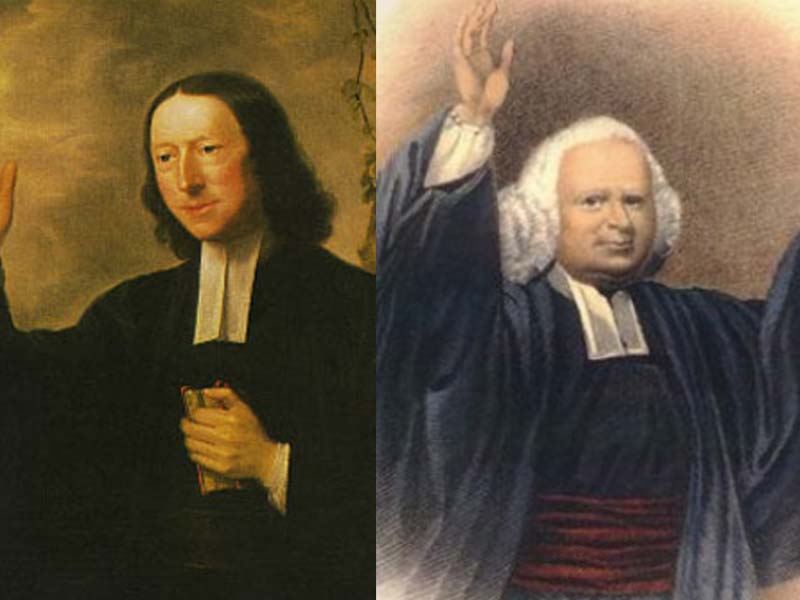
John Wesley (1703-1791) and George Whitefield (1714-1770) were the most well-known Christian leaders in the English-speaking world of the 18th century. Yet they struggled with each other regarding some significant points of Christian doctrine.

John Wesley (1703-1791) and George Whitefield (1714-1770) were the most well-known Christian leaders in the English-speaking world of the 18th century. They struggled with each other regarding some significant points of Christian doctrine, and through their dialogue they introduced the notion of “agreeing to disagree” into Christian discourse.

Sometimes “agreeing to disagree” with fellow believers can be difficult. I know. I have been there. But first, let me give you some historical background…

In 18th century England and America, two of the most celebrated figures were George Whitefield and John Wesley. Whitefield and Wesley would travel up and down the American Eastern seaboard and across the British Isles preaching in the open air. The first “Great Awakening” can largely be attributed to how God used these two men to lead many thousands into a relationship with Jesus Christ, perhaps one of the greatest spiritual revivals in the history of the church.

But Whitefield and Wesley had some rough spots in their relationship with one another. In one important matter, they differed in terms of some significant Christian doctrine. George Whitefield, a Calvinist theologically, believed that when Jesus Christ died on the cross, He died only for the elect who would come to know Christ. If you were not among the predestined elect, Whitefield concluded that the Bible taught that Jesus had not died for you. John Wesley, an Arminian theologically, vehemently rejected this teaching. For Wesley, Jesus Christ died for all of humanity, whether someone received Christ or not. Though these men clearly differed on the extent of Christ’s atoning work on the cross and how that related to predestination, they were united in many more things in terms of doctrine than over that which they were divided.

The prolonged controversy between Whitefield and Wesley was at times very tense. Though I do not recall the reference, my understanding is that John Wesley was the more quarrelsome of the two men. But it is to John Wesley’s credit that eventually when he was asked to deliver a memorial sermon when George Whitefield died, he was extremely charitable to his evangelistic counterpart. In that sermon, Wesley uttered a most memorable phrase:

“There are many doctrines of a less essential nature … In these we may think and let think; we may ‘agree to disagree.’ But, meantime, let us hold fast the essentials…”

Since that remarkable sermon, Christians over the years have recalled Wesley’s words that he at times exchanged with his colleague Whitefield about “agreeing to disagree.” Though these men still had their points of conflict, in the end, they were able to consider each other not as enemies but rather as friends, as brothers in Christ, despite their disputes over some points of doctrine.

It is a lesson that the evangelical church today still needs to hear.
Continue reading

A Layman’s Faith

Religio-Laici

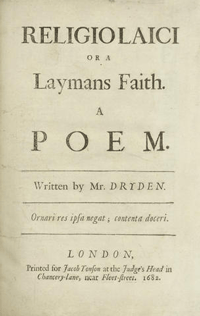
Religio Laici, or A Layman’s Faith. John Dryden’s radical 1682 poem comprises a warrant for personal discipleship.

“For every man is building a several way; impotently conceited of his own model, and his own materials: reason is always striving, and always at a loss; and of necessity it must so come to pass, while it is exercised about that which is not its proper object. Let us be content at last, to know God, by his own methods; at least, so much of him, as he is pleased to reveal to us in the sacred Scriptures; to apprehend them to be the word of God, is all our reason has to do; for all beyond it is the work of faith, which is the seal of heaven impressed upon our human understanding.

“Yet to such as are grounded in the true belief, those explanatory Creeds, the Nicene and this of Athanasius, might perhaps be spared: for what is supernatural will always be a mystery in spite of exposition: and for my own part the plain Apostles Creed, is most suitable to my weak understanding; as the simplest diet is the most easy of digestion.

“But, by asserting the Scripture to be the canon of our faith, I have unavoidably created to myself two sorts of enemies: the papists indeed, more directly, because they have kept the Scripture from us, what they could; and have reserved to themselves a right of interpreting what they have delivered under the pretence of infallibility: and the fanatics more collaterally, because they have assumed what amounts to an infallibility in the private spirit: and have distorted those texts of Scripture, which are not necessary to salvation, to the damnable uses of sedition, disturbance, and destruction of the civil government.

“The florid, elevated, and figurative way is for the passions; for love and hatred, fear and anger, are begotten in the soul by showing their objects out of their true proportion; either greater than the life, or less; but instruction is to be given by showing them what they naturally are. A man is to be cheated into passion, but to be reasoned into Truth.”
John Dryden, Preface to Religio Laici, 1682

(Ed: One of our regular readers complained recently about the length of a typical Veracity post. His complaint was that they are too short. Well…far be it from us to ignore our readers.)
Continue reading


Persecution: Christians in Iraq

The Arabic letter "n" signifying the word "Nasarani."  The sign is being painted on Iraqi homes to mark out where the Christians live.

The Arabic letter “n” signifying the word “Nasrani ” from Surah 5:82 in the Koran, a word for a “Christian” or “Nazarene.”  The sign is being painted on Iraqi homes to mark out where the Christians live.

Let us face it: We simply do not know how good we have it in the United States when it comes to religious freedom. Just ask the Christians fleeing from Northern Iraq.

My wife and I recently attended a family gathering where several people there affirmed having a Christian faith. We enjoyed a good time together, catching up with one another, having a lot of fun, but much of the experience seemed like such a stark contrast with what is going on in the rest of the world. We never once as a family took the time to thank God for all of the blessings that we have when compared to the suffering of believers across the globe, as with Christian families in Iraq.

In our celebrations, we missed a crucial opportunity to stand in solidarity with those who suffer for their faith. Continue reading


A Gideon Exposé

Room 19, Central House Hotel  in Boscobel, Wisconsin. Kept in the style it was in September 1898 when the first Gideon founders, Nicholson and Hill, met here. From the scramped quarters one evening came a ministry that has impacted millions of people around the world for Christ.

Room 19, Central House Hotel in Boscobel, Wisconsin. Kept in the style it was in September 1898 when the first Gideon founders, Nicholson and Hill, met here. From the cramped quarters one evening came a ministry that has impacted millions of people around the world for Christ.

1898. Boscobel, Wisconsin. Two businessmen, John H. Nicholson and Samuel E. Hill, arrived in town looking for a place to spend the night. However, the Central Hotel was so crowded that there was only one room left available. Nicholson and Hill, who had never met one another before, agreed to share that room with a double bed for the night. These men soon discovered that they were Christians. They prayed and read the Bible together. As these men were on their knees, they soon realized an idea that would eventually become the Bible distribution ministry of the Gideons.

If you stay at nearly any hotel these days, pull open the bedside drawer and chances are that you will find a Bible placed there by the Gideons. Over a hundred years after Nicholson and Hill met that evening together, first as strangers, then as brothers in Christ, the Gideons International has placed over 1.9 billion Bibles all over the world, in multiple languages, at an average rate of two copies of the Bible per second. The Gideons record countless stories of changed lives through people picking up a Gideon distributed Bible. Astrophysicist Hugh Ross had grown up in a completely secularized environment until he took the time to read a copy of the Bible given to him by the Gideons in his school, which eventually led him to place his faith in Christ. I myself remember getting my own green copy of the New Testament as a freshman in college.

But have you ever seen a sticker placed by an atheist on a Gideon Bible?
Continue reading


Martin and the Origin of “the Chapel”

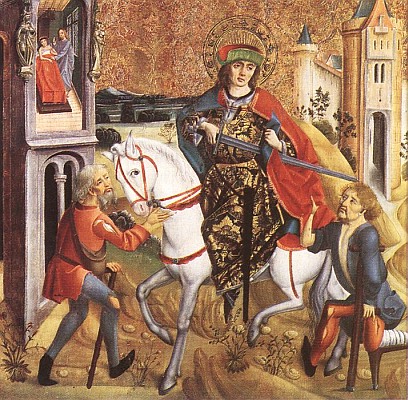
Martin of Tours cutting his cloak in half to give to a poor man. Herein lies the story of the term "the Chapel."

Martin of Tours cutting his cloak in half to give to a poor man. Herein lies the story of the term “the Chapel.”

In the 4th. century A.D., a young solider in the Roman army named Martin encountered a beggar one day in northern France. The beggar’s clothes were terribly worn. Martin was moved with compassion and cut his military cloak in half and gave it to the poor man.

Later that evening, Martin had an incredibly profound dream. According to one account, Martin experienced a vision, seeing Jesus Christ standing before him wearing his half cloak. Harkening back to Matthew 25:31-46, Martin is commended for giving Jesus part of the soldier’s cloak to wear. In response to this vision, Martin presented himself as a candidate for Christian baptism.

Martin had grown up in northern Italy, where Christianity had yet only a small influence in the wake of Emperor Constantine’s only recent acceptance of Christianity as a legal faith within his realm. Nevertheless, at age ten, he attended a local church against the wishes of his parents.

After being baptized as a Christian and serving for several years in military service, Martin laid down his sword and dedicated himself to missionary work and the monastic life. He made his way to the French city of Tours, where the people were so impressed with his devotion to Christ and his character that they tricked him into becoming the bishop of Tours. Martin had been urged to visit a sick person, only to arrive at the home greeted by a crowd demanding that he become their leader. The stunned Martin was not seeking this position, so he fled and hid himself in a barn full of geese. When the crowd found him, he was duly anointed as bishop as he smelled of geese manure.

Martin of Tours went on to become a great evangelist for the Christian faith, challenging the local pagan shrines with the confidence of an Elijah and opposing false teaching within the church, exemplified mostly in his time by the popularity of Arianism, a movement started years earlier by the heretic Arius who denied the full divinity of Jesus as the Son of God coequal with the Father, not too much unlike what modern day Jehovah’s Witnesses believe.

Nevertheless, Martin opposed the popular practice in his day of condemning heretics to death, preferring instead to use the art of persuasion to bring them to repentance. Magistrates dreaded seeing Martin, as they knew that the popular bishop would come and visit them, entreating them to release their religious prisoners. The magistrates felt so bad about possibility disappointing this godly man that they had to let their captives go.

After his death, Martin has been most remembered for the story of the cloak. The other half of the cloak he had kept became a medieval relic that was passed down from generation to generation, eventually in bits and pieces. This half cloak was considered to be a small cape, which was then kept in a small building called a cappella, in Latin. The priest who was in charge of the small cape relic was called a cappellanu. Later, as Saint Martin of Tours was declared to be the patron saint of the military, a cappellani was any priest who served in the military, which is the French root of the English word chaplain.

Parts of Martin’s cape were distributed in cappellas all throughout Europe. Over time, small churches like these were eventually called chapels, though the association with Martin’s cloak was eventually lost, particularly as Protestants began to reject the practice of venerating relics. Nevertheless, “the chapel” terminology has continued to be used, long after the remains of Martin’s cape decayed away.

The next time you go to “the chapel,” you might remember Martin and his famous cloak, part of which he gave to that poor beggar.