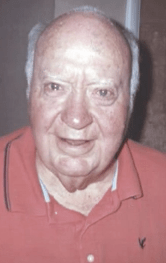
Melvin G. Rosche. February 27, 1921 to March 16, 2015. Photo: Brigette Weis
Several weeks ago, I lost my mother to cancer. One of the first people I talked to after my mother died was my former Young Life leader, Mel Rosche. At 94 years of age, Mel took my hand and prayed with me and cried with me. Mel Rosche was one of the most remarkable people I have ever known.
A farm boy growing up in rural Illinois, Mel Rosche went off to serve as a pilot in the Army Air Force during World War II. On a bombing mission out of Italy in December, 1944, Mel’s plane was shot down over Hungary. I remember as a high school kid sitting at Mel’s feet, enraptured as he told us about being picked up by some Hungarians out of a corn field in his parachute, when he pulled out a Sunday School picture of Jesus from his wallet, whereupon his captors realized that Mel was a Christian. Several months later, while on a train bound towards a German camp for prisoners of war, the train stopped so that the prisoners could see Werhner von Braun’s V-2 rockets being fired off, presumably against the British. Little did Mel know at that time that he would have the opportunity to work near von Braun at NASA in the 1960s in the development of the United States space program. Mel’s prisoner of war camp was eventually liberated by the Soviet army.
Mel came back to the States after the war to marry Ruth, his high school sweetheart. Mel and Ruth moved to Virginia with his degree in aeronautical engineering and served in NACA, which eventually became NASA, and raised two children along the way. Mel’s career was fascinating as he helped to lead a team of structural engineers in designing and testing spacecraft that could carry people back and forth to the moon. One of his most famous colleagues for a brief period was the indefatigable visionary Buckminster Fuller.
While living in northern Virginia, the Rosches met Scott Dimock, an area director for Young Life, a ministry whose mission is dedicated to reaching disinterested high school kids with the Good News of Jesus Christ. When Mel and Ruth moved to Williamsburg, near where Mel was working at NASA Langley Research Center, they met up with a former Young Life student, Bill Clark, then a young man attending the College of William and Mary in 1972. Following Clark’s leadership, they started the ministry of Young Life in the Williamsburg, Virginia area (currently led some 43 years later by area director Nathan Havasy).
When Bill Clark graduated from William and Mary in 1974, Mel had a bit of a crisis. What would become of the Young Life outreach to teenagers that they had started? Well, just as Martin Luther King Jr. had his “kitchen table” experience which led to his commitment to the civil rights movement, Mel Rosche had a “kitchen table” experience of his own. Mel’s experience might not have been as dramatic as King’s, but it still impacted a whole generation of people. As Mel sat and prayed, he got a clear sense that God had called him to be a missionary to teenagers. God gave Mel a love for high school kids.
Over the next few years, Mel took early retirement from government service so that he and Ruth could dedicate their lives to loving teenagers for Jesus Christ. Mel would invite kids to come over and play pool in the Rosche’s basement, and he would teach dozens of young people how to water ski off of his boat. Countless young people were impacted by this man and his determination to answer the call of God in his life.
By 1979, I had received dozens of invitations to attend a Young Life meeting in high school. I never showed any interest. But then one day, a friend of mine told me that there were good-looking girls at the Young Life club. So I went. Sure, there were some good-looking girls there. But I was really intrigued by this “old” guy with white hair. Here was this retired NASA engineer standing in front of a group of rowdy teenagers, trying to lead the group in singing some song terribly off-key.
Mel could not hit a note even if it was painted on the side of a barn. What was it that would possess this man to hang out with a bunch of rascally teenagers?
I kept coming to Young Life meetings, and I listened as Mel shared stories of Jesus from the Bible. Even though I had grown up in a church, I was filled with a lot of doubts and questions about the Christian faith. But within a few months, I continue to listen and learn, and I was drawn in.
I even got up on water skis myself.
Later when I was in college, I would come back to ask Mel more questions. I was going through a crisis of faith. Caught up in the academic rigor of a secular university, a number of well-intentioned Christian friends of mine had told me that I basically had to choose between the Bible and science, between following after Jesus and pursuing the life of the mind. One of the issues at stake was the Creation vs. Evolution controversy. After I poured out my anguish with Mel, I listened to his story of when he was about my age. Growing up in the post-Scopes Monkey Trial era in the 1930s, the question of evolution dominated Mel’s mind. As Mel put it, “I got so tired of thinking about it, I asked God, my junior year [in high school] to free me from it. He did and still has. When I saw that He had answered my prayer, I asked Jesus Christ to be my Savior.”
Mel’s answer impressed me so much. It was not theologically sophisticated, but it was genuine, honest and simple. For Mel, there was no conflict between accepting the findings of modern science and accepting the Biblical testimony about the Risen Jesus. Mel was determined not to let anything stand in the way between him and his love for God.
Mel eventually left Young Life staff in the mid-1980’s, training my dear friend, Charly Franks, to take over the leadership of the local ministry. But when Charly left Williamsburg, Mel stayed on Young Life committee and mentored me when I was the local ministry staff.
Soon, Mel’s life changed dramatically when he began to have difficulties standing. Not too long after that, his partner for many, many years, Ruth, died, and Mel suffered more health difficulties. Mel had been beat up pretty bad by all of these trials in his life.
But this did not stop Mel. His passion for young people found a new expression through the ministry of Heart for Orphans, an outreach in Ukraine with a mission to provide small, family-style transition homes to teens who have graduated from orphanages.
As Mel entered the last decade of his life, he was beset with continued health problems. But Mel’s attitude was incredibly inspiring. He would always say that he “never felt better.” He was a blessing and shared this blessing with everyone around him. At the retirement community where he lived, to date he is the only person to have been sent into “skilled nursing” care, only to return back to assisted living… not simply once, but twice!
That is why I can say that the best word to describe Mel is tenacity. Once Mel got a grip on something, he could never let go, whether it was a joyful passion for teenagers, his love for his children and grandchildren, or even his health. After every setback, he would always bounce back. But most importantly, Mel had an incredibly tenacious grip on the grace of God.
Whether or not I ever live to be 94 years old, I want to be just like Mel Rosche.






 Veracity