Category Archives: Topics

Verbicide

I might step on some toes here.

I am just as guilty here as the next person, but in C.S. Lewis’ masterful work, Studies in Words, p.7-8, the great Oxford don nails it:

“Verbicide, the murder of a word, happens in many ways. Inflation is one of the commonest; those who taught us to say awfully for ‘very,’ tremendous for ‘great,’ sadism for ‘cruelty,’ and unthinkable for ‘undesirable’ were verbicides. Another way is verbiage, by which I here mean the use of a word as a promise to pay which is never going to be kept. The use of significant as if it were an absolute, and with no intention of ever telling us what the thing is significant of, is an example. So is diametrically when it is used merely to put opposite into the superlative. Men often commit verbicide because they want to snatch a word as a party banner, to appropriate its ‘selling quality.’ Verbicide was committed when we exchanged Whig and Tory for Liberal and Conservative. But the greatest cause of verbicide is the fact that most people are obviously far more anxious to express their approval and disapproval of things than to describe them. Hence the tendency of words to become less descriptive and more evaluative. . . . and to end up by being purely evaluative– useless synonyms for good or for bad.”

I see this type of verbicide happening all of the time among Christians, including myself. I will use a word like awesome, simply to say that I like something, which is hardly what awesome meant some thirty years ago, in normal speech. To create a sense of awe, or reverence, about something or someone, is what awesome has typically meant for years. Nowadays, awesome has become almost a throw-away word, used to describe how good that hamburger tasted, that you just ate for lunch.

But among fellow Christians, the problem seems like an epidemic. Some believers insist on the literal interpretation of Scripture, when it is clear that literal merely has an inflationary characteristic, that Lewis identifies back in 1960, when he wrote Studies in Words. It is found in the common colloquialism of “it is literally raining cats and dogs out there!” Surely, no one believes that your neighbor’s siamese cat and yellow labrador just landed on your front lawn. No, it simply means that it is raining really, really, really hard.

Verbicide. We have killed the word literally.

We have turned the word literally into something not literal at all. Or to recall the previous blog post, whereby we discovery that metaphors can become so stable, that they can actually become new words. Just think of the word concrete, which in construction lingo, refers to a mixture of cement and sand, and other materials. But it could also have a metaphorical meaning, abstracted away from its construction context, to mean something that is firm or stable itself….. You know, something concrete.

Then there is that old discussion about inerrancy. For some, inerrancy is an affirmation that Scripture is the Christian’s authority. Why would you submit to something as your authority, if you lack the confidence that it is without error? A humble posture of obedience to the teachings of Scripture is predicated on the assumption that you accept the Bible to be true. This is the reason why inerrancy, which affirms the truthfulness of Scripture, is so important.

However, often inerrancy gets spun around to say, “My interpretation of the Bible is inerrant, and your interpretation is not!” So, two Christians can both hold to the inerrancy of the Bible, but if one Christian does not agree with an interpretation of a particular passage, that another Christian holds to, in good conscience, sometimes they might pull out the charge that the other Christian is denying the inerrancy of the Bible.

Yet what they really are doing is arguing for the inerrancy of their own, particular interpretation of a Bible passage. When thought poorly, in this manner, biblical “inerrancy” has less to do with describing and affirming the authority of Scripture, and more to do with evaluating the acceptability or non-acceptability of someone’s interpretation of the Scriptures. Not all interpretations of the Bible are created equal, but when we do stuff like this with words, then the word inerrancy becomes almost useless.

Note, however, I am not saying that inerrancy is not a useful word. I still firmly believe that it is. You can have a correct interpretation of a particular Bible passage, but still refuse to submit to it, if you fail to trust the Bible as God’s True Word. Affirming the inerrancy of Scripture is the first step, but not the last step. We still need to learn how to interpret Scripture correctly. Hopefully, this makes sense and is clear.

So, what I am saying is that when a word like inerrancy gets transformed from Lewis’ descriptive sense; that is, describing the authority and trustworthiness of Scripture, as in the classic usage, to Lewis’ more evaluative sense; that is, “your interpretation of the Bible is bad; therefore, you must be denying the inerrancy of the Bible,” then we have pretty much committed verbicide, thus rendering inerrancy as being an ineffective word.

And that is not good. It is not helpful. But that is what we do.

People of the Word can do some crazy things with words.

If you poke around on social media, whether it be following Twitter, reading Facebook posts, or in the worst possible case, that absolute scourge of the online era, reading YouTube video comments…. I find it to be a terribly depressing display of how Christians can commit verbicide, without much reflective thought. Why some people, even followers of Christ, would resort to such incoherent and even vitriolic language you find online, that they would never-ever-ever use in face-to-face to conversation, is simply appalling. But as the era of using social media has now pretty much become the norm, I am now starting to hear to such abusive talk, by the murder of words, ranging from comments given at a Bible study, to everyday face-to-face conversation with another believer…. And much of this we pick up from the world around us, particularly from our social media habits.

If I were the Pope, and we still had one organized church body, I would instigate a ban on all Christians writing on Twitter, Facebook, or YouTube video comments, or at least impose a 24-hour cooling off period, before a Christian types out a response to something they have seen or read online, with threats of immediate excommunication, in order to stop the madness.

If I was smart enough, I would just stop right here….. But please indulge me a few more paragraphs to gripe a bit more about the problem with verbicide….. Otherwise, you can stop now, and enjoy the rest of your day….

Here is a classic example as to why I never simply assume what someone means anymore when they use particular words, particularly when it comes to social media: What grieves me these days is watching what has happened to something like the word gay. In the 1890s, it meant describing someone who was “happy.” Any sexual flavor to the word was simply unknown.

In popular culture, this meaning was preserved even in the opening credits of the 1960s Flintstones cartoon, “we’ll have a gay old time!”

That practice shifted, however, somewhere in my lifetime.

Thirty years ago, and for some of us, still today, gay means to describe the experience of persons, who find themselves with some sort of disposition of being sexually attracted to another person of the same sex. To be gay does not necessarily mean being sexually active, though that is possible. It generally applies to describing someone’s sexual orientation, which may or may not be immutable, but that typically does not change for most people, who think of themselves as gay.

Sure, there are reports that one’s sexual orientation may change over time, but such reports are rarely common. Being gay is more of an internal struggle, as indicating that one’s experience of sexual attraction, is outside of the norm. To be gay, in this sense, is a product of the Fall, but it is not an indication of any particular moral failure, on the part of the person who has this disposition, if they do not act on this disposition, either in thought or deed. To be gay, therefore, only becomes sin when one is tempted to act upon such desire, and succumb to that temptation, either through imaginative lust, or by actually participating in a sexual relationship.

Sadly, over the past few decades, much of the church’s response towards those who say that they are gay has been to try to get them to become heterosexual. But the goal of sanctification is not heterosexuality. Rather, the goal is holiness.

As a result of this misstep in the church, over time, the language of being gay has evolved for some, to be a type of descriptor of someone’s ontological identity. This shift has become sharply pronounced and accelerated in the era of Facebook and Twitter. Instead of merely describing a person’s experience of sexual attraction, the use of the word gay goes deeper than describing personal experience of sexual attraction, as it has come to describe “who I am, as a person,” for someone who thinks of themselves as gay.

A shocking example of this is the same-sex couple in Colorado, who took Jack Phillips, a master cake decorator, to court, for claiming that Phillip’s refusal to endorse a same-sex wedding, using Phillip’s skills as a artist, contrary to Phillip’s evangelical theological beliefs, was actually an attack on who they were as persons. This same-sex couple, and others like them, make the surprising leap that a failure to approve of a particular behavior, by not using socially approved forms of speech, is somehow a violation of someone’s else’s personal identity.

I do not personally know of anyone who consciously thinks of themselves as being gay like this, but clearly I do hear about it. Surely, as contemporary culture continues to raise awareness of “LGBTQ” concerns, the word gay is more and more used, in the media, as indicating a type of social or political identity, implying the active expression of same-sex erotic activity.

My concern is that in response, many Christians then take this word, gay, also in a morally evaluative sense. To be gay, therefore, has no place in God’s divine purposes, even indirect, and therefore not good, in any way, shape, or form. If someone’s experience of same-sex attraction persists, then many Christians believe that there must be something awfully wrong with that person’s faith.

What a shift from the 1890s, the 1960s, or even the 1980s.

So, when a Christian describes themselves as a “single gay Christian,” or a “celibate gay Christian,” they must be careful to define what they mean. But for a growing number of Christians, because of the morally evaluative sense, so prevalently attached to that word, “gay,” any attempt to define what the word means, in any merely descriptive sense, arouses deep suspicion.

Acknowledging the experience of being gay, as a product of the Fall, is insufficient, for some Christians. To the one who holds such deep suspicions, the language of gay must be rejected at every point, for the believing Christian. “Gay” and “celibate” are inherently contradictory, despite any effort at explanation and precise definition.

In other words, we have killed the word “gay.”

As a result, some Christians over the years, have cast aside the wholly negative language of gay, and then, in the most neutral sense possible, as so many of us think, and now speak exclusively of being “same-sex attracted.” In other words, to be same-sex attracted is to have such a disposition, or orientation, towards finding a member of the same sex attractive. This sense of being same-sex attracted can be characterized as allowing for a presentation of a temptation, that could lead to sin, either in thought, as in lust, or in deed, engaging in sexual relations. The same-sex attracted Christian then wrestles with their condition, seeking to resist temptation, that they might not succumb to sin, if they wish to be faithful to the classic teaching of the Scriptures.  Interestingly, the very language Christians use here has become a topic of intense debate, within the evangelical church.

A excellent example of this type of preference of one term, “same-sex attracted” against another similar term, “gay,” to describe the experience of some Christians, who nevertheless hold to the traditional view of marriage, as being exclusively between a man and a woman, can be found in a 2019 resolution among Southern Baptists.

In other words, for Southern Baptists in 2019, it is permissible to “identify” as being “same-sex attracted,” while still affirming celibacy. But it is NOT permissible to “identify” as being “gay,” while still affirming celibacy. Why? Because presumably being “same-sex attracted” carries no morally evaluative stigma with it, whereas “gay” does.

According to C.S. Lewis, this is how we go about murdering words.

But just within the last couple of years, I am seeing that same language of “same-sex attracted” being cast under the same, morally evaluative scrutiny as gay once was. Now even some Christians are calling on others to reject the language of same-sex attracted, as inherently being a damnable sin, by the mere presentation of a Fallen desire.

I am an advocate for ministries, like Celebrate Recovery, where Christian people gather together, and confide with one another that they are “recovering or sober alcoholics,” and the like. Granted, there is a danger here. For it might be misconstrued, that to describe one’s self as a “recovering or sober alcoholicis an unfortunate means of “identifying” with your sin, instead of trusting fully with Christ, as the very center and grounding of one’s identity. All sin is sin, so we should not major on the particularities. Christ and Christ alone is and should be our sole identity. I totally get that.

However, there is also an equally important danger going too far in the other direction. The aversion to using the language of a “recovering or sober alcoholicmight lead one to think that one’s particular experience, wrestling against a particular tendency towards a particular sin, might cause us to downplay the particularities of a person’s struggle. In other words, I am concerned that there might come a day when is it no longer permissible to self-describe oneself as an “alcoholic,” in this manner, because it inherently implies a morally evaluative status.

But this would be wrong-headed. For the best way for an “alcoholic” to make their journey towards recovery, is by finding support among other “recovering alcoholics.” There can be some overlap with “recovering pornography addicts” or “recovering gambling addicts,” but the experiences are nevertheless still different. Someone with a gambling addiction is not always the best person to help someone with an alcohol problem. A recovering alcoholic can only offer limited assistance to someone who suffers from chronic overeating.

I suggest, we should not shy away from talking about the unique aspects of one’s experience with unique sanctification struggles, for fear of “over-identifying” with something apart from Christ. Sadly, I believe that the Southern Baptist 2019 resolution can lead some towards this type of unhealthy shyness.

What makes the 2019 resolution so bizarre is that Celebrate Recovery, with its goal of helping people with their “hurts, habits, and hang-ups,” had its genesis in a Southern Baptist church.

Theologically, it is like it is becoming more impossible to carefully distinguish temptation from sin, without collapsing the latter onto the former. It reminds of me of playing tag football as a kid, when my neighbor would move the goalposts, right in the middle of the play. I thought I was getting to the touchdown zone, only to discover that the touchdown zone had moved down the field, another few yards away.

What a frustrating thing it is, to have a conversation with someone, thinking you are talking about the same thing, only to realize that the goalposts have been moved on you, and you discover that you can not even agree on the basic terms of the conversation.

Perhaps it is because I do not watch television any more, on a regular basis, that I notice these things. Perhaps it is due to the way Facebook, and other means of social media exchange, take place in an online world. But it really bothers me to see so many, otherwise earnest Christians falling into these changing patterns of thinking and expression. And, if I am honest, it probably influences me in such subtle ways that I am not even aware of it.

Alas. We as Christians follow the ways of the world without thinking carefully and clearly, just as Lewis observed.

Or perhaps a better way to put it is this: language is changing, and these days, in the era of social media, it is changing more rapidly than ever before. But sadly, Christians can easily get stuck in certain language patterns, without realizing it, that can make effective communication exceedingly difficult.

We live in strange times.

Lord help us.


How Christians Change Words

I am doing a study on how Christians use words, taking a look at reading some of the Inklings, namely Owen Barfield and C. S. Lewis. But I ran into this nugget from a blog post by Logos software bible scholar, Mark Ward, author of the extraordinary Authorized: The Use and Misuse of the King James Bible, that I reviewed last summer.

So, what is a “pastor?” Furthermore, what is an “elder?”

I have already written about that elusive term “elder.” So, let us focus on the former here.

Oddly enough, for the word “pastor,” the venerable King James Bible (KJV) only uses that exact word once in the whole Bible, Ephesians 4:11. Otherwise, the term “pastor,” from the Greek word poimen, is translated as “shepherd,” as in being a shepherd of sheep.

Notice that in Ephesians 4:11, the word pastor does not describe an office, but rather a particular spiritual gift. Elsewhere, the concept of pastor/shepherd describes a certain function in the church. Notably, that same concept of shepherding is used to describe the function of the elders (from the Greek, presbyters) of the church in Ephesus, who are charged by Paul (Acts 20), to care for the flock, and protect them from spiritual wolves, that threaten to come in and devour the sheep (Acts 20:28-30).

The word elder, and its related term, overseer, do correspond to a type of office in the church, as in 1 Timothy 3, as one who is “able to teach,” “not a recent convert,” and so on. This meshes well with the function of pastoring the flock.

At the risk of oversimplifying a complex topic, or beating it to death, ponder a moment again about that word elder. Oddly though, Christians today typically do not always regard the word elder has having the same sense of pastor. Often, we split the concept of elder from pastor. Many churches will have a group of elders, but those elders are different than the pastor or pastors, which can be really confusing.

Then there is the term overseer. The old King James Version translation of that Greek word, episcopos, “bishop,” does get used by different denominational groups. Furthermore, for those traditions that tend to predate the Reformation, there is the terminology of priest, that is sort of, but not quite, synonymous with the Protestant pastor, but that is another whole intricate discussion.

But for some odd reason, the term pastor appears to win out, above them all, to describe the leader of a church, in many evangelical circles. I typically hear someone called “Pastor Bob,” but never “Shepherd Bob,” and only sometimes “Elder Bob.” Never have I heard someone called “Overseer Bob,” or “Church Leader Bob,” despite the fact that most modern translations of 1 Timothy 3:1 speak of the word overseer or the phrase church leader, to describe an elder. Rarely do you hear “Elder Bob” mentioned as the “Pastor.”

As Mark Ward points out, this is an example of when a metaphor, becomes so stable over time, that it effectively becomes a whole new word. If I could pay money to get every student of the Bible to grasp this, I would surely go broke.

To be a pastor was once used to describe a practice in animal husbandry. Now a pastor has become almost exclusively an ecclesiastical term. You rarely see a shepherd caring for their flock of sheep, in industrial, modern societies. But when observed, I never hear the term pastor used, only shepherd.

A pastor is nowadays almost always a “religious” term.

What was once a metaphor to describe the function of an office, has now become the office itself. Rightly or wrongly, that is what Christians do to words. Language changes.

…..Which just goes to prove that a lot of the discussions we have in our churches today about church governance can be exceedingly difficult, when we do not share a common vocabulary, by not recognizing how metaphors change character over time, to create new meanings.


How Modernity Influenced the Evolution of English Words

I have been reading Owen Barfield’s History in English Words, and it has some amazing insights into how language changes.

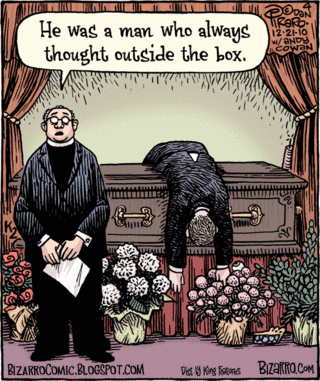
By way of introduction, consider the cartoon above, about “thinking outside of the box.” Today, “thinking outside of the box” is thought of as a virtue. It suggests getting outside of one’s traditional, conceptual world, and considering a larger context for thought. The adage is promoted all over the English-speaking world, ranging from staff development training sessions in corporations, to our political discussions, and in how we think about our view of the world more broadly.

But is it really possible to completely “think outside of the box?” Or is it more accurate to say that humans who uphold such a virtue are really just jumping from one box into another box, merely fooling themselves that they are somehow above the “boxes” that others impose on them? What about the boxes we all impose on ourselves, without realizing it? What happens when you think you are “thinking outside of the box,” only to eventually discover yourself living inside some other box?

The age of the “Enlightenment,” or what some call “modernity,” represents that period in Western history when science developed in ways unimagined heretofore. Now, there have always been Christians, like myself, who believe that science and faith go hand-in-hand with one another, or at the very least, say that science and faith are not at war with one another. But the rise of science, and along with it, the more metaphysically-minded belief of scientism, has had a massive influence on how the English language has changed over just the past few centuries, as scientism leans towards having a more ideological focus, intent on supplanting Christianity…. as though scientism seeks to “think outside of the box” of Christianity.

For example, Barfield in his chapter on Mechanism (p.183-200) notes that the practice of adding the tag of “-ism” to an end of the word, as in scientism, is a modern development, indicating a change in how modern people have a more “contemplative attitude towards all we ourselves do and feel and think,” as Barfield framed it. Perhaps this is because we live in a world that is so captivated by science, along with the accoutrements of technology, with our washing machines, and other labor-saving devices, with our cell phones and Google, all affording us the time and energy to be more contemplative, at least for some. We then take something like science, and give it a more ideological component, by adding the “-ism” tag to the ending of the word. Also, there is the word feminine, which gives us now the related feminism, as well as the word human, and its modern related humanism. The list can go on.

Then there is the whole trend towards the secular, in an attempt to marginalize the spiritual. The growth of scientism has enabled the popularity of words like determinism, as a secular alternative to the word predestination, allowing one to speak of such things without the theological assumptions of the latter.

The practice of prepending “self-” to a whole variety of words, is in particular a product of the Enlightenment, as with words like self-acceptanceself-respect and self-help. You never had self-help books written prior to 19th century, but we are completely overwhelmed with the self-help genre in books today.

The word pious once meant describing someone as devout and spiritually faithful. Now it has the connotation of feeble-mindedness. Even the word religion, which once meant something to describe the whole of human life, with respect to one’s relationship with God, has now been placed in a special category. To be religious is be someone who believes in God, as though religion is a type of add-on to human existence, and not something essential to human existence. In other words, everyone is a human being, but only some are religious, a way of thinking that would have been unthinkable a few hundred years ago.

All of these changes are new, as the modern world has sought to divide the natural and supernatural realms, which were formerly united.

Methinks that the advocates of scientism today have simply jumped out of one box, into another box, without knowing it.


The Problem with Words

You all will probably think I am weird.

But for some upcoming blog posts, I plan on blogging some thoughts every now and then about the problem with words.

Over the past year or so, it occurred to me that many Christians get hung up on how we use certain words, in theological discussion. A lot of strife between believers is due to not having a basic agreement on terminology, when we engage in important discussions about the Bible.

This is not uniquely a Christian problem. It is a problem with the whole human race. Somewhere, I am sure that our sinfulness figures into the equation. But Christians are especially susceptible to the problem because we look to a text, namely “the Bible,” as our authority. So, when you deal with a text, you are dealing with words, and often, words gets lost in translation, and in our communication with other believers.

I confess, that I am not always good at it myself.

When confusion results, because of our failure to grasp a common vocabulary, this is not good for people who believe that God has revealed Himself through the pages of Scripture. So, I decided to read some of the writings of “The Inklings,” that 20th century British braintrust, that met together weekly in a pub, to discuss the really big things in life, to give me some help.

In particular, I checked out C.S. Lewis’ Studies in Words, and Owen Barfield’s History in English Words. Both Lewis and Barfield were experts in philology, or the study of language. Barfield’s theology is a bit strange, compared to Lewis’ “mere Christianity,” but both writers give us tremendous insight into some of the challenges in how language evolves over time, and how we end up using words, in our communication.

For a quick example, Owen Barfield (p.66) writes about a certain Sir John Cheke, a 16th English Reformer, who worked on an English translation of the Book of Matthew. For about a thousand years prior to Cheke, the only readily available translation of the Bible in England was St. Jerome’s Latin Vulgate. But like more well-known Reformers, such as William Tyndale, Cheke believed that the Bible should be accessible in the mother tongue of his native England, in a language that everyone could read, as the average person understood very little of Latin.

But Cheke was very creative in his English translation of Matthew, looking for uniquely English words, or closely English-like words, to translate certain terms, instead of trying to borrow from Latin.  The King James Version (KJV) of the Bible translates Matthew 4:24 like this:

And his fame went throughout all Syria: and they brought unto him all sick people that were taken with divers diseases and torments, and those which were possessed with devils, and those which were lunatick, and those that had the palsy; and he healed them.

Notice how the KJV translators used the word “lunatick” to describe someone who was probably mentally ill. Cheke thought “lunatick,” or our more modern, “lunatic,” to be too Latinized. So, he came up with his own word, derived from the traditional English word, for that brightest object in the nighttime sky, “moond.”

Have you ever thought of a crazy person as being “moond?”  No, I did not think so. Neither did I.

The etymology for the word, luna, the root for lunatic, is derived from an old Latin name for the “goddess of the moon.” Perhaps Cheke believed that the pagan or occultic ideas associated with the word lunatic were inappropriate for use in the Bible, whereas the traditional English moon, could be slightly altered to signify the same idea, with less pagan connotations. I do not know, but it is fascinating to think about.

As an aside, this helps me to better understand why some Christians refuse to use the word “Easter” to speak of Christ’s Resurrection, claiming that the concept of Easter is rooted in pagan mythology.

As a further aside, Barfield notes (p. 65,) that John Wycliffe, the 14th century translator of the Bible into English, used the English-sounding word againrising to translate the Latin word resurrectio, as well as the English-sounding undeadliness to translate the Latin word immortalitas.

I often wonder what the English-speaking world would be like if Wycliffe’s translation of these words would have won out over the traditional Latin transliterations into English.

Anyway, back to Sir John Cheke….

Here are a few more examples of Cheke’s attempt to de-Latinize the Bible:

  • Instead of the Latin word centurion, as in a “Roman centurion,” Cheke opted for the word hundreder.
  • Instead of the Latin word apostle, Cheke chose the word frosent.  This strange word frosent, was derived from a short phrase “from-sent,” since an apostle basically means someone who is sent out by someone else; as in when Jesus sends out the twelve apostles, in Matthew 10.
  • Instead of the Latin word crucified, Cheke translated that as crossed.
  • Instead of the Latin word proselyte, Cheke translated that as freshman.

That all sounds really quirky to us today, for the simple reason that Cheke’s translation of the Book of Matthew never really caught on with 16th century English readers.

Which is why most people have never heard of Sir John Cheke.

Which is why we find more Latinized words, even in some of our more modern translations still today, like centurion, apostle, crucified, proselyte, …. and lunatic.

Words are funny things, are they not?

.     .     .

Other posts in this series:

How Modernity Influenced the Evolution of English Words

How Christians Change Words

Verbicide

Conservative and Liberal as Christian Labels

Concluding Thoughts on Owen Barfield’s History in English Words


Pagans: A Review

Rome’s famous Colosseum, right before dusk (October 2018)

If you have a “bucket list,” of things do in this life, consider putting a trip to Rome on there. My wife and I spent two weeks last October, walking through Rome’s ancient side streets, following tour guides underground in the Catacombs, and savoring some delicious food above ground, all while uncovering layers and layers of buried history. I could have spent a whole month in Rome, and still hungered for more.

What stood out to me the most was how this once great center of pagan, classical culture, was overtaken by the story of Christianity. How did this marbled, sculptured story of the Greco-Roman world get superseded by the painted images of the Crucified and Risen Christ, found throughout so many of Rome’s churches?

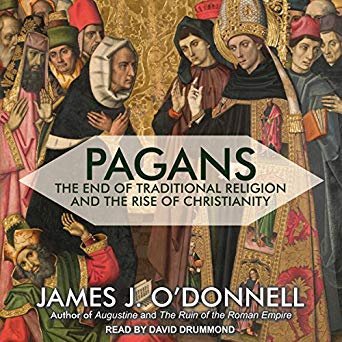
Pagans: The End of Traditional Religion and the Rise of Christianity, by James J. O’Donnell, tells the fascinating story of how “pagan” Rome became Christian Rome.

My wife and I took another trip recently, a bit closer to home, down to Florida and back, which afforded me a lot of time driving and riding in a car … for many hours. It was the perfect opportunity to listen to some Audible audiobooks, so I downloaded James J. O’Donnell’s Pagans: The End of Traditional Religion and the Rise of Christianity , and I enjoyed it immensely. I felt like I was right back there in Rome, ascending the Palantine Hill overlooking the Roman Forum.

Pagans is one of the recommended books that you will find, while viewing Tim O’Neill’s excellent website, History for Atheists. Followers of Veracity will know that Tim O’Neill has done a great service by properly educating atheists regarding the accurate history of Christianity, and Christians can learn from him as well.  As an atheist himself, to accuse O’Neill of having a cognitive bias favoring Christianity simply falls flat.

Likewise, O’Donnell, a classical scholar at Arizona State University, and biographer of Saint Augustine of Hippo, manages to correct a lot of popular errors of pagan and early Christian historiography, despite having a somewhat contrarian bent of his own.

In O’Donnell’s retelling, “paganism” as a religious system, did not exist, prior to the rise of Christianity, in the latter days of ancient Rome. The religious traditions of the Greco-Roman world were an amalgamation of various local practices, shrines, and deities, all jumbled together, to be ultimately synthesized by Greek philosophy and Rome’s politics. Christianity essentially invented “paganism” as a concept, as a convenient way of describing what the Christian faith was not. Christianity was unique, as was Judaism, from which it came, in that it claimed that the God is Israel, who raised Jesus from the dead, was the one and only true divine being. The victory of Christianity therefore made the ad hoc assemblage of pagan gods and goddesses irrelevant.

In describing the transition of the pagan world to a Christian Rome, O’Donnell skewers many common misperceptions, that all too often get tossed together along with other “fake news” of our day, propagated by social media. Take the word, “pagan” itself. Historically, to be “pagan” had no religious connotation. The root word, pagani, simply meant “country folk.” This makes great sense considering that the early Christian movement took root in cities like Corinth, Ephesus, and Rome, and not the countryside.

More “fake news” gets annihilated with O’Donnell’s prose. No, the emperor Constantine did not impose his imperial thumb on the Christian church, in order to “make” Jesus into a God, at the Council of Nicea. If anything, O’Donnell correctly shows that Constantine went along with the bishops’ decisions at Nicea, affirming the divinity of Jesus, largely as a matter of political expediency. But he  was actually more sympathetic to the Arian heresy, that situated Jesus as being something greater than merely human, but nevertheless, still not wholly divine. You can think of Constantine as a politicized promoter of Jehovah’s Witnesses-style theology, as opposed to someone who supposedly “made” Jesus into becoming God.

It was not until emperor Theodosius, several regimes later, that orthodox Christianity, as we know it today, got the full rubber stamp from the seat of political power in Rome, as affirmed by the church at the Council of Constantinople in 381.

This did not mean that Theodosius’ orthodox theology necessarily made him a nice guy. Theodosius was excommunicated from the church, by the influential bishop Ambrose, following a massacre that Theodosius ordered in Thessalonica. Only after months of penance was the emperor readmitted back into the church. Though Theodosius did crack down on pagan temples, much of the old ways of the Greco-Roman gods were already fading away.

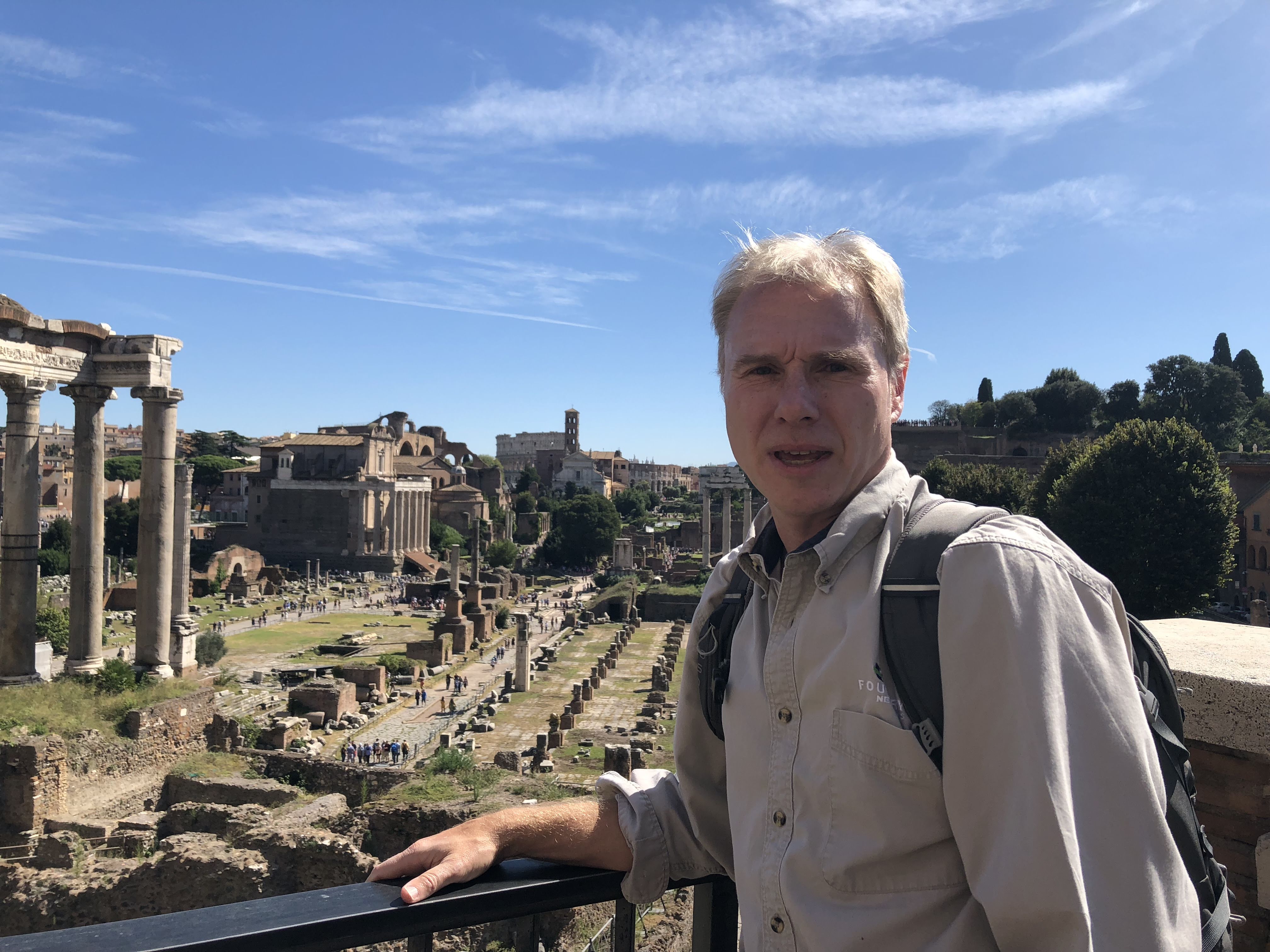
Veracity blogger, on-site, overlooking the Roman Forum, in 2018, where the “pagan” culture of Rome reigned supreme, until the story of the Crucified and Resurrected One superseded it.

Furthermore, the greatest Christian thinkers of the 4th and 5th centuries, like Ambrose and Augustine, made use of the classical tradition, when it served the purposes of promoting the Gospel. They were not afraid of any inherently polluting influence of paganism, though such thinkers often disagreed with one another, as to what aspects of pagan culture could be redeemed, and what aspects of pagan culture should be rejected, when advancing the cause of the faith.

I appreciated O’Donnell’s frank retelling of this fascinating period, avoiding the over-romanticization of Christianity’s history, on the one side, while also correcting a lot of the misinformation, regularly propagated by atheists on the Internet, on the other. It was a relief to hear from a genuine scholar. Alas, O’Donnell’s contrarian tendency disturbed me at a few points, which I thought took away from his overall presentation.

For example, O’Donnell matter of factly describing Saint Augustine of Hippo to be entirely ambitious in using his rhetorical skills, to promote himself, as a defender of the faith. I can see this in Augustine as the young Christian, but I would certainly hope that as Augustine matured, so would his growth in sanctification. Plus, O’Donnell’s insistence that Augustine never actually “converted” to the Christian faith, came across as forced and unconvincing. Yes, Augustine had a Christian mother, and so he surely did have some basic Christian instruction as a child. But that did not mean that Augustine automatically embraced his mother’s faith. Augustine’s Confessions still tells that story of his conversion, as a young man, into the loving arms of Jesus, rather well.

But aside from a few prickly moments like these, I found O’Donnell to be generally an excellent, accurate tour guide of ancient Rome. O’Donnell does not reveal where his sympathies regarding the Christian faith really stand (based on his few, cynical digs, here and there, he probably is not), but for a work of history like this, he need not to. If you want to understand how the ancient world transitioned from “paganism” to Christianity, O’Donnell’s Pagans would be a good place to start.


See Don Webb’s excellent review of Pagans here, and Michael Bird’s brief review.

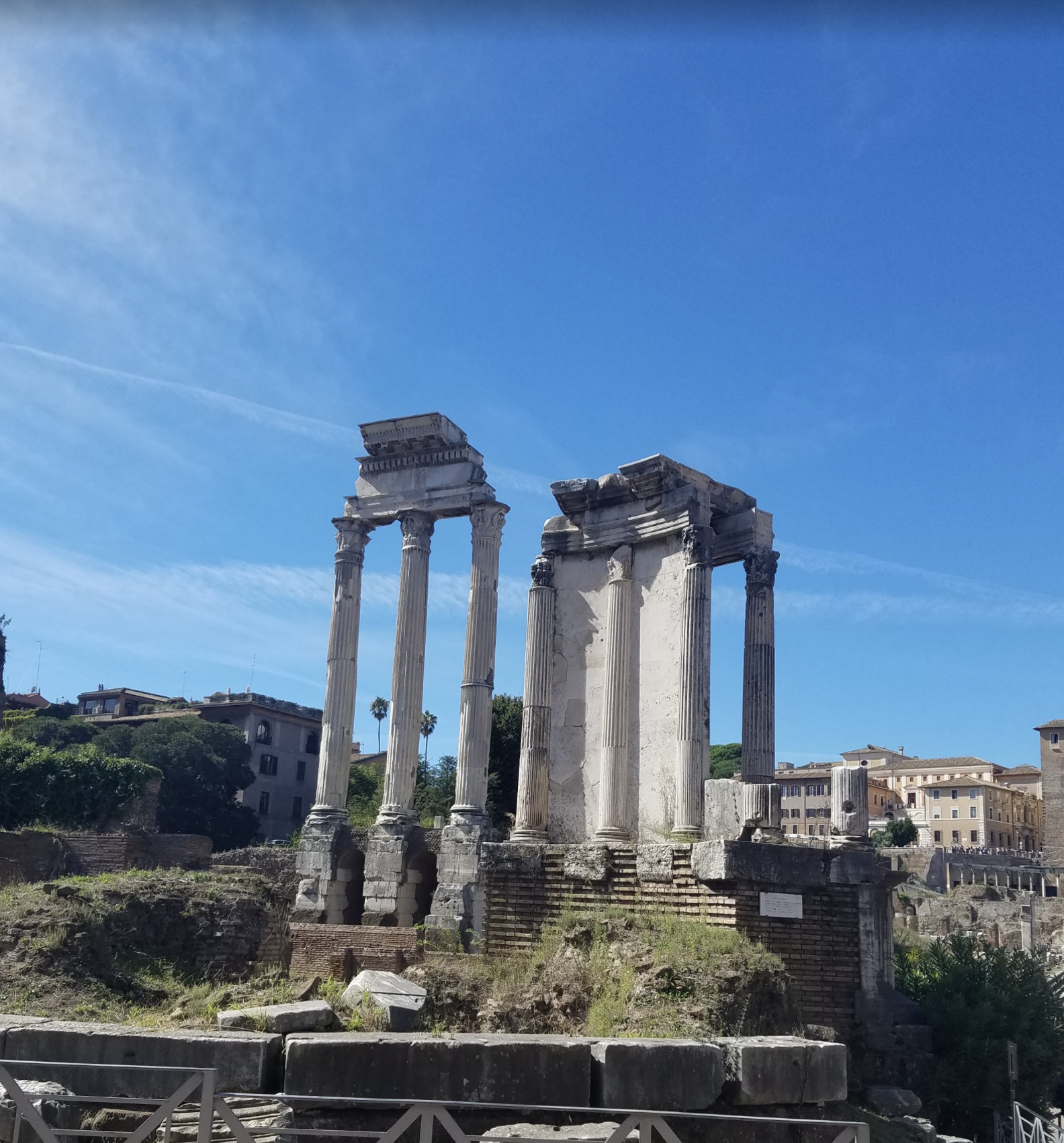
The Temple of Vesta, in the Roman Forum, was a site for “pagan” cultic activity, back to the 7th century before Christ. The temple was eventually closed during the late 4th century C.E., when Christianity became the official religion of Rome.