Category Archives: Apologetics

Wideness of God’s Mercy: Pluralism #4

I like playing soccer. But playing pick-up soccer is pretty difficult when you do not have any goals. Sometimes you have to improvise with a pair of shoes, a few backpacks, or if you are really lucky, a set of orange highway department cones.

Mmmm…. those look like some mighty fine cones ….. perfect soccer goals!

If you want to mess with the opposing soccer team, just move those improvised goals when they are not looking. When on the opponent’s side of the field, sneak that one cone farther apart from the other one to make that goal wider. Then just wait a few minutes. Pretty soon, you’ll be hearing, “Morledge! What are you doing messing around with the goals?! You can not make the goals wider for you!”

There is always a temptation to try to widen the goals. But it does not just happen in soccer. It also happens when we think about God and salvation. How wide is God’s mercy when we consider who will be saved and who will not be saved? What a troublesome question! In an age drawn more to the love of God as opposed to His justice, does human sentimentality confuse us in our understanding of the parameters God has set for salvation?

Continue reading


Have a Merry Mithras!?

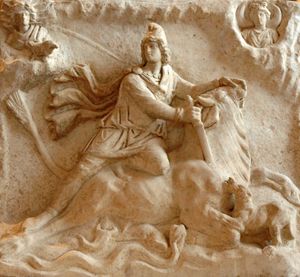
Roman bas relief from 2nd or 3rd century depicting Mithras, a central figure of the "Mystery Religions" of the early Christian era, killing a bull.

Roman bas relief from 2nd or 3rd century depicting Mithras, one of the gods of the “Mystery Religions” of the early Christian era, killing a bull.

Who was born on December 25th? Born of a virgin in a stable with shepherds present? Who had twelve disciples? Who was killed and buried in a tomb, and then rose up three days later after his death? Students of the Bible might think the answer is obvious. Not so, according to a popular movement known as “mythicism”. For the “mythicists” this original ancient figure is Mithras, a Persian god. Christianity is really just a copycat faith of Mithraism. Should we be wishing one another a “Merry Mithras” instead during the Christmas season?
Continue reading


Who Created God?

Who created God?  Good question. Atheists fall on their backside thinking this one through.  It’s all in how deeply we can think—specifically being able to think outside the box of our own worldly experiences.  Here…if you’re still wondering, I’ll save you a headache the next time someone asks you—God is transcendent.

Here’s a short video by Oxford mathematician and Christian apologist John Lennox that shows why you might not want to mess with someone who’s wise—particularly when he is wearing a grin.

John Lennox is a delightful, gentlemanly, brilliant and crafty defender of the faith.  He gives atheists fits with his use of logic and his calm, unflappable, charitable demeanor.   In 1962 he attended the last lectures of C.S. Lewis, to whom he is now sometimes compared.  Dr. Lennox can hold his own, and give as good as he gets. Continue reading


The Scandal: Pluralism #3

Pssst! Have you heard about the “scandal”? All curious ears, listen in.

The Scandal of Particularity: Is there really only one way?

Yes, it is the greatest “scandal” of all. Theologians have called it the “scandal of particularity”. In a particular time. In a particular place. In a particular person. God spoke. God acted. Who is the scandal about? Simply put. Jesus Christ. There is just no other way around Jesus. This is indeed a scandal to a post-modern culture that resists particular truth claims. It sounds so exclusive. So intolerant. And that doesn’t sound so good. Right?
Continue reading


Conflict Avoidance: Pluralism #2

OK. I admit it. I hate conflict. John Paine does not like it either, so I am glad I am not alone.

Cowboys or the Redskins? Duke or North Carolina? Red Sox or the Yankees? Me? I’ll just watch the ball game, thank you. Some love a feisty contest. But it is one thing to engage in competitive sports talk. Conversing about “God” in a pluralistic culture is a much more serious ball game.

Nothing like some good ole’ competition!

There is much at stake when it comes to conflicting truth claims regarding religious belief … or “non-religious” belief … let us not forget atheism. The consequences are great. Eternal matters hang in the balance. Heaven and hell. Life and death.

Imagine you are at a water cooler somewhere in corporate America, and the topic of religion comes up. A disagreement emerges. You feel the tension in the hallway as the conversation heats up. Someone tries to resolve the tension in the conversation and says, “You know, I believe that all religions basically teach the same thing.”

The “conflict avoidance” part of me wonders….”What a powerful and attractive idea”…..
Continue reading