“Just as we are now like the earthly man, we will someday be like the heavenly man.”
1 Corinthians 15:49 (see Dick Woodward’s post)
 Have you ever thought about your thoughts? This may seem like a ridiculous question, but it turns out there is a powerful apologetic argument for life after death that derives from simply understanding that humans have a body and a soul, and that the immaterial element (the soul) is spectacularly different from the material element (the body).
Continuing our review of the Areopagus Journal issue dedicated to Life After Death (Fall 2011), in this post we will explore what apologetics can bring to bear on the subject using philosophy, logic, and history.
The blog text below in italics is entirely the writing of Chad V. Meister. I have edited out quite a bit of material to fit this format, without (I hope) misrepresenting his beliefs and positions.
Mind, Body, and the Possibility of Life After Death
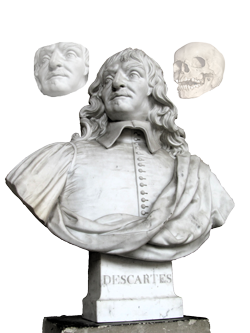
Various conceptions of the human self have been held in the West, the two foremost being dualism and materialism. Historically, dualism has been the more prominent of the two. There are different conceptions of dualism as well, but on one main account the human person consists of two substances, one material (the body) and the other immaterial or mental (the soul or mind). Rene Descartes (1596-1650) is perhaps the most widely recognized defender of substance dualism. On his account, sometimes called the Cartesian view of the soul, the soul is an unextended, non-spatial substance, and it is contrasted with the body, an extended, spatial substance. The soul and body are (somehow) connected to one another, but how an immaterial substance can connect to and interact with a physical substance is a bit of a mystery—a mystery which has often been castigated as the problem of the “ghost in the machine.” Continue reading