

Category Archives: Apologetics
Pluralism In Your Face
Editorial comment:
I’m not a political person. Faith means much more to me than politics. I do have strong opinions about the need to keep politics out of practicing and sharing our faith because equating the importance of God and politics is disrespectful to God. And it’s unwise. There is scriptural guidance in the form of an argument from silence—Jesus did not politicize His teachings. At the risk of appearing to taint this ethic, please dismiss the political and constitutional implications of the following material and focus on the core questions.
In potentially uncomfortable situations, most of us have some fear of rejection or confrontation that compels us to be silent about our faith. Thinking about it ahead of time can help overcome those fears.
Imagine that you are on the hot seat. Attention is focused on you, and your beliefs are called into question. How would you respond? (If you’ve never been in this position it might be good to ask yourself, seriously, “Why not?”)
Earlier this month, Russell Vought, an evangelical Christian, was testifying during a confirmation hearing, and Senator Bernie Sanders questioned Vought’s beliefs. The following two-minute YouTube clip captures the contentiousness of the incident.
For context, please read what The Atlantic has to report. Pay careful attention to the scriptural citations. If you aren’t aware of the context, you could be inclined more to an opinionated, rather than informed, reaction.
Back to the question. Forgetting about the political and constitutional issues and personalities involved, how would you respond?
Just in case this topic comes up at your water cooler or cocktail party, here are some thoughts to help you prepare an answer.
- The teaching of Jesus does not foment hatred, bigotry, or intolerance. Jesus said, directly, the greatest two commandments are to love God and love your neighbor. When questioned about whom He meant by ‘neighbor,’ Jesus taught the parable of the good Samaritan. Samaritans were held to be low-class people in the first century. By including them in the parable, Jesus made a clear point that His followers are to love others broadly and inclusively.
- As Christians, we believe the Bible contains the inspired word of God and is the final authority for faith and practice. We rely on what it says and do not have the liberty or right to make up our own brand of Christianity, or to cherry pick proof texts. There are many reasons, objectively and personally, for accepting the Bible as the inspired, holy word of God.
- Christians do not have the right to condemn people—we are commanded to love people—but God does have that right. If you really want to understand why, study the Bible. We, the created, are in rebellion against the Creator, and a holy and just God has a plan for the salvation of those who accept His complete sacrifice on our behalf. He has the right to condemn those who reject Him, as Scripture clearly teaches (again, read The Atlantic article).
- John 3:16, the most familiar passage of scripture in the New Testament, states, “For God so loved the world that he gave his one and only Son, that whoever believes in him shall not perish but have eternal life.” From this passage, we can see that God is loving and did not discriminate to whom salvation is offered. He offers salvation to the world.
- Jesus said directly that He is the way, the truth, and the life, and that no one comes to God the Father except by Him.
- The apostle Paul, who wrote half of the New Testament, taught that we are saved by our faith in Jesus, not by our works. While we all know people of every faith and creed who are indeed wonderfully good, salvation is by faith in Jesus alone. Again, we’re not free to make this up—it is directly stated in the Bible. Just because people are ‘good’ does not entitle them to salvation.
- Western culture is inebriated with pluralism. We resist anything that might impinge upon personal freedoms—such as a morally-based worldview. Pluralism by its nature appeals to a wide swath of voters and is therefore quite pragmatic in politics. But on logical and spiritual levels, pluralism comes up short.
- In logic, there is the law of non-contradiction, which holds that two opposite truth claims cannot both be true in the same sense at the same time. “There is either milk in the refrigerator now, or there isn’t,” as Norman Geisler says.
- The world’s major religions ALL have opposing truth claims. The nature of truth claims is that they are exclusive.
- Christianity teaches that Jesus was crucified and resurrected from the dead. Islam teaches that Jesus was not crucified and therefore did not rise from the dead. Keep it real. Both claims can be false, but both cannot be true. The apostle Paul wrote in 1 Corinthians 15:14, “If Christ has not been raised, then our preaching is futile and your faith is empty.” Christianity depends on the objective truth of the Resurrection.
- Hindus acknowledge multitudes of gods and goddesses. Buddhists say there is no deity. Muslims believe in a powerful but unknowable God. Christians believe that God is loving and personal. As Ravi Zacharias says, “The world’s major religions are not fundamentally similar and superficially different, they are fundamentally different and superficially similar.” Most advocates of pluralism don’t take the time to investigate the differences.
Pluralism may be good for getting votes, but it’s an empty and illogical worldview. Although I disagree with those who wish to cast Christianity into a cultural stew with the world’s other religions, my Christian faith compels me to love those who disagree. I wish we could at least all agree on that.
Truth in a Culture of Doubt: Brief Book Review
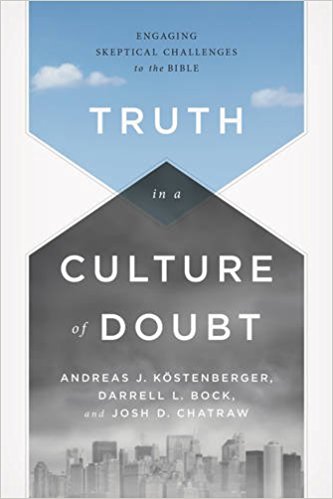
Still looking for that perfect gift book, for a high school graduate, off on their way to college? Consider Truth in a Culture of Doubt: Engaging Skeptical Challenges to the Bible, by Andreas Köstenberger, Darrell Bock, and Josh Chatraw.
Young people growing up in the church today face immense challenges from a culture skeptical to the Gospel. Leading the charge towards encouraging doubt is popular author and University of North Carolina religion professor, Bart Ehrman.
If you have never heard of Bart Ehrman before, you need to get out from underneath your rock, and learn about him. Ehrman grew up going to church and attending Christian colleges, but eventually lost his faith in the process. He has since authored five New York Times Bestsellers, and dozens of other books, all aimed at undermining confidence in the reliability of the Bible and its message.
What makes Ehrman’s skepticism so caustic, is that he knows his facts really, really well. He knows his Bible better than most Christians do, and he remains one of the world’s top textual critical scholars of the New Testament. The problem is that the conclusions he draws from his research are not always warranted. There are indeed very good answers to the issues he raises, that affirm the trustworthiness of the Bible.
In Truth in a Culture of Doubt, Köstenberger, Bock, and Chatraw, all evangelical and believing scholars themselves, tackle each of Erhman’s challenges in a very engaging manner, issues that every thoughtful Christian will face, as they seek to share their faith with their informed neighbors:
- Is God Immoral Because He Allows Suffering?
- Is the Bible Full of Irresolvable Contradictions?
- Are the Biblical Manuscripts Corrupt?
- Were there Many Christianities?
- Are Many New Testament Documents Forged?
A nice little extra is a quick question and answer guide at the back of the book, that summarizes the basic arguments. Truth in a Culture of Doubt is an updated, more in-depth version of an earlier book by these evangelical scholars, Truth Matters, that I reviewed a few years ago. Though Truth in a Culture of Doubt was itself published back in 2014, the information packed in it is still relevant today, as the issues dealt within are not going away any time soon. Ehrman is still himself writing books, but more and more, any new issues that he writes about move further away from his area of expertise.
In many ways, the topics that Ehrman has been writing about for over fifteen years are not new. They are no more than popular distillations of scholarly, critical views in the history of Christianity, that have been taught in secular departments of religion at private and public universities for nearly a century now. Sadly, it has taken a barrage of these skeptical writings, in popular form, to force the evangelical church to better inform her people, and give better answers.
Read a brief excerpt from Truth in a Culture of Doubt here, then go buy the book for that young person you know, who is facing challenges from a skeptical culture.
Should a Christian Have a Dream Catcher in Their Car?

A number of years ago, my parents took a cruise ship to Alaska. On that trip, my mother found an attractive dream catcher, and she gave it to me as a birthday gift. I hung it up in my car, around the rear view window mirror, just as a way to remember her, and her thoughtful gift to me.
So, I was really caught off-guard a few years later, when a Christian friend of mine was offended that I had that dream catcher hanging in my car. Some Native American cultures historically revere dream catchers as religious symbols, intended to protect children from bad dreams and evil spirits. But the larger Pan-Indian movement in the 20th century, in an effort to raise awareness of Native American cultures among the majority population, adopted the dream catcher as a cultural symbol. Not all Native Americans share the exact same spiritual beliefs as the Ojibwe tribe, from where the dream catcher most probably originated years ago. My mother looked at it as a memorabilia keepsake, something she wanted to give to her son.
Christian apologist John Oakes, at the apologetics blog Evidence for Christianity, that I highly respect, has an article explaining why he personally would not have a dream catcher in his car. We both agree that having a dream catcher is a gray area, in the “disputable matter” category, as found in Romans 14. Oakes does not think a dream catcher is sinful, but he personally would not have a dream catcher, as it might offend someone else, just as eating food sacrificed to idols might personally offend another Christian, in the first century church.
I support most of what Oakes is saying, but I take a different personal position. It is important to remember the context for Romans 14. There were Christians in the first century, who came out of pagan backgrounds, where eating food sacrificed to idols was readily practiced. Such practices would offend the conscience of those believers from those backgrounds, so this is why the Apostle Paul urged other believers, from different backgrounds, to carefully avoid insulting the conscience of the more sensitive believers, by avoiding such practices.
In the case of my Christian friend who objected to my mom’s dream catcher, this friend had no Native American background. Much less did this friend have any association with the Ojibwe tribe. Neither was this true of my mom, nor myself. Therefore, it was not anyone’s conscience that was being “offended,” but rather it was the rumored idea my friend had in their mind, of a dark power, that possibly someone, somewhere might be troubled by the presence of a dream catcher.
Though I appreciate my friend’s concern, that followers of Christ should reject idols, my response is this:
Good grief.
The effort that we could expend in trying to remove all things in our lives that might possibly offend someone, somewhere in the world, is a fool’s errand. To apply Romans 14 in this manner, takes the text out of its appropriate, New Testament context. It would be a form a perverse legalism to constantly police our lives, searching for those practices or artifacts that might trouble someone, somewhere. The meaning of symbols constantly changes across various cultures today, being appropriated and re-appropriated with different meanings, quite frequently.
For example, the radical Islamic State (ISIS) has destroyed countless precious cultural artifacts of ancient Syrian culture, all in the name of stamping out idolatry. Technically, those Muslims were right in declaring various statues as polytheistic idols, from a past era. But would someone be tempted to worship these idols today? Possibly, but this is highly, highly unlikely. Most moderns view these artifacts as testimonies to history, and we therefore grieve their loss. As such destructive ideological extremism spreads, the preservation of valuable cultural heritages becomes more important than ever.
Just think about the evolution of the swastika, discovered by archaeologist Heinrich Schliemann, and more recently, the Confederate flag. At one time, these were symbols with positive meanings, but not anymore.

A popular, American Coca-Cola pendant, before the Nazi’s adopted the swastika as their symbol, and ruined it for everyone.
As Christians, we regularly use terms like “Sunday,” “Monday,” “Tuesday,” “Wednesday,” etc., to describe the days of the week. The Quakers of the 17th and 18th centuries refused to use that terminology for weekdays, as those names correspond to pagan gods, which were worshipped hundreds of years ago, during the pre-Christian era of Europe (the same logic applied to the first eight months of the Roman calendar). So those early Quakers would use terms like “first day,” “second day,” “third day,” etc., all very biblical terminology, to faithfully describe the days of the week. But to my knowledge, there are no people today, nor in the 17th century, who come or came from such pagan backgrounds, who might have or had such sensitive consciences. I do not see Christians today clamoring for altering the names of weekdays, who wish to rid our minds of such supposedly pagan mindsets, who might be tempted to worship the sun (Sunday), or the moon (Monday), or Thor, the god of war (Thursday).
Now, suppose I actually know someone, who would ride in my car, who really came from a background, where a dream catcher did possess some religious or spiritual meaning. They might see my dream catcher as an implicit endorsement, tempting them towards a spiritually harmful practice.
This would be an area where Romans 14, with respect to “disputable matters,” would be applicable. I would hope that in this case, I would discreetly take down my dream catcher, and slip it into my glovebox. I would not want something I have to become a stumbling block in their journey towards Christ.
But until then, I like having that dream catcher visible, as a way of remembering how much my mother cared for me. If there are any other Christians, who continue to object, I would say this: They probably have too much time on their hands, and they would be better off putting their efforts to rid our lives of “idols” to better use.
Is It A Stretch?….The Big Bang and the Bible
I know that a number of my Young Earth Creationist friends are not too crazy about the “Big Bang Theory,” as they argue that the Big Bang can not be found in the Bible…. and I am not talking about the TV show, but rather the cosmological theory….
But try this one on for size:
- Bless the Lord, O my soul!
O Lord my God, you are very great!
You are clothed with splendor and majesty,
covering yourself with light as with a garment,
stretching out the heavens like a tent. (Psalm 104:1-2 ESV)
The continuous expansion of the universe, that results from the cosmological Big Bang, ties in very well with the psalmist’s metaphor, of God “stretching out the heavens like a tent.”
Okay. I am not necessarily saying that a psalm writer was consciously thinking about the modern physics of cosmic radiation, underneath his Middle Eastern tent, over twenty-five hundred years ago.
That would be a “stretch!”
Yet we are dealing with not just a human author, but a supernatural author, as well. It seems to be more than mere coincidence that God’s Word just happens to have a metaphor, that perfectly matches the description that astronomer Edwin Hubble first discovered in 1929. As John Paine demonstrates, the history of the universe from science is a good argument to help people who do not accept the Bible, to consider the possibility of believing in the God of the Bible.
True, having conversations with your neighbors about the Big Bang, rarely by itself will lead them to profess faith in Jesus. But it can create a pathway to share the Gospel. Otherwise, to refrain from appealing to general revelation in our conversations, is like trying “to snatch defeat from the jaws of victory.”
Think about it.
Perhaps the connection between the Bible and the Big Bang is not such a “stretch” after all.
If you are still a bit confused, Christian astrophysicist Hugh Ross at Reasons to Believe gives us some background on the Big Bang Theory (two videos, about 90-seconds each). If you want to know more about how we at Veracity approach the debate over creation, just find the search field on the Veracity blog, type in “creation” or “creationism,” and click GO!….. (SLIGHTLY OFF-TOPIC: John Paine filmed the promotion video for Faith Bible College. Check that out, too!)
Feel free to share our book…

Join the Conversation
Clarke Morledge on Paul’s Early Visits to J… Gary Beaty on Daniel’s Seventy Weeks… Our Father Prayer -… on Why Different Christians Recit… Clarke Morledge on The Council of Nicaea Demythol… Clarke Morledge on From Genesis to Junia: An Hone… Clarke Morledge on From Genesis to Junia: An Hone… Clarke Morledge on From Genesis to Junia: An Hone… Clarke Morledge on From Genesis to Junia: An Hone… Clarke Morledge on From Genesis to Junia: An Hone… Clarke Morledge on Is the Apostle Paul Being Anti… Clarke Morledge on Reversing Hermon, by Michael H… Clarke Morledge on What About Those “Lost S… Clarke Morledge on Is the Virgin Birth Prophecy a… Clarke Morledge on The First Thousand Years, by R… Mark on The First Thousand Years, by R…


 Veracity