Clarke Morledge -- Computer Network Engineer, College of William and Mary...
I hiked the Mount of the Holy Cross, one of the famous Colorado Fourteeners, with some friends in July, 2012. My buddy, Mike Scott, snapped this photo of me on the summit.
When two theological heavyweights clash with one another, the ensuing dialogue can be fireworks. But one can learn a lot about the state of the church from such disputes.
The immensely erudite and (apparently recently) idiosyncratic Eastern Orthodox David Bentley Hart published an extended essay, Tradition and Apocalypse: An Essay on the Future of Christian Belief (Listen to this summary in Hart’s own words). Hart has been one of the greatest theological voices undermining the pretentiousness of the New Atheist movement. In exposing the fault lines of thinkers like Richard Dawkins and Christopher Hitchens, Hart’s Atheist Delusions has been regarded as one of the finest polemical works against early 21st century atheism.
Alas, Hart’s star has since fallen after his That All Shall Be Saved, a bold and dogmatically absolutist defense of a Christian universalism, which argues that while there is still a future hell and divine judgment, that experience of hell is ultimately purgative and redeeming, such that none are ultimately lost in the very end.
Like what former megachurch pastor and now California surfer and podcaster Rob Bell strongly hinted at, and what the author of the evangelical blockbuster novel, The Shack, William Paul Young finally came out and admitted, at least to a certain degree, the brilliant and exceedingly well-read David Bentley Hart has whole-heartedly endorsed a theological position that has historically been condemned by the vast majority of Christians. Hart does not care. Anyone who disagrees with him about universalism is effectively morally challenged, in his view, and he is not afraid to unload condescension on his critics.
That was just a few years ago. Now that this previous storm has passed, he has yet again triggered even more controversy.
On a late spring day earlier this year, I was enjoying a walk across the college campus where I work to grab a sandwich from Chick-fil-A, when two young men approached me and asked, “Do you know what the Bible says about our ‘Heavenly Mother’?”
I must admit, I found this to be an interesting ice breaker, in order to start a conversation. Curious, I stuffed my hot sandwich away, and asked for more information. My spicy chicken would have to wait.
Out came their Bibles, heavily highlighted, with penciled in cross references. “Our Heavenly Mother is taught in the Bible from beginning to end.” I was intrigued. I mean, how often do you get hit up with an on-the-spot Bible study? “Tell me more,” I responded.
For the next twenty minutes, I was given a whirlwind tour through the Bible, from beginning to end. First, I was shown Genesis 1:26–27, which talks on page one about God creating men and women in “our” image. The “our” is God “the Father” and….
… you guessed it,… our “Heavenly Mother.”
Just in case there was any doubt, they took me right over to the end of the Bible, at Revelation 21:9-10 and 22:17.
Then came one of the seven angels who had the seven bowls full of the seven last plagues and spoke to me, saying, “Come, I will show you the Bride, the wife of the Lamb.”And he carried me away in the Spirit to a great, high mountain, and showed me the holy city Jerusalem coming down out of heaven from God,…..
…. The Spirit and the Bride say, “Come.” And let the one who hears say, “Come.” And let the one who is thirsty come; let the one who desires take the water of life without price.
The message here is that the “bride” is interpreted to mean our “Heavenly Mother,” otherwise known as “God the Mother.” The “Bride, the wife of the Lamb” is shown to us to be the “holy city Jerusalem coming down out of heaven.” In other words, “Jerusalem” is a symbol representing “God the Mother.” Of course, these fine looking young men told me that they were not giving me an “interpretation” of these verses. They were simply telling me what “the Bible itself was saying.”
“O…K-ay…..”
At that point, I knew that my hot sandwich was going to be cold before I could get a chance to eat it….
But the Jerusalem above is free, and she is our mother.
Mmmm…. the prooftexts they had were ready made to answer me. Jerusalem symbolizes the “Heavenly Mother,” and not the church. But still sensing that I was hesitant, they urged me to consider the parable of the wedding banquet. A few page turns later, we came to Matthew 22:1-10:
And again Jesus spoke to them in parables, saying, “The kingdom of heaven may be compared to a king who gave a wedding feast for his son” (v.1-2)…. ‘Go therefore to the main roads and invite to the wedding feast as many as you find.’And those servants went out into the roads and gathered all whom they found, both bad and good. So the wedding hall was filled with guests (v.9-10).
They called on me to notice that the bride is not linked to the church. Rather, the church are the “guests” that have been invited to the wedding banquet. Clearly, the bride herself has to be someone else, and not the church.
You guessed it…. the “bride” is none other than our “Heavenly Mother.”
I have talked with several Jehovah’s Witnesses and Mormons before, but this was all new to me. Nevertheless, I had a hunch as to where this was all going. I took a gamble, and I asked, “Does this have anything to do with the Second Coming of Jesus?”
“Why, yes! You know something about the Bible. Glad to hear that you already suspected that!,” came back the reply from one of my interlocutors. The two young men were trading off in responding to me, though one of them did most of the talking.
By this time, we all decided to sit down, on a nearby bench, and that is when I began to hear about “the dates.”
Of course, how can you talk about the Second Coming of Jesus and not talk about “the dates”????
My friendly interlocutors laid it all out for me:
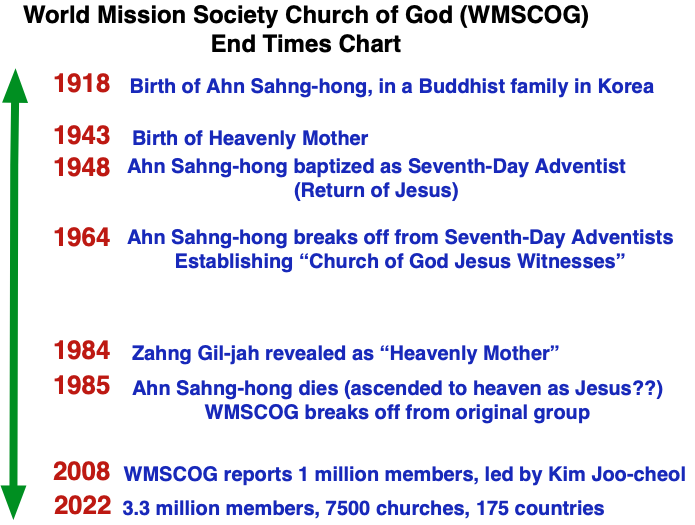
Jesus returned to earth in 1948. You just did not know about it because Jesus came back with another name.
It was only after Jesus’ return when the “Heavenly Mother” was finally revealed to the world…. in 1984.
The “Heavenly Mother” had been born in 1943, and so she had to wait until after Jesus’ return, when the “wife of the lamb” would be eventually revealed. This is what happened in 1984.
Now, my head was spinning. But I had another question. “So, if Jesus came back in 1948, is Jesus still here?”
“Well, no. Not exactly. He ascended back to heaven in 1985.”
I said, “Huh?”
One of my interlocutors awkwardly replied, ” I really do not like saying that Jesus died, so I just say that He ascended back to heaven…. in 1985.”
Wow. All of those dates. A secret return of Jesus, with Jesus having another name. Heavenly Mother. And Jesus then re-ascending back to heaven?? Mmmph…… So, what was this exchange all about, anyway?
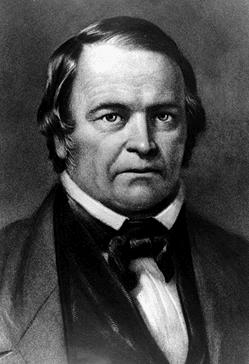
William Miller (1782-1849). Leader of the first Adventist movement, that eventually led to the Great Disappointment of 1844. Forerunner to many of today’s adventist splinter-movements.
A Brief History of Adventist-Type Movements in Christianity
Well, if you have not read the three part Veracity blog series on the Seventh-Day Adventist movement (#1, #2, #3), or do not know anything about the 19th century adventist movement, you should probably go ahead and read that. But in a nutshell, in the early 19th century, many Christians had adopted an historicist hermeneutic for Bible prophecy. This historicist hermeneutic has been one of the ways that Christian have used to interpret the Bible, by specifically locating different events described in certain books, mainly the Book of Daniel and the Book of Revelation, with exact moments in world history, all culminating with the expected Second Coming of Jesus.
The most well-known movement was associated with a Baptist minister, William Miller, who believed that the Book of Daniel teaches that Jesus would return in the year 1844. Thousands of Americans were persuaded by Miller’s teachings, known as the “Millerites,” selling their homes and all of their possessions, in anticipation of meeting Jesus at the Second Coming. When Jesus did not show up, it was known as the “Great Disappointment.”
Nevertheless, some of Miller’s followers did not give up, but simply concluded that they had interpreted the Bible wrongly, and mis-dated Christ’s return. The most well-known of these followers became the Seventh-Day Adventists, which in our present day, are pretty tame compared to some of the other groups that splintered off with other, more odd teachings, the Jehovah’s Witnesses being the most peculiar splinter group.
In the mid-20th century, Seventh-Day Adventist missionaries started churches in South Korea, eventually reaching a particular Buddhist family. One young man in this family, Ahn Sahng-Hong, became baptized as a Seventh-Day Adventist in the year ….
…. wait for it….
…. 1948.
However, Ahn Sahng-Hong got married, had three children, and was eventually booted out of the Seventh-Day Adventist Church in the early 1960s, because he was starting to promote some rather oddball teachings, that made his Seventh-Day Adventist teachers cringe. Ahn Sahng-Hong’s movement grew until he became associated with his “spiritual wife,” Zahng Gil-jah (that is a whole other story!!). Zahng Gil-jah had been born in….
…. wait for it….
….1943.
In 1984, Ahn Sahng-Hong had a revelation about Zahng Gil-jah. Then Ahn Sahng-Hong died in 1985.
Who is the “True” World Mission Society Church of God?
Well, this is when the story really gets really complicated, but it sounds a whole lot like what happened with the legacy of Joseph Smith, and the Mormons, when Joseph Smith died. In the Mormon narrative, the death of Joseph Smith in the 1840’s created a leadership crisis. Smith’s wife and son led a small splinter group that settled in Independence, Missouri, whereas the bigger splinter group, that everyone knows about, led by Brigham Young, made their way to Utah and Salt Lake City.
When Ahn Sahng-Hong died, unexpectedly in 1985, it created a leadership crisis. Ahn Sahng-Hong’s legal wife and at least one of his sons led a small splinter group, The New Covenant Passover Church of God. The larger splinter group eventually became what is now known as the World Mission Society Church of God (WMSCOG), led by Zahng Gil-jah, and a vibrant male leader, Joo Cheol Kim. The two men who were my interlocutors on my cross-campus walk have been members of a local World Mission Society Church of God congregation.
Let us put all of the pieces together: The WMSCOG teaches that Zahng Gil-jah, born in 1943 and still living, is in fact the “Heavenly Mother,” revealed to the world in 1984. On top of that, Ahn Sahng-Hong was the Second Coming of Jesus, having officially returned at Ahn Sahng-Hong’s baptism in 1948, the same year as the founding of the nation-state of Israel. This explains why Jesus came back with another name, Ahn Sahng-Hong. Nevertheless, Ahn Sahng-Hong, the returned Jesus, eventually “ascended back to heaven” in 1985. With Jesus back off in heaven now, the fundamental focus and tenet of salvation for the WMSCOG is accepting Zahng Gil-jah as the “Mother of God.”
Got it?
Well, there is interestingly even more to the story.
What makes it even more complicated is that back when Ahn Sahng-Hong was still alive, he never considered himself to be the Second Coming of Jesus, nor did he accept the revelation of Zahng Gil-jah as the “Mother of God,” or “Heavenly Mother.” Instead, Ahn Sahng-Hong dismissed the whole “Heavenly Mother” teaching to be complete nonsense, something that went way beyond his 1984 revelation, and he also taught that the Second Coming of Jesus is still yet a future event. The smaller splinter group, the New Covenant Passover Church of God, still holds to these alternative teachings.
The WMSCOG have been growing rapidly over the past ten years. In 2013, they reported some 2,500 congregations across the world, whereas most recently, in about 2018, they have reported to have over 7,500 congregations. In 2008, the WMSCOG reportedly had about 1 million registered members, whereas today, that number is at about 3.3 million registered members in 175 countries.
Unlike more familiar groups, such as the Mormons and the Jehovah’s Witnesses, the World Mission Society Church of God (WMSCOG) like to target their evangelistic work on college campuses, which explains why these nice young men approached me on my college campus. In an age where Biblical illiteracy, particularly among young people, is so common, college environments are a ripe mission field for the WMSCOG.
Even though historically orthodox Christians do not believe that God the Father is “male,” there are many who think that this is what Christians actually believe, so the WMSCOG concept of “God the Mother” offers an attractive balance to those who think that the Christian standard teaching on God the Father alone is misogynist, and too male-centric. It should be no surprise that in an age when “toxic masculinity” is rejected as evil that any effort to bring out a more feminine side to God offers a better way to balance out what is perceived to be a bias towards a masculine concept of God. The WMSCOG are also well known for their volunteer service and relief work in local communities.
Zangh Gil-Jah. The Mother of God (according to the WMSCOG). Who knew???!!!!
Taking Bible Verses Out of Context
It is not just the history behind the WMSCOG, and its growing influence on college campuses, that makes the “Heavenly Mother” message seem so odd. The practice of taking Bible verses out of context can be very confusing to Christians, particularly those who do not understand basic principles of doing Bible study. It is always a good idea to read the verses surrounding the passage in question, as well as reading the passage carefully and slowly.
For example, the WMSCOG use of Galatians 4:26 to identify the Jerusalem with the “Heavenly Mother” completely ignores the context of the verse itself. In the larger passage of Galatians 4:21-31, the Apostle Paul is using an allegory, about the story of Abraham and Hagar versus the story of Abraham and Sarah, as an analogy to describe the difference between Jews who accept Jesus as the Messiah, and those Jews who reject Jesus as the Messiah. Those Jews who reject Jesus are like the descendants of Hagar, who have Hagar as their mother. In contrast, those Jews who accept Jesus as their Messiah are like the descendants of Sarah, who have Sarah as their mother.
There is not a single passage in the Bible where Sarah is described as a “heavenly mother,” or otherwise somehow identified with God, or any other concept of divinity. Therefore, Galatians 4:26 is not talking about a heavenly Jerusalem as a symbol for “God the Mother.” Rather, it is associating a heavenly Jerusalem with Sarah, who is the spiritual mother of all those who believe in Jesus, that is the church.
The point of the parable is about the king celebrating his son at this banquet, and not any kind of introduction to the bride. There might be a better way of putting it, but this “wedding banquet” is more like a “bachelor’s party,” where the bride is not present. But instead of just the bridegroom’s friends and other special guests being invited, everyone in the king’s realm have been invited to celebrate the son.
To be honest, I never picked up on that when my friendly interlocutors were explaining the “true meaning” of the Bible to me. But when I went back afterwards and read the parable, slowly and more carefully, I noticed that the bride is nowhere mentioned in the story.
Mmmph.
Now the score is historic orthodox Christianity: 2, WMSCOG: 0.
The WMSCOG almost snuck that one right past me…. but not quite.
How to Read the WMSCOG Evangelistic Script
If Christians are really getting good Bible teaching in their local church, they will not be caught off-guard as much when faced with the rhetorical tactics employed by members of the WMSCOG. You do not need to be an expert in the WMSCOG, to try to defend your own understanding of the Bible. All you need to do is to invest in good Bible study skills yourself. It really pays to read the surrounding verses around a proof-texted Bible passage, along with reading the passage in question carefully and slowly.
I was genuinely surprised that my interlocutors closed off the conversation at that point giving me all of those dates, about Christ’s return, etc. But little did I know, I had played right in perfectly with their script. YouTube apologist Mike Winger has done several very informative videos describing the methods that the WMSCOG use to bring people into their group. Winger is a former Calvary Chapel youth pastor who is now dedicated to producing YouTube videos to help believers, and he has personally dealt with a number of people who have been influenced by the WMSCOG, in Southern California. I link to some of his videos below. Mike’s teaching is pretty in-depth, giving you more than you probably would ever want to know, but it is a very thorough critique of a growing, popular movement.
According to the script, my friendly interlocutors (and indeed, they were quite delightful to talk with) got my email address and asked if I would be interested in sitting down for another Bible study at a later point in time. In other words, the WMSCOG is not interested in “sealing the deal” at the first encounter. Instead, they want folks to dive into a multi-hour Bible study at a later point in time, in order to lay out the key beliefs that they want to try to promote.
Well, like I expected…. my sandwich was cold, after this conversation…. I decided to save it for the next day, and nibble on something else for dinner…..
I do not know if my interlocutors will really follow up with me or not, as I was able to anticipate a number of points they were trying to make in their presentation. I had followed them down the rabbit hole, hook, line and sinker, in playing the role they wanted me to play in following their script. Perhaps I caught on too much with what they were trying to do. But if they do follow up with me, I hope that I might offer some challenging questions, that might encourage them to think outside of the WMSCOG box.
What happens after we die? Is there a “heaven?” Is there a “hell?” If so, what does either of these look like?
The historical development of these ideas is the subject of Bart Ehrman’s Heaven and Hell: A History of the Afterlife. Bart Ehrman is perhaps the world’s best known critic of evangelical Christian faith, having grown up in the evangelical world until he deconverted out of it in graduate school. His New York Times best selling Misquoting Jesus has made him one of most widely read biblical scholars in our day at the popular level, sought after by the media almost every time a major story arises within Christianity.
With such a title, Heaven and Hell: A History of the Afterlife really peaked my interest. As you will read in this review, I really got into it and made dozens of notes. For over the past few years during the COVID pandemic, I have known of several friends who died of the disease, some of whom were at a relatively young age. I, myself, had a close brush with death about four years ago, after an automobile slammed into my bicycle on a busy road, throwing me back into the driver’s windshield. Thankfully, the only major injury I had was a concussion, that knocked me out cold for about an hour. The paramedics told me that I could have easily died, if the driver had hit me at a higher rate of speed. So, the topic of the afterlife is pretty pertinent to me, a lot more urgent than when I was a teenager, when I thought I was invulnerable to death.
Time for another English Bible translations update!!
I did one of these back in 2020, but some fairly big news stories warrants another installment for this year. First, some might have heard that BibleGateway.com has removed the Passion Translation from its website. I found the following meme on Brent Niedergall’s biblical studies blog that made me chuckle, based on the Star Wars theme:
The Passion Translation Controversy
What was all of the fuss about? Well, the Passion Translation, advertises itself as “a modern, easy-to-read Bible translation that unlocks the passion of God’s heart and expresses his fiery love—merging emotion and life-changing truth.”
Well, a number of Bible scholars and pastors think otherwise. The Passion Translation has been popular among a number of charismatic and Pentecostal Christians, written by a missionary who has faithfully served for the Gospel in Latin America for many years, Brian Simmons, who claims to utilize the original languages, Hebrew and Greek, and … wait for it … Aramaic, to produce the English text. While we can commend the good natured intent, the problem with the “Aramaic” part is that relatively little of our ancient original sources for the Bible are actually found in Aramaic. It makes one wonder what the publisher means by “Aramaic.”
As a paraphrase, the Passion Translation has a lot of interesting ways of freshening up the text. But as British pastor/teacher Andrew Wilson puts it, the problem is that the Passion Translation is marketed as a translation, when it really should be called a paraphrase. The promotional materials claim: “Recent biblical scholarship has begun tracing many of Jesus’ teachings back to an original Aramaic source. Some even argue the original Greek manuscripts were translations of even more original Aramaic sources.” Wilson contacted Australian theologian, Michael Bird, who was cited as an authoritative source for this claim, and Wilson’s way of telling it is quite colorful:
‘I actually followed this up with Mike Bird, and his response was short and to the point; I won’t quote it, but it was effectively Australian for “I don’t think this person is correct.”’
Probably the bigger news this year concerns the recent update to the New Revised Standard Version (NRSV) for 2021/2022, marketed as NRSVue, or NRSV Updated Edition. The NRSV is the endorsed Bible of the National Council of Churches, and the NRSV is pretty much the standard in mainline circles and in academia.
The older NRSV comes from a completely reworked version of the 20th century mainline standard translation, the Revised Standard Version (RSV), which was put together starting in the late 1940s with the New Testament, followed by the finished Old Testament being published in 1952 (some did not like the RSV then). After World War II, the National Council of Churches was known as the American wing of the World Council of Churches, resulting from a renewed emphasis in the ecumenical movement and world evangelization, after military servicemen were scattered all across the world, fighting in World War II. Since then, the National Council of Churches (NCC) appears to have drifted to the left theologically, as conservative evangelical churches kept their distance from the NCC. Along with that was skepticism among many evangelicals towards the NCC standard bearer Bible, the RSV….. despite the fact that one of my favorite professors in seminary loved the late 1980s edition of the RSV.
By the late 1980s, it was felt that the RSV was getting a bit “long in the tooth,” so the NCC bagged it. Interestingly, the conservative evangelical book publisher, Crossway, picked up the copyright of that old RSV, made some changes more suitable for conservative readers, and released a new Bible, the English Standard Version (ESV). While the venerable King James Version (KJV) and the New International Version (NIV) still remain the most popular Bible translation for conservative evangelical Christians, support for the ESV appears to be gaining more and more as the years go by.
The NCC decided to go with a different approach and came out with the NRSV in 1989, which became controversial for its use of “gender-neutral language.” In partnership with the Society of Biblical Literature, the NRSV Updated Edition (NRSVue) was finished in late 2021. A massive 10,000 substantial edits were made to the original NRSV, with 20,000 minor revisions, many of them described in this paper put out by the publisher. The NRSVue is destined to become the mainline standard Bible translation, superseding the previous NRSV. Here is a short sample of some of the changes:
changes “slave woman” to “enslaved woman” (Galatians)
changes “wise men” to “magi” (Gospel of Matthew)
changes “demoniacs, epileptics and paralytics” to “people possessed by demons or having epilepsy or afflicted with paralysis” (Gospel of Matthew)
adding capitalization to Jewish High Holy Days
changes “servant-girl” to “female servant” (Mark 14:69)
Do not let the reference to “mainline” scare you immediately, as the NRSVue is really one of the most competent translations available (… although there is a catch, as I will note in a moment). In my Bible reading, I like to compare popular evangelical Bible translations, like the ones I love, such as the English Standard Version (ESV), the New International Version (NIV), and the Christian Standard Bible (CSB) with the NRSV, … and now the NRSVue. In many ways the NRSV/NRSVue actually offers a more word-for-word sense of what the text is saying, in some cases. I frequently use the Harper Collins Study Bible, which uses the NRSV, to see if the NRSV will keep some of the other translations honest.
Nevertheless, the catch with the NRSVue is there is still an interpretive bias that peeks through every now and then, which tends to be progressive, appealing to its more liberal National Council of Churches constituents. More and more progressive elements have made their way into the new NRSVue. For example, The Institute on Religion and Democracy posted a pretty scathing review of the new NRSVue.
The most controversial example comes from the Updated Edition’s revision of 1 Corinthians 6:9-10:
Do you not know that wrongdoers will not inherit the kingdom of God? Do not be deceived! The sexually immoral, idolaters, adulterers, male prostitutes, men who engage in illicit sex, thieves, the greedy, drunkards, revilers, swindlers—none of these will inherit the kingdom of God.
The highlighted phrase “men who engage in illicit sex” is more ambiguous, as compared to the same phrase found in something like the Christian Standard Bible (CSB): “males who have sex with males.” The CSB rules out all sexual relationships between males, whereas the NRSVue leaves a door open. Is it therefore possible for men to have non-illicit sex with one another, and that still be okay in the Apostle Paul’s mind? On the other hand, other passages in the new NRSVue that deal with the same topic are more traditional, like Romans 1:27:
… and in the same way also the males, giving up natural intercourse with females, were consumed with their passionate desires for one another. Males committed shameless acts with males and received in their own persons the due penalty for their error.
Did God forbid Adam and Eve to include hamburger in their diet?
Many vegetarians and vegans would agree with that. But an even broader group of Christians today believe that Adam and Eve’s restricted diet demonstrates that there was no animal death before Adam and Eve sinned in the Garden. Young Earth Creationists, whether they be vegetarians themselves or not, claim that in God’s good Creation there would be no animal suffering or death. This all changed once Adam and Eve fell from God’s grace. It was not until the time of Noah and the Great Flood that humans were finally allowed to expand their diet to include the eating of meat.
But Adam and Eve were not the only ones required to have such a restricted diet. Visitors at the Creation Museum in Kentucky have at times taken a photo of a sign that asks, “What did dinosaurs eat?” Unlike what you see in all of those Jurassic Park movies, T-Rex would not have been a carnivorous, meat-eater. Instead, he would have feasted primarily on perhaps flowering plants.
No Animal Death and Suffering Before the Fall: Rationale for Adam and Eve’s Vegetarianism?
There are many arguments advanced by Young Earth Creationism, but this argument about “no animal death before the Fall,” which leads to the corollary belief that Adam and Eve were vegetarians, is probably the strongest argument in favor of a Young Earth Creationist interpretation of the Bible.
After all, it really is hard for many to imagine how God could create the animal world, and then allow for animal death and suffering to exist, and still call such a creation “good.” It is reasonable to conclude that God’s good plan for the redemption of humanity would also include a solution for the suffering experienced in the created world of the animals. As the Apostle Paul tells us:
For the creation waits with eager longing for the revealing of the sons of God.For the creation was subjected to futility, not willingly, but because of him who subjected it, in hopethat the creation itself will be set free from its bondage to corruption and obtain the freedom of the glory of the children of God.For we know that the whole creation has been groaning together in the pains of childbirth until now (Romans 8:19-22 ESV).
The argument is summarized by Ken Ham, the President of Answers in Genesis, on a rainy Kentucky day by a graveyard:











 Veracity