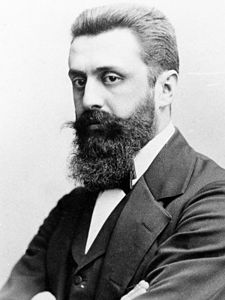
Theodor Herzl (1860-1904), one of the chief visionaries behind modern Zionist, the desire for a Jewish state in Palestine (credit: Wikipedia)
Was biblical prophecy fulfilled when the modern nation state of Israel was founded in 1948? Well, the story in its historical context is rather complex. Efforts to establish a Zionist state in the Holy Land began many years before 1948, and the impact of that history continues to be felt today.
The best place to start this part of the story is with a young Austria-Hungarian Jew in the late 19th century, Theodor Herzl.
Theodor Herzl (1860-1904) had gone to France to embark on a career as a journalist. There he followed the sensational Dreyfus Affair, where a French Jewish army officer was falsely accused and convicted of spying for the Germans. It was evident to many, including Herzl, that antisemitism was behind the entire trial, and that the future for Jews in Europe was rather bleak. As we saw in an earlier blog post, antisemitism was a terrible stain on traditionally “Christian” Europe. Continue reading
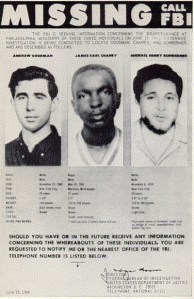
FBI poster looking for three missing civil rights workers in Neshoba County, Mississippi, June 21, 1964.
Ferguson, Missouri. Baltimore. Minneapolis. Baton Rouge. Dallas. Black Lives Matter.
America is caught in the middle of racial conflict, as tensions between law enforcement and African American communities have erupted in violence. However, the problem has deep roots in history. An understanding of these roots will go a long way towards healing and reconciliation. Some of these roots go back to misinterpretation of the Bible.
The Klansmen were aided by one of their number, a local deputy sheriff, Cecil Price, who arranged for the abduction of the three men after a supposed traffic stop and afternoon in jail. The three were taken to an earthen dam, where they were shot and buried, one of them still breathing as the bulldozer shoveled the dirt over them.
Deputy Cecil Price was never convicted of murder, but he was tried and sentenced to six years in prison on civil rights violations, in 1967. The ringleader of the Klan group, Edgar Ray Killen, was finally convicted of manslaughter and put in jail thirty-six years later in 2005, as part of this infamous “Mississippi Burning” case.1
Edgar Ray Killen was a part-time Baptist preacher. Killen had been put on trial back in the 1960s, but he escaped conviction back then due to a hung jury. One of the jurors in that early case claimed that they could have never convicted a preacher.
Price was the “law man,” and Killen had the Bible. Thankfully, men like Price and Killen are an exception, and do not represent in any way all law enforcement authorities or Christian preachers. Yet I sincerely doubt that Price would have been able to self-justify his actions if Killen, the preacher, had not somehow signaled that the terrible actions they ended up all taking were somehow, “Okay with God.”
So, what goes through the mind of someone, like “Preacher” Killen, who can justify such brutality, a man who claims to be guided by the Word of God? How can a law enforcement official, like Cecil Price, go along with such actions? Where do people get the idea, that the “mixing of the races” is something contrary to the Bible, to begin with? Continue reading
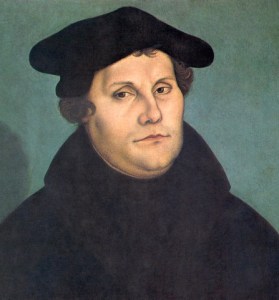
Martin Luther (1483-1546), by Cranach. Zealous champion of the Gospel, but with a horrific personal flaw (credit: Wikipedia)
“To forget the victims means to kill them a second time. So I couldn’t prevent the first death. I surely must be capable of saving them from a second death. “
“Antisemitism”, commonly understood to be the discrimination against the Jewish people, has never, ever been approved doctrine by any orthodox branch of the Christian church. After all, Jesus Himself was Jewish.
However, there have been a number of very terrible instances when antisemitic sentiment found itself promoted by a supposedly “Christianized” culture, and even supported by some practicing and prominent Christians themselves. As we continue this blog series on Christian Zionism, we take a closer look at one of the greatest tragedies in Christian history, stemming back to the famous Protestant reformer, Martin Luther. Continue reading
There is a good chance that you might be hearing quite a bit about Noah’s Ark in the near future…
Today, Answers in Genesis, will be opening a brand new museum, ArkEncounter, in Williamstown, Kentucky. Ken Ham, the visionary behind the project, believes that the story of the Bible teaches that a global flood cataclysm enveloped the earth less than 6,000 years ago. To drive home this interpretation of the Bible, Ham’s team has built a full-sized replica of the original ark, as a type of educational, Christian-themed amusement park.
Contrary to the quaint, Sunday-School description of cute giraffes sticking their heads out of the top of the ark, the primary message behind Noah and the flood is deadly serious. Humanity is sick with sin and rebellion against a holy and loving God, and apart from the Good News of Jesus Christ, we all deserve to perish underneath the waves of His holy judgment. While those who believe the Bible embrace these truths, not every believer interprets the scientific details of the flood in the same, precise manner as presented by ArkEncounter.
For example, ArkEncounter promotes the interpretation that the great mountains of the world, such as Mount Everest, were a great deal shorter just a few thousand years ago, prior to Noah’s flood. Therefore, God would not have needed five miles high of water to envelope the planet. Nor would have the animals required oxygen at such a great height, aboard the ark. This presupposes that once the great flood began to recede, a rapid series of plate tectonic movements resulted in the creation of mountains, like Everest, even though no such event is clearly described in the Bible, and no scientific evidence of such catastrophic tectonic movements has been found. Other Christians, on the other hand, believe that Noah’s flood was more local in scope to the Mesopotamian area, though sufficient enough to wipeout the then known, “world of the ungodly” (2 Peter 2:5). Such a large scale flooding event, though not global, does find support within current scientific research.
Several years ago, John Paine and I put together a bunch of posts examining the flood from a biblical point of view:
Noah, featuring the ministry of Hugh Ross and Reasons to Believe
Noah vs. Noah, more on the flood, and how Hollywood often gets the story wrong.
Also, Old Testament scholar Tremper Longman has a few blog posts, at Biologos.org, looking at the question of what is the ancient and proper literary genre of Genesis 6-9, as the key to understanding Noah and the flood. His answer, briefly? The flood story is “neither literal history nor myth.” It is something far more interesting.
Eric Metaxas, If You Can Keep It, passionately encourages our culture to consider the legacy of American exceptionalism. I like a lot of what Metaxas has to say. But does he take us down the right road theologically?
While your hot dogs are grilling and you wait for the fireworks…
There is much talk about “replacement theology” in the church today, as I am exploring in this summer’s blog series on Christian Zionism, concerning how national Israel relates to the Christian church. However, as the Fourth of July is nearly upon us, I wanted to briefly tackle a more pressing kind of “replacement theology” that dangerously threatens Christianity today. There is a disturbing trend among some Christians, who, in a sense, see the American nation as somehow “replacing” either the church or national Israel, or possibly both, within the plan and providence of God.
In If You Can Keep It, Metaxas’ reviewers note that the author makes a number of historical errors that hamper his otherwise noble thesis. One of the most egregious errors concerns a common misreading of Massachusetts Bay governor John Winthrop’s 1630 sermon, “A Model of Christian Charity.” Metaxas misreads the famous line by Winthrop, that “we shall be as a city on a hill,” to be a reference to the American nation for all time. However, the original context of Winthrop’s sermon is concerning the witness of Winthrop’s particular Christian community, going back to the teaching of Matthew 5:14. In other words, Winthrop is teaching about the church, not about America as a nation.
Think about it: By replacing the church as the “city on a hill” with the American nation, does this not radically change the message of Matthew 5:14?
Furthermore, Metaxas proclaims that Founding Father, John Adams, was a “theologically orthodox Christian.” However, an observant reader in colonial American history will know that Adams rejected a number of core tenets of orthodox Christian faith, such as the deity of Christ, the atoning work of Christ for salvation, and the belief in the Triune nature of God.2 Adams also preferred the Hindu Shastra as the best source for “orthodox” theology.
Think about it: Does remaking the great patriot, John Adams, into an honorary evangelical Christian really help Metaxas’ case? Does not this mishandling of historical data, at the very least, confuse the reader?
So, while I am very sympathetic to Metaxas’ call to virtue and the role of Christian values in public life, his reworking of some details of American history raises this disturbing question: Is Eric Metaxas promoting a kind of “replacement theology,” whereby the American nation replaces either the church or national Israel in the message of the Bible? For starters, read those two book reviews, previously linked above, read Winthrop’s sermon, or even allow Eric Metaxas to make his own case. Examine the evidence, think about it as you enjoy your hotdogs and the fireworks this weekend, and then come to your own conclusion.
Notes:
1. The Masters College is affiliated with the ministry of Southern California pastor and teacher, John MacArthur.↩





 Veracity