Monthly Archives: May 2016

The Civil War as a Theological Crisis

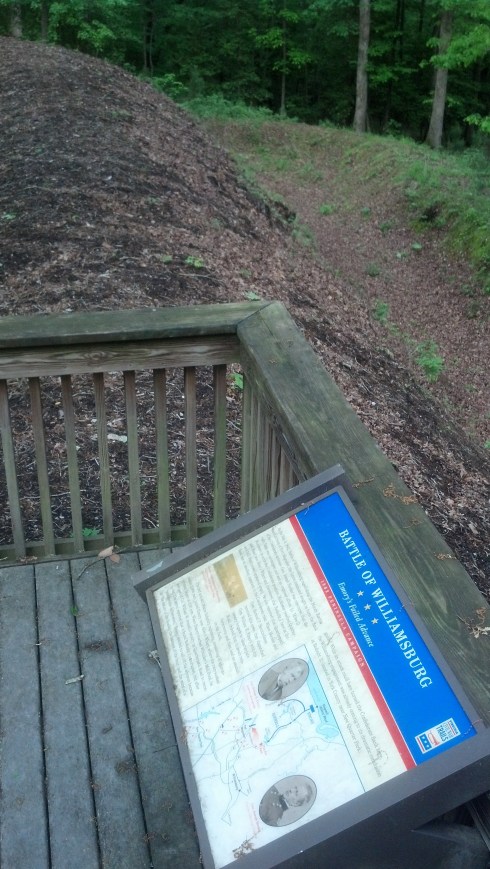
A steep, dugout embankment defending Redoubt #1, off of Quarterpath Road, where Confederate troops waited for advancing Federal soldiers to attack from Tutter's Mill Pond below, during the Battle of Williamsburg. Sadly, relatively very few of my fellow Williamsburg neighbors even know that this place even exists.

A steep, dugout embankment defending Redoubt #1, off of Quarterpath Road, where Confederate troops waited for advancing Federal soldiers to attack from Tutter’s Mill Pond below, during the Battle of Williamsburg. Sadly, relatively very few of my fellow Williamsburg neighbors even know that this place even exists.

Does the American national tragedy over the Civil War have something to teach us about how we are to read the Bible?

As a kid, I grew up near the remains of an oft-forgotten, Civil War battlefield. Whenever I ran among the dugout, redoubt embankments, I always kept in mind the warnings of neighbors to be careful, as there was likely to be found unexploded ordinance somewhere underneath my feet.

On the same day, hundreds of miles away, when Mexico was resisting the French on May 5, 1862, remembered now as Cinco de Mayo, Federal forces met Confederate forces just east of my town, for the Battle of Williamsburg, with nearly 4,000 casualties among both sides. Within a couple of years, the significance of that battle faded, displaced in memory by placenames like Antietam and Gettysburg.

Efforts to preserve the battlefield from being run over by suburban housing developments have been somewhat, moderately successful, though the land, as well as the intellectual debates that the led up to the war, have sometimes been forgotten. I often wonder myself, if such a national crisis could have been averted, without such terrible bloodshed.
Continue reading

He is Risen!… (in the East)

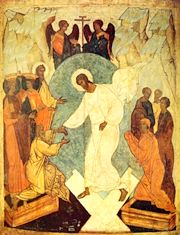
The Resurrection of Christ, by St. Isaac of Syria Skete (Boscobel, Wisconsin), credits the Orthodox Wiki.

He is Risen! The Resurrection of Christ, by St. Isaac of Syria Skete (Boscobel, Wisconsin), credit: the Orthodox Wiki.

To all of my Eastern Orthodox friends, I say “He is Risen!” on this day when you celebrate Pascha.

For those evangelical friends who have no idea what I am talking about, Pascha is the original name for Easter. Pascha is essentially a transliteration of the Hebrew word for “passover,” or pesach. Way back at the Council of Nicea in 325 A.D., the famous church council that resolved the dispute over the deity of Christ, which made way for the mature formulation of the doctrine of the Trinity, the council also established a uniform method for calculating the date for celebrating the Resurrection of Jesus.

However, the church in those days used the Julian calendar, which proved to be flawed in its ability to keep track of the solar year. The Western churches later fixed this by going to the current Gregorian calendar. However, the Eastern churches still have retained the old, Julian calendar method of calculation for Pascha. Hence, this year, the celebration of Pascha falls on May 1st, instead of March 27.

There are some who reject Easter because of its supposed connection to Germanic paganism. But since Pascha is really the earlier name, maybe Christians in the West can drop “Easter” and adopt “Pascha” instead, for now on, and be rid of this fringe complaint.

How about this? I have an idea. Next year, Western Easter and Eastern Pascha will fall on the same date, April 16. How about if the West adopts the “Pascha” name and the East adopts the updated Gregorian calendar calculation system, so that we can all celebrate the Resurrection of our Lord on the same day, in future years? Would this not move us a step towards Christian unity?

Do I have any takers?

…………………

I blogged about this before in 2014.