Monthly Archives: December 2015

Do Christians and Muslims Worship the Same God?

Wheaton College professor, Larycia Hawkins, in "hijab." (Facebook)

Wheaton College professor, Larycia Hawkins, in “hijab.” (Facebook)

Christianity Today magazine recently reported that Wheaton College, an evangelical university in Illinois, has suspended political science professor Larycia Hawkins after she made statements that “Muslims & Christians worship the same God.” Professor Hawkins raised eyebrows on campus a few weeks ago when she adorned herself with the Islamic “hijab,” as an expression of solidarity with Muslims across the world. But it was her “same God” comments that motivated school officials to place her on administrative leave, pending a review of her statements in view of Wheaton’s statement of faith that all faculty must sign.

Wheaton College made a good decision here, and let me explain why. In view of the recent excellent series on “Basic Islam” (#1, #2, #3, #4, #5) by my Veracity blogging colleague, John Paine, it might be good to revisit why John’s interest in Islam is so timely and important. The question of whether or not Christians and Muslims worship the “same God” is complicated. It is sort of like asking whether or not someone likes the game of “football.” For most Americans, this means a game involving helmets, shoulder pads, and touchdowns. But for the rest of the world, “football” means nets, headers, and penalty kicks; that is, the game of soccer. So, it all depends on what you mean by the question.

For example, Professor Hawkins states that both Muslims and Christians are “people of the book,” assumedly the Bible. In a sense, this is true. But the problem is that Muslims and Christians have very different views of the Jewish Scriptures and the Christian New Testament. Christians believe the Bible we have now is the very Word of God, whereas Muslims believe that the current Christian Bible is terribly corrupted. Are these different assessments of “the book” not contradictory with one another? In one sense, Christian and Muslims both agree that the Bible testifies to the one “God of Abraham,” but they disagree as to what correctly represents the revelatory content of that Bible.

Professor Hawkins is evidently responding to various, unnecessarily Islamaphobic statements being propagated among the American media in the weeks following recent terrorist attacks in 2015. Sadly, many Christians are giving into an ethic of fear, when the Bible makes it clear that the perfect love of Christ casts out all fear (1 John 4:18). However, going to the opposite extreme only confuses matters. A lot more nuance is required before a professor representing a Christian college issues a blanket Facebook post stating that we all “worship the same God.” For a balanced view of what lies behind the recent controversy, I would encourage Veracity readers to digest Scot McKnight’s recent blog post at Jesus Creed.

As fellow human beings, we must learn to live peacefully in a pluralistic society with our neighbors who embrace very different perspectives of who “God” is. We must receive even the Muslims as our neighbors, and love them just as Jesus loves them. To this point, I hope professor Hawkins is able to make her case clear to the community at Wheaton College and eventually return back to her teaching position. But we must not sweep the differences between Christians and Muslims underneath the rug and treat them trivially.

In an age when doors to missions among most Islamic countries remain closed, American Christians have only recently encountered an incredible opportunity to share their faith. Many Muslims, including refugees from Syria, are making their way to the United States, living in our towns and neighborhoods. You do not need to go overseas to become a missionary to Muslims when Muslims are living next door to you, working in your company, or attending classes with you in your school. We betray the Great Commission of our Lord if we turn a blind eye to developing relationships with these neighbors for the sake of the Gospel. Some say that within the last ten years, more Muslims have come to faith in Christ than in the previous fifteen centuries. The fields are ripe for the harvest.

I have friends who are Muslim, and they are truly wonderful people. Frankly, there are times where I would much rather hang out with some of my Muslim friends, than others who proudly deny the values shared by both Muslims and Christians, in favor of a godless materialism. Nevertheless, like with anyone else on planet earth, every Muslim needs to hear about Jesus:  but not only my Muslim friends, but everyone who is my neighbor.

Let us not get muddled over questions that lead us towards a sound bite theology. Make it point to learn something about Islam. Read John Paine’s blog posts for starters! Go out of your way to introduce yourself to a Muslim and get to know them as a friend. Pray for the opportunity to share the Good News of Jesus with others and be obedient. Love your neighbor.

We all need the Gospel. We all need Jesus, Christians and Muslim and everyone else alike.

UPDATE: 12/22/15 See updates on the situation at Wheaton College here.

Gloria In Excelsis Deo…and Standing Up Against Heresy

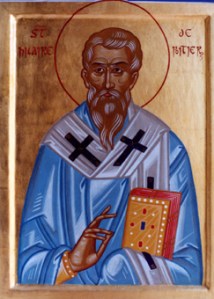
Hilary of Poitiers (about 300 - 367 AD), otherwise known as the "Hammer of the Arians," for his efforts to defend the doctrine of the Trinity

Hilary of Poitiers (about 300 – 367 AD), otherwise known as the “Hammer of the Arians,” for his efforts to defend the doctrine of the Trinity

Unlike the previous posts in this series about the “Gospel in Song,” regarding the Magnificat and the Benedictus, the popular Christmas song inspired by Luke 2:14 does not derive its name from Saint Jerome’s Vulgate translation of the Bible from the late 4th century AD. Jerome’s phrasing is gloria in altissimis Deo, where altissimis is one Latin variation meaning “highest.”  Instead, Gloria in Excelsis Deoor “Glory to God in the highest,” actually has its roots in an “old Latin” hymn from the early 4th century. Tradition suggests that it was Saint Hilary of Poiters (c.300-367 AD), a famous Western bishop of the church, who popularized the text for use in Christian worship.

Hilary of Poitiers grew up in a pagan home, receiving a thoroughly pagan education, before coming to Christ. When Hilary eventually became a leader in the church, he was embroiled in the Arian controversy, a theological movement that swept through Hilary’s Christian community. The Arians did not believe that Jesus, as the Son of God, was truly divine, so they rejected the doctrine of the Trinity, not too much unlike what Jehovah’s Witnesses today believe. When pressure came from the government for Hilary to reject the Trinity as well, Hilary refused to comply and was soon banished. Hilary believed that a denial of the biblical doctrine of the Trinity would trivialize the “glory to God in the highest” that is proclaimed in this old Christian hymn. Hilary’s stand to defend the truth of the Bible encouraged the faithful, and eventually the heresy of Arianism was rooted out of the church. Though Hilary of Poitiers is often forgotten by Christians today, the great hymn Gloria in Excelsis Deo, that is associated with his legacy, continues to be remembered all over the world.

The first movement of Antonia Vivaldi’s Gloria in Excelsis Deo, with a Latin/English translation here, performed in the National Auditorium of Music in Madrid:


Benedictus, Hanukkah and Jesus

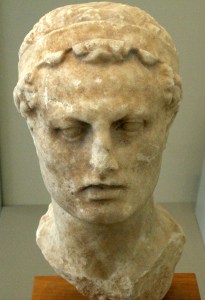
Syrian king Antiochus IV Epiphanies persecuted the Jews, which later triggered the Maccabean revolt, remembered today during Jewish holiday of Hanukkah (source Wikipedia: Altes Museum, Berlin)

Syrian king Antiochus IV Epiphanies persecuted the Jews, which later triggered the Maccabean revolt, remembered today during the Jewish holiday of Hanukkah (source Wikipedia: Altes Museum, Berlin)

Following on last week’s post on the Magnificat, from our church’s Advent sermon series on the “Gospel in Song,” we now consider the Benedictus, the Song of Zechariah, from Luke 1:68-79. The Benedictus is the great prophecy given by Zechariah regarding the birth of his son, John the Baptist (Luke 1).

In the last book of the Old Testament, Malachi, in the very last few verses, we read:

“Behold, I will send you Elijah the prophet before the great and awesome day of the Lord comes. And he will turn the hearts of fathers to their children and the hearts of children to their fathers, lest I come and strike the land with a decree of utter destruction.” (Malachi 4:5-6 ESV).

After this, the prophetic voice found in sacred Scripture is silent for some four hundred years. When would this “Elijah the prophet” come and prepare the way for the Lord?

Readers of the New Testament understand that this new “Elijah” is none other than John the Baptist.  Zechariah, the boy’s father, would sing of the “blessing”, or “benedictus”, in Jerome’s Latin Vulgate translation of the Bible, of the coming prophet who would announce that the Lord “has raised up a horn of salvation for us in the house of his servant David” (verse 69), where the “horn” is a reference to the deadly weapon and tremendous power of Jesus, the coming Messiah.

However, it is important to set the Benedictus within its proper historical context. Many Christians assume that since there is a Scriptural gap between Malachi and the New Testament, that nothing of significance happened here. But this would be terribly wrong.

A body of Jewish writings, primarily written in ancient Greek, did appear during this four hundred year “silent” period. Many of these writings found their way into the Septuagint, a collection of Greek translations of the Old Testament that effectively became the “Bible” for the early Christian movement. These writings that were not of Hebrew origin are typically known as the Apocrypha. In Roman Catholicism, the Apocrypha are considered to be deuterocanonical, or “second canon,” whereas for Protestants, these writings are simply known for being useful in terms of spiritual edification, but not sufficient for establishing doctrine. Consequentially, the lesser status of these writings has meant that the significance of these writings are often forgotten in our churches today.

But one very important incident, the Maccabean revolt, is preserved for us in the apocryphal writings of 1 and 2 Maccabees. When the Syrian Greeks led by Antiochus Epiphanes took over the land of Israel, they desecrated the Jewish temple and forbade the worship of the one True God. In response, Jewish revolutionaries led by a Judas Maccabeus resisted and successfully defeated the pagan invaders, against tremendous odds. This remarkable incident in Jewish history became the foundation for the celebration of Hanukkah.  Jesus Himself celebrated Hanukkah during his earthly ministry (John 10:22-23).

Some scholars have even suggested that the Benedictus, and perhaps the Magnificat, as well, have their historical roots, in some way, as Maccabean war songs. One might be able to see a connection here when Zechariah sings “that we should be saved from our enemies and from the hand of all who hate us “(verse 71). Whether or not these scholars are correct, is not so important. What is important is that we can surely appreciate how the early Jewish followers of Jesus saw that the message of Christmas was not simply about a sweet boy lying in a manger. Rather, they could see that the message of the Gospel, as announced by Zechariah, was a bold cry for light in the midst of a dark and hopeless world, which dovetails in rather nicely with the celebration of Hanukkah. Zechariah ends his song with:

To give light to those who sit in darkness and in the shadow of death, to guide our feet into the way of peace (Luke 1:79).

May we better understand that revolutionary message today, too.

The following 4-minute video from a Messianic Jewish community in Israel sums up the connection between Hanukkah and Yeshua (Jesus) rather well.


Krampus: “Santa’s” Dark Side

A 'Greetings for the Kampus' Christmas postcard from the early 1900s (source: Wikipedia)

A ‘Greetings from the Kampus’ Christmas postcard from the early 1900s (source: Wikipedia)

Just in time for this Christmas season, there is a new movie in theaters with a twist on Santa, Krampus (view trailer here). Krampus is actually an ancient, Alpine pagan character from pre-Christian Austria, a horrific beast who comes once year to scare children into good behavior. As the Gospel spread in that part of Europe centuries ago, the legend of Krampus got intertwined with the celebration of the Christian feast day for Saint Nicholas, on December 6. Old habits are hard to break! National Geographic has an informative write-up on the revival of Krampus celebrations, which generally takes place the night before Saint Nicholas’ day.

As Western culture continues to loosen its moorings to Christendom, it should not surprise us that Krampus makes his way to America. Krampus is yet another attempt in postmodernity to distract us from considering the mystery of the Incarnation. But it would be wrong-headed for Christians to dismiss Christmas itself as simply being of some pagan invention because of Krampus. We really need to be a bit “tongue in cheek” about this. So, I thought it might be helpful to relink a couple of older Veracity posts that dive into the history:


How Rosa Parks Became the “Patron Saint” of the Civil Rights Movement

Sixty years ago today, Rosa Parks, a “faithful member of St. Paul’s AME Church in Montgomery,” Alabama, refused to give up her seat to a white man on the bus. Gospel Coalition blogger, Justin Taylor, tells the story in this Washington Post article of how Rosa Parks, through her Christian faith, effectively became the “patron saint” of the American Civil Rights movement on December 1, 1955. Taylor notes five misunderstandings about Parks that have been distorted by popular history. While another woman previous to Parks challenged the bus segregation laws, it was the almost “biblical quality” of Parks that made her an iconic figure. How many of us today have the almost “biblical quality” that set Rosa Parks apart from others on that day in 1955?

Here is an interview with Parks before her death in 2005:

Explore these other Veracity postings on: