We had a very interesting evening of apologetics last night at the Williamsburg Community Chapel. Lee Strobel, Mark Mittelberg, and Michael Licona presented the Case for Easter in a simulcast to churches throughout North America.
Please use this post to make comments, ask follow-up questions, or share anything related to this event. We also offer the following materials and resources from the simulcast producers:
For those new to—or unsure of—the Christian faith, here is a presentation of the Gospel in an interactive ebook that uses apologetics to share the joy of personal discipleship.
Have a question, comment, or something to share? Please use the “What do you think?” box in the Comments section below. We look forward to sharing with you!
HT: Shirley Vining, Judy Williamson, Martha Karam, Dave Rudy, Clarke Morledge, Cliff Roebuck, Arlene Vander Loon, Eileen Grant, Andy Flint, Kevin Wilkins, Steve Flanary
A Veracity reader suggested that I review the Darren Aronofsky movie, Noah, if I happen to see it. My small group wanted to go, and since I had just seen God’s Not Dead, I figured I was on a roll anyway.
My biggest problem with Noah was that it really departed greatly from the story of the Bible without a compelling reason as to why this was necessary. To say that Aronofsky had a “creative interpretation” of the Genesis story is clearly an understatement. To put it in a nutshell, though I was fairly critical of some aspects of the God’s Not Dead movie, as a Christian if you had to pick between movies, go see God’s Not Dead instead, save the rest of your money and read the Bible story of Noah on your own. Probably the best thing to come out of the Aronofsky film is that hopefully it will encourage people to actually go read and study the Bible and talk about it (that is why I went to see the film in the first place with my Bible study small group!).
Please do not get me wrong. I really like well-constructed, imaginative sci-fi flicks and Noah was no exception. Noah clearly had a strong mythological feel to it, provocative reflections on the Book of Enoch’s “Watchers” (speculative ancient Jewish literature based on Genesis 6), a somewhat curious allusion to Abraham’s faith testing with respect to offering up Isaac as a sacrifice, and a strong environmentalist message with breathtaking views of Iceland. As a story with lots of Biblical elements, Noah was intriguing. I just think the actual Biblical story in Genesis 6-9 is far more interesting. Not only that, the Biblical narrative is also true. I will take the truth of Scripture any day over the speculative fantasies of Hollywood film producers.
The challenge for the Christian in reading Genesis is in trying to determine in what sense is it true. We already covered some of the basics here before on Veracity, but in light of the movie, a number of creationist ministries have produced material to help the church to process the Genesis Flood story.
Answers in Genesishas an extensive critique from a Young Earth perspective that embraces the Noah flood as a global event, including a two-hour teaching video analyzing the Noah movie.
Reasons to Believe has a number of helpful videos, podcasts, and other resources from an Old Earth perspective that sees the flood more in terms of a local event impacting the then known world of that time.
The BioLogos Foundation understands the flood from an Evolutionary Creationism perspective, viewing the flood with respect to the original, ancient literary genre of the text as the key to interpreting this passage of Scripture.
I want to highlight one approach from BioLogos given by Old Testament scholar, John Walton, from Wheaton College, who views the Noah story in terms of transforming the world of disorder into non-order and then into a world of order within the context of God’s covenant with His people.
One more closing thought: one of the problems with the flood narrative from a scientific perspective is that if you understand a pure literal reading of only Noah and his immediate family and their wives entering the ark, it makes the subsequent re-population of the earth problematic from a genetic diversity perspective. But if the human population on the ark also includes others in Noah’s extended family, household servants, etc. that the Bible simply omits to tell us about, this becomes less of a problem. Also, remembering that the flood was specifically sent upon the “world of the ungodly” (2 Peter 2:5), this may allow for the possibility of the Noahic survivors of the flood contacting other humans who were not impacted by the judgment of the flood. I have nothing definitive here, as these are just some thoughts to stimulate further study in this most intriguing text of God’s Word.
The final takeaway: the movie is more than a little weird, but it has some elements that warrant good discussion and critical engagement with its themes, and it rightly presents Noah as a complicated man. Contrary to popular belief, the Biblical Noah was not righteous because of his works. Rather, he was declared righteous by the grace of God. Humanity is in rebellion against God. That includes Noah. Thankfully, God’s salvation is extended to us by His loving mercy. If we can get this central message of the Biblical Noah in our minds and hearts, then the rest of the details should fit within the proper Biblical perspective.
William Tyndale is one of the most important people in English history that few rarely ever know. Through his passion to get the Bible, God’s Word, into the hands of ordinary people, he gave us the linguistic structure of what we consider modern English, perhaps just as influential, if not more so, than William Shakespeare. The following blog post from our church’s Lenten series demonstrates the Tyndale legacy…
Some dismiss William Tyndale and his followers as being hopelessly anti-Catholic, but such an assessment obscures his otherwise remarkable contribution to the history of the church.
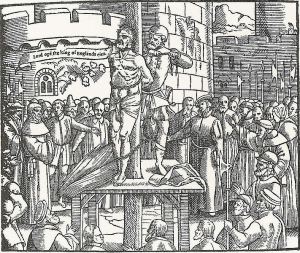
Woodcut from John Foxe’s The Book of Martyrs. William Tyndale (1494-1536) cries out, “Lord, open the King of England’s eyes.”
Are you willing to “go the extra mile” for someone?
If you know what I am talking about, you might know that this phrase,
“go the extra mile“, comes from the Bible (Matthew 5:41). But
did you know how this phrase became part of the English language?
William Tyndale (1494-1536) was an energetic scholar, a real brainy
guy, kind of like his fellow yet modern Englishman, Tom Wright, who
wrote our study book for Lent on the Gospel of Matthew.
Tyndale was bothered that his typical neighbor was not able to read
the Bible in their native English language in the 16th century. So he
went about learning ancient Greek and Hebrew and began translating the
Bible into English. Unfortunately, the political and religious establishment of his day…
Christ Driving the Merchants from the Temple by Jacob Jordaens, c. 1650
Left to your imagination, what would Jesus look like?
In Matthew 21:1-22 we see Jesus’ triumphal entry into Jerusalem on Palm Sunday, with an adoring crowd shouting praises and laying palm branches on the road. They shout “Hosanna!” which is a Hebrew expression for “Save!” and an exclamation of praise.
If you would like to get a sense for the setting of the Palm Sunday processional, here’s a brief video on the Golden Gate in Jerusalem that documents an extraordinary archaeological find.
One theme throughout the Gospels is that Jesus is on a mission, and that mission includes the fulfillment of prophesies made centuries before He appeared on earth. In this case, the parade was foretold by the prophet Zechariah—who prescribed a donkey for the processional. Not some big chariot, not with a military escort as a show of power, not…








 Veracity