Tag Archives: zionism

Racism, Police Authority, and the Misinterpretation of the Bible

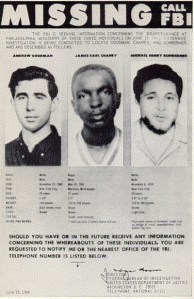
FBI posted looking for three civil rights workers in Neshoba County, Mississippi, June 21, 1964.

FBI poster looking for three missing civil rights workers in Neshoba County, Mississippi, June 21, 1964.

Ferguson, Missouri. Baltimore. Minneapolis. Baton Rouge. Dallas. Black Lives Matter.

America is caught in the middle of racial conflict, as tensions between law enforcement and African American communities have erupted in violence. However, the problem has deep roots in history. An understanding of these roots will go a long way towards healing and reconciliation. Some of these roots go back to misinterpretation of the Bible.

In June, 2016, the Mississippi attorney general officially closed a 52-year old case involving the murders of three civil rights workers, in the summer of 1964. Members of the Ku Klux Klan in Neshoba County had killed two white men and one African American who had traveled to Mississippi to help segregated African Americans register to vote. The Klansmen feared that the efforts of these three men would lead to the “mixing of the races,” so they sought to teach the civil rights workers “a lesson.”

The Klansmen were aided by one of their number, a local deputy sheriff, Cecil Price, who arranged for the abduction of the three men after a supposed traffic stop and afternoon in jail. The three were taken to an earthen dam, where they were shot and buried, one of them still breathing as the bulldozer shoveled the dirt over them.

Deputy Cecil Price was never convicted of murder, but he was tried and sentenced to six years in prison on civil rights violations, in 1967. The ringleader of the Klan group, Edgar Ray Killen, was finally convicted of manslaughter and put in jail thirty-six years later in 2005, as part of this infamous “Mississippi Burning” case.1

Edgar Ray Killen was a part-time Baptist preacher. Killen had been put on trial back in the 1960s, but he escaped conviction back then due to a hung jury. One of the jurors in that early case claimed that they could have never convicted a preacher.

Price was the “law man,” and Killen had the Bible. Thankfully, men like Price and Killen are an exception, and do not represent in any way all law enforcement authorities or Christian preachers. Yet I sincerely doubt that Price would have been able to self-justify his actions if Killen, the preacher, had not somehow signaled that the terrible actions they ended up all taking were somehow, “Okay with God.”

So, what goes through the mind of someone, like “Preacher” Killen, who can justify such brutality, a man who claims to be guided by the Word of God? How can a law enforcement official, like Cecil Price, go along with such actions? Where do people get the idea, that the “mixing of the races” is something contrary to the Bible, to begin with? Continue reading


Luther’s Deadly Error: Zionism #3

Martin Luther (1483-1546), by Cranach (credit: Wikipedia)

Martin Luther (1483-1546), by Cranach. Zealous champion of the Gospel, but with a horrific personal flaw  (credit: Wikipedia)

“To forget the victims means to kill them a second time. So I couldn’t prevent the first death. I surely must be capable of saving them from a second death. “

Elie Wiesel, holocaust survivor, died July 2, 2016

“Antisemitism”, commonly understood to be the discrimination against the Jewish people, has never, ever been approved doctrine by any orthodox branch of the Christian church. After all, Jesus Himself was Jewish.

However, there have been a number of very terrible instances when antisemitic sentiment found itself promoted by a supposedly “Christianized” culture, and even supported by some practicing and prominent Christians themselves. As we continue this blog series on Christian Zionism, we take a closer look at one of the greatest tragedies in Christian history, stemming back to the famous Protestant reformer, Martin Luther.
Continue reading


The Parting of the Ways: Zionism #2

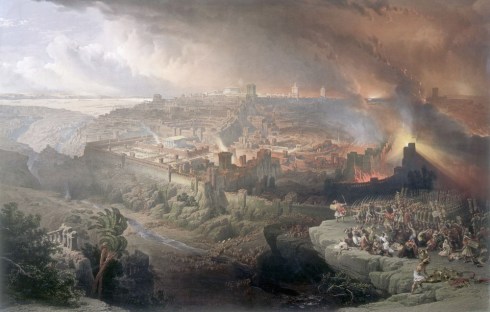
The destruction of Jerusalem by the Romans in 70AD -- a painting by David Roberts (1796-1849).

The destruction of Jerusalem by the Romans in 70AD —
a painting by David Roberts (1796-1849).

In our first post on Zionism, we briefly defined what Zionism is, and gave a broad sketch of history. Here we dig deeper and look at what happened between the early Christian and Jewish communities after the destruction of the Temple in Jerusalem in 70 A.D.

The early Christian church was primarily Jewish and mainly worshipped in the synagogues. However, Christians mostly did not support Jewish efforts to rebel against the Roman authorities during the conflict leading up to and after 70 A.D., as the Temple was no longer central to the life of the Christians. Instead of fighting alongside their other Jewish brethren to repel the Romans, the Jewish Christians in Jerusalem and the surrounding area fled the city to escape the coming bloodbath, when the Romans began to take seige of the ancient, holy city. This, along with the rejection of many Jewish practices, created resentment by traditional Jews against their Jewish Christian brethren.

The increasingly predominant Gentile Christian movement eventually overwhelmed Judaism in terms of numerical growth, and then Christianity became the official religion of the old Roman empire, further marginalizing Judaism. Over time, Jewish and Christian communities had parted ways from each other.
Continue reading


What is Christian Zionism? : Zionism #1

Is the secular nation state of Israel a fulfillment of Bible prophecy? Veracity tackles a "hot potato."

Is the secular nation state of Israel a fulfillment of Bible prophecy? Veracity tackles a “hot potato.”

On May 15, 1948, the modern nation state of Israel was created. Ever since then, students of the Bible have taken a great interest in the Jewish return to the Holy Land. Is this a fulfillment of biblical prophecy?

Many people are interested in events surrounding the End Times. A number of Christians say that the establishment of the Israel in 1948 is proof that God has fulfilled biblical prophecy. Other Christians are not so sure. Some even question the idea that the Scriptures teach about a literal return of Jews to the Holy Land as a modern nation state. How do we sort these difficult and complicated issues out?

Here we begin a multi-part series1 of blog postings that examines the question of the founding of the modern nation of Israel and its relationship to Bible prophecy. We will look at the history of why there was a felt need to create a Jewish state in the modern Middle East. We will address some of the events that led to the creation of this Jewish state and the conflict that resulted. We will then consider the relationship between modern Israel, Judaism, and the Christian community in the Holy Land. After that, we will survey different Christian approaches to Bible prophecy that address the role of modern Israel. Towards the end of the series, I hope to share some of my personal reflections as I have studied this issue in the Bible.

Many Christians have strong views on “Israel,” and this has forced me to dig into both Scripture and history to work this out. As you will see, I mainly offer some food for thought, as I seek to submit to the teaching ministry of the Holy Spirit, that this might become a blessing to others as they struggle in this area. I invite your feedback in the comments section, as we think together through this.

Continue reading


Christian Passion About Israel: Can We Talk?

Is the secular nation state of Israel a fulfillment of Bible prophecy? Veracity tackles a "hot potato."

If I had to name one, persistent, mind-boggling issue that has divided so many conservative, evangelical Christians, it would be this one: Israel.

Unlike, say the creation vs. evolution controversy, women in ministry, etc., that some categorize as conservative vs. liberal splits, the question of what to think and do about national Israel defies simple labels. There is tremendous pressure from the surrounding culture to go in very opposite directions. On one side, are those who view Christianity as complicit in enabling, and even consciously encouraging, centuries of antisemitism. On the other side, are those who view Christianity as terribly narrow and closed-minded, urging Christians not to try to share their faith with the Jewish people.

Nowhere does the issue become more focused and heated among believers, than when it comes to the subject of the land of Israel, and the current Jewish nation state that exists there in the modern Middle East. To one extreme, are those who view any criticism of the nation of Israel as being hateful and antisemitic. On the other extreme, vocal support of the nation of Israel at the expense of spiritual concerns is sometimes viewed as a compromise on the centrality of Christ, diminishing the need to have Christ, and Christ alone, for salvation.

Israel can be deeply polarizing.

Call me naive, but I am a big believer in the need for Christians to have better and more civil conversations with one another, on emotionally-charged subjects like Israel.  Otherwise, the consequences can be devastating. If Christians are unable to have frank and open dialogue with one another, without resorting to name-calling, then this brings ill repute upon the message of the Gospel to a watching world. In an effort to promote such open and brotherly discussion, I will soon embark on a multi-part blog series on the question of “Zionism,” and its relationship to Bible prophecy1.

As I have been studying Romans 9-11 over the past year or so, the theme of how a Christian should respond to “Zionism,” the Jewish desire to return to their ancestral homeland, pops up over and over again in my conversations with fellow believers. Keep an eye out for this upcoming blog series…. and keep your Bibles, and your minds, and your hearts open.

Do you want to get the conversation going? How about two movies that illustrate the tension in the discussion?

Continue reading