Tag Archives: veracity

Transformation: Dallas Willard

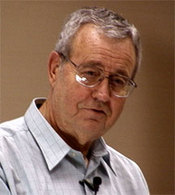
Dallas Willard. Pioneer for the renewal of spiritual formation in the contemporary church.

Dallas Willard. Pioneer for the renewal of spiritual formation in the contemporary church.

Can you tell the difference between someone who says that they are a Christian, and someone who is not?

The Apostle Paul challenges us:

Examine yourselves, to see whether you are in the faith. Test yourselves. Or do you not realize this about yourselves, that Jesus Christ is in you?—unless indeed you fail to meet the test! (2 Corinthians 13:5, ESV)

Whoa.  I am not sure I like this type of test. Do you meet the test? Or does it only apply to the really “spiritual” people out there?

The existence of many people who are Christian “in name only” is a serious problem in the contemporary church, even among so-called “Bible-believing” congregations. Dallas Willard, who died on May 8, 2013, believed that he had pinpointed the source of the problem.
Continue reading


Taizë

This coming  Sunday, our church will sing a modified version of a Taizë worship song, “Holy Spirit, Come to Us.” Songs from Taizë are generally simple, short choruses based on the Bible. In the original Taizë community, these worshipful, chant-like songs are sung over and over again multiple times. Here is a recording of the original version of “Holy Spirit, Come to Us.”

But what is Taizë? In the spring of 1940, the German army overran the defenses of France, bypassing what was thought to be the impenetrable Maginot Line, shattering the confidence of the French people.  Roger Louis Schütz-Marsauche, who was raised in a Swiss Protestant Reformed family, was absolutely stunned by the overwhelming power of Nazi Germany’s military might. But he believed that God was much bigger than the Nazi war machine. He rode on a bicycle to the small town of Taizë in unoccupied France near Switzerland, where he spent two years hiding Jewish refugees from the grip of the Nazis. He was forced to leave Taizë for a few years, but “Brother Roger” was able to return in 1944 to start a small community of men committed to living in poverty, chastity, and obedience. From that time forward, “Brother Roger” and his band of like-minded were committed to a quest for reconciliation in the spirit of Christ.

Over the years, along with other refugees, tens of thousands of young people from all over the world have come to visit the community. What is particularly unique about Taizë is the ecumenical nature of the community, Protestants and Catholics, all living together in a monastic style focused around prayer, work and hospitality. But the most profound influence of Taizë is the music.

Various churches around the world offer Taizë services that can give you a taste of how meditative music and silence is practiced in the original Taizë community. In the Richmond, Virginia area, the Richmond Hill Retreat Center at 2209 East Grace Street offers a Taizë prayer service on the first Monday of every month at 7:30pm.


Son of Man: In Search of That Missing Prophecy

Is this Jonah being swallowed by the big fish, or is this how I felt at a Bible study the other night when I was stumped by a really good question?

Jonah and the big fish… or small group Bible study leader stumped by a really good question?

So, we had a “mini-crisis” in our small group Bible study recently. We were looking at the question of how Jesus fulfills prophecy in the New Testament. Someone read from Luke 24:45-46:

Then he opened their minds to understand the Scriptures, and said to them, “Thus it is written, that the Christ should suffer and on the third day rise from the dead”(ESV)

Then, the question came: “Does anyone have a reference for this prophecy given in the Old Testament?”

Pages started to rattle. Folks were hunting for a cross-reference. Someone looks around the room for a concordance. Others were pulling out their iPhones to ask the “Almighty All-Knowning Google” for the answer. Whew, boy. I was in trouble.

You see, I’m like, uh, the small group leader. Not only that. I got a seminary degree. Yet, I was completely stumped. All that theological mumbo-jumbo and graduate school $$$  and I was busted.  I tried to mutter something spiritual and intelligent sounding. It was not really working. Folks were looking at me like, “Nice try, no dice, buddy”. I was thinking that Professor Hagner back in seminary was watching, peering over the top of his glasses down at me.  Sweat was pouring down my brow. The room was uncomfortably warm. I was glad I had my day job. Perhaps I could have tried to sneak out the backdoor…. Whoops. That would not have been good…. We were meeting at our house.

😉

OK. I am exaggerating quite a bit. We have a wonderful small group, after all. But it is a great question: Where in the Old Testament do you find the prophecy where Jesus says He will rise again from the dead on the third day? Well, unfortunately, you might be searching a long, long, long time for a specific verse…..
Continue reading


Things that Go Bump in the Night

“From goulies and ghosties and long-leggedy beasties
And things that go bump in the night
Good Lord, deliver us!”
Scottish prayer recorded in The Cornish and West Country Litany, 1926
Nightmare

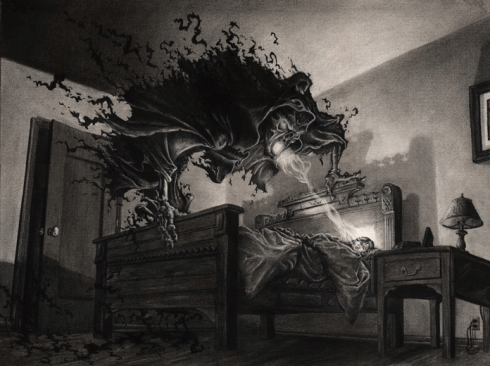
Nightmare by Paul Bielaczyc. Charcoal, 2005.


There was my dentist—a normally genteel man—in the back of a military cargo plane decked in an olive-drab Level A HAZMAT suit, gesturing me into his examination chair with long, gleaming, barbaric surgical instruments. I had a hard time making out what he was saying behind his face shield, but it sounded like, “Buckle up.” I’m pretty sure he was grinning.

I’m not one much for dreaming, nor am I particularly anxious, but it’s amazing what the anticipation of a minor dental procedure did to loose my subconscious this week.

Fear is powerful, and the Bible has a lot to say about it. The words fear, afraidanxious, and anxiety appear 541 times in the ESV.

  • The fear of the LORD is the beginning of knowledge; (Proverbs 1:7)
  • Be not wise in your own eyes; fear the LORD, and turn away from evil. (Proverbs 3:7)
  • Therefore I tell you, do not be anxious about your life, what you will eat or what you will drink, nor about your body, what you will put on.” (Matthew 6:25)
  • He said to them, “Why are you so afraid? Have you still no faith?” (Mark 4:40)
  • And he said to them, “Why are you afraid, O you of little faith?” (Matthew 8:26)

Need an anti-anxiety prescription?  Here you go: fear in the right channel is prescribed—throughout Proverbs and the rest of the Bible. The apostle Paul instructs believers in Philippians 2 to, “Work out your own salvation with fear and trembling.”  We’re not supposed to be free from fear. We’re supposed to live with fear in the right context—reverence and respect for the awesome power of our Creator. That’s what Dick Woodward’s 4 Spiritual Secrets are all about.

Ready for some good news? According to Jesus, fear has an anecdote: faith.

Fear is powerful. My loving mother, who hung that Scottish prayer just outside my bedroom door, was paralyzed by fear her entire life. So many times I wished I could have helped her think through her fear. But that’s not the way it works. Overcoming fear is not a matter of our intellect or will—it’s a matter of the heart. And no one gets out alive. Apart from the grace of God and a little faith we don’t stand a chance.

Here’s a link to Whom Shall I Fear? by Chris Tomlin that gets to the heart of the matter.

Peace.

HT: Paul Bielaczyc (Nightmare used with the kind permission of the artist.)


Son of Man as Israel?

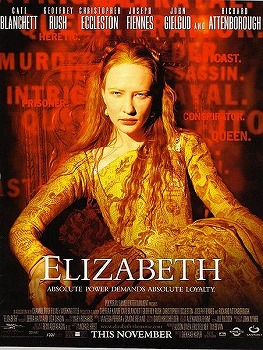
Elizabeth, Queen of England.   She represented the aspirations, hopes and dreams of her nation.

Elizabeth, Queen of England. She represented the aspirations, hopes and dreams of her nation.  What insight does this give us in knowing  how the Son of Man represents Israel?

Jesus’ self-designated title of Son of Man is a mystery to many. What does Son of Man “represent”?

One of my favorite movies is Elizabeth, starring Cate Blanchett. What strikes me about the Virgin Queen was that she truly personified England as the up and coming European empire in the 16th century. As she matured over her long forty-four year reign, England grew along with her to become a decisive world power. Elizabeth never simply spoke nor acted on her own. She represented England as a nation.  She was not just a queen.  She was England.

To “represent” some entity has an interesting etymology. It is derived from a Latin phrase meaning “to present”, or “to symbolize, to be the embodiment of”.

Earlier on Veracity, we explored how Jesus as God’s “Son” lives out the same type of life that the nation of Israel was originally supposed to do as God’s “son” in the Old Testament. Israel was disobedient, but Jesus obediently fulfills what God intended Israel to do. Jesus somehow embodies all of what the nation of Israel is meant to be.  How do we clarify what it means to say that Jesus represented Israel?
Continue reading