An introductory note: Before Dick Woodward died on March 8, 2014, Dick asked me to write a tribute to Tim Hansel here on Veracity. Not too long after Dick Woodward realized that he would never walk again in the 1980s, Dick started to read Tim Hansel’s books. They made a huge impact. As you consider Tim Hansel’s example, you might see why Dick thought that this story is so important and still needs to be told… Clarke Morledge
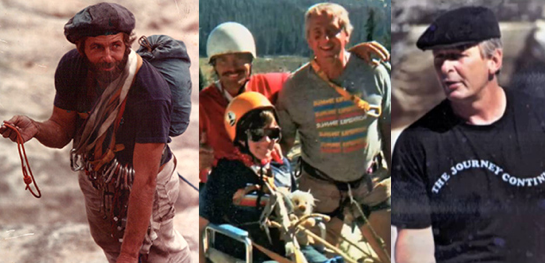
Tim Hansel (1941-2009). Adventurer, friend of high school kids, …. and sufferer of unbearable chronic pain. Tim is on the right in the middle photo (photo credit: SummitAdventure)
I never met Tim Hansel. He was speaking at a Young Life staff conference back in 1990 and I missed his talk. But I got a cassette tape later of his message. As I was listening to him make jokes left and right throughout his talk, I thought to myself that this guy was a real character. I was laughing right along with him, … until he was telling his listeners that he was living in continuous chronic pain. Continue reading
Remember those earlier days after you had received the light, when you stood your ground in a great contest in the face of suffering.
So do not throw away your confidence; it will be richly rewarded. You need to persevere so that when you have done the will of God, you will receive what he has promised.
Hebrews 10:32, 35-36 (NIV84)
Dick Woodward
The wisest man I ever met went home yesterday.
Our regular readers know how much Clarke and I have been shaped by Dick Woodward’s ministry. It would have been impossible for us to have any kind of teaching ministry—blog or otherwise— without sharing what we learned from him. His occupational title was ‘pastor’, but he saw himself, perhaps first and foremost, as a teacher.
There will be many fine tributes in the days ahead, and I am not a good enough writer to do him justice. But I will share some personal remembrances as a small way of saying ‘thanks’.
Biography
Dick Woodward helped found and pastor both the Virginia Beach Community Chapel, where he served 23 years, and the Williamsburg Community Chapel, where he remained as pastor emeritus until his passing. His relationship with (don’t skip this hyperlink) Dois Rosser, the founder of International Cooperating Ministries (ICM), made it possible for Dick to realize his dream of “The Whole Word for the Whole World.” His Mini Bible College program has been translated into 31 strategic languages and is used around the world to nurture believers and assist in church growth. MBC is a survey, book, and topical study of the Bible that teaches practical and devotional applications of every book of the Bible to our lives.
In 1980 Dick was diagnosed with a degenerative disease of the spinal cord that eventually left him a bedfast quadriplegic. In spite of this disease he remained active in small groups, mentoring, and writing Bible study materials. He was an avid blogger and a meticulous and prolific writer, and produced his ambitious Marketplace Disciples in December, 2013. He often said, “The less I can do, the more the Lord does.”
Being around him was like taking a spiritual shower. He was always upbeat and encouraging—unquestionably the most steadfast, most faithful, and toughest man I ever met. I never saw him down, and never heard him say an unkind word about anyone. Never.
In no particular order, here are a few remembrances and impressions for which I am grateful.
If Dick had not been a pastor, I am certain he would have been a comedian. He started every sermon with a joke, and most of them were very funny. There was a method to his joke telling—people didn’t want to miss the beginning of his sermons for fear they would miss the joke.
He was completely self-deprecating. When I started attending his church I was taken by his descriptions of shooting rats in a landfill, stray bullets, and snatching a parishioner by the collar. This guy was for real. He described himself as a ‘barbarian’ in his teenage years. He wasn’t what I thought preachers were like. Again, I am extremely grateful.
Dick had a very sharp mind. He had memorized over 100 hymns and countless lines of Scripture. I always hesitated to cite a chapter and verse with him, because if I missed, he could call me out. He never did.
He loved Scripture songs. I can vividly recall his a cappella voice leading the congregation in “Jesus is Lord of Heaven and Earth,” from his wheelchair, with Jane Hanson and Gayla Johnson making my neck tingle with their soprano runs from the seats behind me. Wow, what I wouldn’t give to hear that again!
He loved the Pittsburg Steelers, sports, and generally anything to do with Pittsburg (where he grew up).
In recent years Dick and I would meet under the guise of helping him with his computer. His doctors and caregivers said he had to limit his time with visitors to save energy, and I was always looking at my watch, but he loved to talk. Even when he had to struggle to do so. He was diagnosed with sleep apnea a year or two ago, and his BiPAP therapy gave him a second wind (literally). There were times when he just wouldn’t stop talking.
Dick would not miss any opportunity to teach people about the Bible and about Jesus Christ. One of the things I set up for him was the automatic signature for his outgoing emails. Tonight, it seems like a fitting epitaph. It read:
Dick Woodward Founder & Teacher Mini Bible College 4 Spiritual Secrets learntolive
“And I am sure that God, who began the good work within you, will continue his work… For God is working in you, giving you the desire to obey him and the power to do what pleases him.” (Philippians 1:6; 2:13, NLT)
He was encouraging; some would say to a fault. If anyone went to him and said they wanted to become a brain surgeon, Dick would encourage them, regardless. There were no limits, just positive support. Dick truly believed that God could do anything with anyone—as expressed in his email signature.
I have listened to thousands of hours of his preaching and teaching, and his lessons are quite ingrained. When I began teaching adults, Dick’s material was my plumb line. It always will be. When I am blogging and find myself getting on a high horse, I ask myself “what would Dick say or think about that?” The result is typically a deletion of smarmy words and comments, and a softening of my attitude.
Dick was so humble. I remember reading one of Clarke’s statements that, “C.S. Lewis never systematized his theology,” and began wondering why Dick never systematized his theology. When I came to my senses I realized Dick had completely systematized his theology—it’s called “The Four Spiritual Secrets.”
Dick said he really didn’t get C.S. Lewis. He once told me he thought Lewis made things too complicated. “I’ve spent my ministry trying to make things simple so people can understand.” Every time I catch myself wanting to toss in an extra big word in my writing, I hear Dick’s echo.
He was a fierce writer. He had editors for his published books, and he would send them drafts, and when the editor’s comments came back Dick was persistent and insistent. Man, he worked over sentences! It was an amazing thing to watch because he had to draw in a breath and push hard to make the voice-activation work. It took a lot of voice commands to revise his text, particularly when, as he would say, his “computer was having a bad day.” It was exhausting, but he did it because the words really mattered to him.
He knew all the big names in Christianity. I would tell him about a video I saw on Robertson McQuilkin, and Dick would start talking about what kind of cook Muriel McQuilkin was, and how they used to come visit Dick in Williamsburg. Dick studied under Robertson McQuilkin—and Howard Hendricks (Dick affectionately remembered him as ‘Howie’). Bill Bright and Ravi Zacharias came to see him. He arranged to have John Stott come speak. He worked under J. Vernon McGee. He studied at Biola and Columbia University.
For all his publishing and ministerial work, Dick never tried to cash in. He once told me that he and Ginny hated “that sort of thing” (meaning where people made God’s Word less accessible by charging for it, and even worse, trying to profit from its distribution). He said everything he did was intentionally in the public domain. His publishers still need payment for their efforts, but that’s the way he truly felt about what he was doing.
Dick’s dad worked multiple jobs to support his family through the Great Depression, including driving a cab at night. Dick got his work ethic from his dad, as well as his love of the Scriptures (which you can read about here). His family is tight. It always has been—never under the circumstances.
There’s much more to be grateful for, but most of that will be documented by others and is available in his published materials and audio resources. Dick persevered, with grace, with humility, and with great joy, through all things. He trusted his favorite verse, Romans 8:28, and he clearly demonstrated that he knew whom he believed:
“That is why I am suffering as I am. Yet I am not ashamed, because I know whom I have believed, and am convinced that he is able to guard what I have entrusted to him for that day.” 2 Timothy 1:12 (NIV84)
Thanks to Dick’s hard work and dedication, we can all share that trust with confidence and greater understanding.
Video Remembrances
ICM produced the following “Meet the Man” video on Dick and his ministry.
Here is Ravi Zacharias describing how Dick inspired him. (Ravi’s meeting with Dick starts at 2:09 in the video.)
Dick’s Family
This is where I really start to get choked up. This is where the love of God and personal sacrifice were most demonstrated for all of us. Dick’s family took care of Dick when his body failed. Without asking for help. For decades they steadfastly sacrificed to do everything, EVERYTHING, for Dick. Their love for each other and their devotion to Dick, Ginny, and each other was completely unflappable. To say it was “truly inspiring to witness that kind of love” is completely inadequate. I really have no words—and tears are streaming down my face as I type.
Another packed out arena for Bill Gothards’s “Seminar in Basic Youth Conflicts”. Where are all of these people today?
It looks like the Bill Gothard train has finally run off of the rails. The Bill Gothard story is an important one to tell, as it has important challenges for those of us in the Body of Christ respecting how evangelicals handle the notion of authority in a Biblical way.
I first heard of Bill Gothard way back in the late 1970s. I was a young believer in the Lord in high school, and some friends of mine had just recently attended something called the “Seminar in Basic Youth Conflicts”. Several thousand people had packed the Hampton Coliseum for about a week of Gothard’s teaching about Christian discipleship and family. Most of it was really, really good stuff. Gothard emphasized the principles of getting out and staying out of debt, emphasizing moral purity, confronting spiritual rebellion, and grounding oneself in the study of God’s Word.
Gothard would give the seminar participants a large, loaded red manual filled with practical teachings. For people looking for some solid, spiritual guidance in an age where permissiveness and ungodliness pervades society, Gothard’s positive teachings have served many, many people for the advancement of the Kingdom of God. Gothard eventually became a popular advocate for Christian home schooling, which I think is a really a wonderful thing to do, assuming it makes the most sense for the child and the parents.
However, all was not quite what it seemed from the outside within Bill Gothard’s world. Continue reading
As John mentioned yesterday, he and I have been invited to blog our way through the season of Lent, with a group of fellow believers in our local community of faith. I thought it might be nice to first reflect on where “Lent” came from. We hope you enjoy these posts….
Gregory the Great (540-604) dictating the Gregorian chant
The period of Lent, derived from a 14 century English word for “springtime”, has a long history within Christianity. In the first few centuries of the Christian movement, believers would spend several days in fasting and preparation for the celebration of the Resurrection at Easter. The Lenten period was eventually extended to forty days, but it got its biggest boost from the sixth century bishop of Rome, Gregory the Great (540-604). Gregory moved the beginning of Lent to what many Christians now call “Ash Wednesday”, establishing “Lent” as an important period in the yearly calendar of the Western Christian church.
The Chapel is a diverse community of faith, and so the idea of “Lent” for some may sound a little weird, or simply “a bit too Catholic”. So perhaps it might be some consolation to you to know…
Clarke and I have been invited, along with four other bloggers, to share devotional posts with our Church (Williamsburg Community Chapel) during Lent. Here’s the first post we’d like to also share with our Veracity readers as we start this ” Lessons In Lent” series on Ash Wednesday.
Personal discipleship has been a lifeline for me between what had become a comfortable and complacent Christian experience, and one that became vibrant, exciting, and very real. As we embark on this new Lenten series, I invite you to take a fresh approach to your devotional life.
Personal discipleship is the process in which a believer or seeker takes personal responsibility for investigating the claims and content of the Bible. While we all appreciate hearing a well-turned sermon in a moving worship service, sitting in a pew is a passive experience. None of us would get very far academically if all we ever did was attend lectures. We have to read, study, work some problems through, write, engage others in discussion, apply ourselves, and prepare to be tested. And so it is with our faith.
Matthew’s Gospel invites that kind of approach. His…








 Veracity