Tag Archives: veracity

William Tyndale’s Gospel

William Tyndale is one of the most important people in English history that few rarely ever know. Through his passion to get the Bible, God’s Word, into the hands of ordinary people, he gave us the linguistic structure of what we consider modern English, perhaps just as influential, if not more so, than William Shakespeare. The following blog post from our church’s Lenten series demonstrates the Tyndale legacy…

Some dismiss William Tyndale and his followers as being hopelessly anti-Catholic, but such an assessment obscures his otherwise remarkable contribution to the history of the church.

As an aid to better appreciate William Tyndale, I found the following documentary by BBC journalist Melyvn Bragg, one of Britain’s foremost public intellectuals, linked here below on Veracity. Bragg is not evangelical in his theology, as he embraces a high-minded form of Christianity as a type of “tribal” faith celebrating the history and grandeur of English culture over against an empty atheism. Nevertheless, his appreciation for Tyndale is something that I hope evangelically-minded Christians will find contagious.

lathamta's avatarLessons in Lent

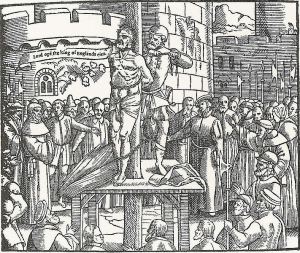
Woodcut from John Foxe's  The Book of Martyrs. William Tyndale (1494-1536) cries out, "Lord, open the King of England's eyes." Woodcut from John Foxe’s The Book of Martyrs. William Tyndale (1494-1536) cries out, “Lord, open the King of England’s eyes.”

Are you willing to “go the extra mile” for someone?

If you know what I am talking about, you might know that this phrase,
go the extra mile“, comes from the Bible (Matthew 5:41). But
did you know how this phrase became part of the English language?

William Tyndale (1494-1536) was an energetic scholar, a real brainy
guy, kind of like his fellow yet modern Englishman, Tom Wright, who
wrote our study book for Lent on the Gospel of Matthew.

Tyndale was bothered that his typical neighbor was not able to read
the Bible in their native English language in the 16th century. So he
went about learning ancient Greek and Hebrew and began translating the
Bible into English. Unfortunately, the political and religious
establishment of his day…

View original post 379 more words


Painting Jesus

John Paine's avatarLessons in Lent

Christ Driving the Merchants from the Temple Christ Driving the Merchants from the Temple by Jacob Jordaens, c. 1650

Left to your imagination, what would Jesus look like?

In Matthew 21:1-22 we see Jesus’ triumphal entry into Jerusalem on Palm Sunday, with an adoring crowd shouting praises and laying palm branches on the road. They shout “Hosanna!” which is a Hebrew expression for “Save!” and an exclamation of praise.

If  you would like to get a sense for the setting of the Palm Sunday processional, here’s a brief video on the Golden Gate in Jerusalem that documents an extraordinary archaeological find.

One theme throughout the Gospels is that Jesus is on a mission, and that mission includes the fulfillment of prophesies made centuries before He appeared on earth. In this case, the parade was foretold by the prophet Zechariah—who prescribed a donkey for the processional. Not some big chariot, not with a military escort as a show of power, not…

View original post 474 more words


God’s Not Dead: A Movie Review

Apparently, Hollywood has discovered that Christians exist. This spring of 2014, we are witnessing a slew of Christian-themed movies. Son of God and Noah top the list, with Ridley Scott’s Exodus coming out later in the year.

My wife and I went to see the surprise film of the season last night, God’s Not Dead, directed by Harold Cronk, based on a book written by Rice Brooks. The basic plot set in Louisiana involves a young college freshman, an evangelical Christian, who gets pitted against a rather annoyingly obnoxious and atheistic philosophy professor. The freshman takes on the challenge to defend the thesis that “God is Not Dead” in front of the whole class under the glaring watch of the atheistic professor’s superior intellect.

I am not really much of a film reviewer, but I woke up this morning early with a little insomnia and since the subject directly covers matter that we address here on Veracity, I thought I would share an evaluation. Here is the trailer.


Continue reading


The Case for Easter

April 6, 7:00-9:00pm, Williamsburg Community Chapel

April 6, 7:00-9:00pm, Williamsburg Community Chapel

Did Jesus of Nazareth really rise from the dead?

The Veracity community is really excited that our church, Williamsburg Community Chapel, along with other churches across the country, will be hosting The Case for Easter simulcast on Sunday, April 6th, 7:00pm-9:00pm. Featuring Christian apologists Lee Strobel, Mark Mittelberg, and Michael Licona, this will be a great opportunity to bring a friend, whether that be a skeptic or perhaps someone who just is not sure, to hear about the evidence for the cornerstone belief in the Christian faith: the Resurrection of Jesus of Nazareth.

Can an educated person in a scientific age take such a claim seriously? Muslims and some others say Jesus never died on the cross. Some say that contradictions in the Bible render the New Testament’s empty tomb claim suspect. Did the early disciples hallucinate over the post-crucifixion sightings of Jesus? Are there answers to these questions?

Following the 90-minute program, our very own, “Mr. Veracity” himself, John Paine, will be leading a panel discussion to respond to questions from the audience that do not get addressed on the simulcast.

It promises to be great event!


Bonhoeffer’s Cost of Discipleship

Dietrich Bonhoeffer understood what it was to take up the cross and follow Jesus, even if it meant stepping out of the norm of what Christians were expected to do. As a young pastor and seminary professor in Nazi Germany, Bonhoeffer knew that Hitler’s regime was setting up an idol to be worshipped, realizing that the German Christian community was getting hookwinked by the Nazis. Why did this Christian pacifist turn into a co-conspirator attempting to assassinate Hitler?

The following blog post from our church’s Lenten series reflects on the cost of discipleship that Bonhoeffer had to calculate. Granted, I am painting the standard portrait of part of Bonhoeffer’s life. Questions still abound: Was Bonhoeffer right in what he did in trying to assassinate Hitler? (One of my theological heroes, T.F. Torrance, says “NO”, biographer Eric Metaxas says “YES”). At least one historian disputes that Bonhoeffer ever gave up his pacifist beliefs at all! Did he abandon his evangelical faith in the Tegel prison, accusing the evangelical church with being complicit with genocide? Or was he strengthened in his faith through his ordeal for the sake of the Gospel? The definitive answers to these questions remain buried in some unmarked grave at the Flossenburg concentration camp.

As an introduction, author Jim Belcher gives us a glimpse of a trip he took with his family to visit the concentration camp at Flossenburg, where Dietrich Bonhoeffer spent his final twelve hours…

lathamta's avatarLessons in Lent

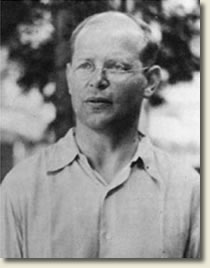
Dietrich Bonhoeffer in the courtyard of the Tegel military prison Dietrich Bonhoeffer in the courtyard of the Tegel military prison

Dietrich Bonhoeffer was not able to sleep very well for nights.

Bonhoeffer had just arrived in New York in 1939. At the urging of
friends, the young German evangelical theologian was able to cross the
Atlantic ocean, giving him sanctuary from the impending doom that
would become World War 2, as instigated by Hitler and the German Nazi
movement. In the safety of good fellowship, Bonhoeffer would have
been spared the terrors of war and enjoy a life of relative ease.

Yet Bonhoeffer was troubled in his soul.

The difficulty was that Bonhoeffer knew that the lives of European
Jews were in dreadful danger. Two years earlier, he had written a book
entitled, The Cost of Discipleship. This book was an
extended exposition of the Sermon on the Mount, from Matthew 5-7, part
of the focus of our sermon…

View original post 362 more words