Tag Archives: rachel held evans

The Civil War as a Theological Crisis

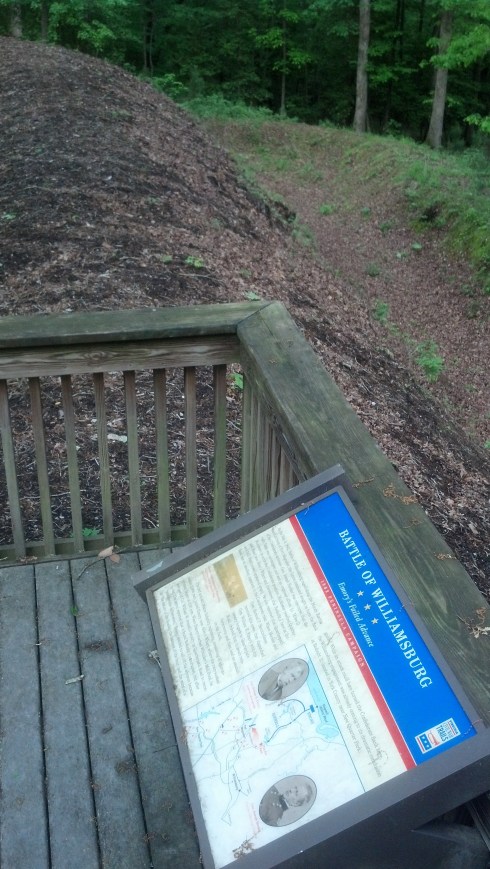
A steep, dugout embankment defending Redoubt #1, off of Quarterpath Road, where Confederate troops waited for advancing Federal soldiers to attack from Tutter's Mill Pond below, during the Battle of Williamsburg. Sadly, relatively very few of my fellow Williamsburg neighbors even know that this place even exists.

A steep, dugout embankment defending Redoubt #1, off of Quarterpath Road, where Confederate troops waited for advancing Federal soldiers to attack from Tutter’s Mill Pond below, during the Battle of Williamsburg. Sadly, relatively very few of my fellow Williamsburg neighbors even know that this place even exists.

Does the American national tragedy over the Civil War have something to teach us about how we are to read the Bible?

As a kid, I grew up near the remains of an oft-forgotten, Civil War battlefield. Whenever I ran among the dugout, redoubt embankments, I always kept in mind the warnings of neighbors to be careful, as there was likely to be found unexploded ordinance somewhere underneath my feet.

On the same day, hundreds of miles away, when Mexico was resisting the French on May 5, 1862, remembered now as Cinco de Mayo, Federal forces met Confederate forces just east of my town, for the Battle of Williamsburg, with nearly 4,000 casualties among both sides. Within a couple of years, the significance of that battle faded, displaced in memory by placenames like Antietam and Gettysburg.

Efforts to preserve the battlefield from being run over by suburban housing developments have been somewhat, moderately successful, though the land, as well as the intellectual debates that the led up to the war, have sometimes been forgotten. I often wonder myself, if such a national crisis could have been averted, without such terrible bloodshed.
Continue reading
More on Newsweek‘s Misunderstanding of the Bible

Plumb LineMy Veracity blogging colleague, John Paine, recently referenced New Testament scholar Dan Wallace’s response to Newsweek author Kurt Eichenwald’s Christmas tirade against Christian “misunderstandings” of the Bible.  Sadly, despite some of the genuine substance Mr. Eichenwald displays to the reader, it is the Newsweek piece itself, “The Bible: So Misunderstood It’s a Sin,” that bears most of the misunderstanding.

The article has generated A LOT of responses, so many that I think it would be best to list out some of the more prominent ones. The original Newsweek article is extremely long, but it is worth taking some time to go through it as it adequately illustrates many of the most common objections and confusions regarding Christianity and the Bible that you will encounter today among secularly-minded thinkers, or those thinkers who wish to reshape Christian faith to look more “modern.” But you should also read a few of the responses as an aid to help you develop an informed response to Eichenwald’s many complaints. It is great way to get an education on some critical issues in doing Christian apologetics in a skeptical world.  Some of what Eichenwald says presents challenging difficulties for the Christian, while much of what he says, if not the bulk of it, can be answered in a manner that effectively communicates an honorable confidence in God’s Word:

  • Michael Kruger (Reformed Seminary in Charlotte, N.C.) has two articles (#1 and #2 ), but what is most valuable is that Mr. Eichenwald offers some rejoinders to Kruger’s critique in the comments section.
  • Ben Witherington (Asbury Seminary, Kentucky) offers a response from an evangelical Wesleyan perspective.
  • For a response from the more conservative wing of mainstream Protestantism, this detailed response from Robert Gagnon (Pittsburgh Theological Seminary) fills in some of the gaps left by others in their critiques.
  • Kurt Eichenwald has repeatedly said that some of the responses to his Christmas essay from Christians were loaded with “vitriol” and “name calling.” Perhaps Eichenwald has this series of video responses in mind ( you have to scroll past much of the unedited chatter in places, but you can look here: #1 and #2)by Reformed apologist James A. White (Alpha-Omega Ministries), but I will let the viewer be the judge of that.
  • In addition to the well-known agnostic Bart Ehrman (University of North Carolina, Chapel Hill), Mr. Eichenwald leans heavily on the critical views of Jason David BeDuhn, professor of Comparative Study of Religions, at Northern Arizona University. BeDuhn, in this essay, responds to a critique of the Newsweek article by Southern Baptist Seminary head, Al Mohler.
  • If you want to know what the more progressive end of Christianity is thinking about this, read this by blogger Rachel Held Evans, or this from Old Testament scholar Pete Enns.
  • In my view, the best and most thorough response is from Darrell Bock (Dallas Seminary). If you only have time to read one of these, pick either the Dan Wallace one linked above or this one by Bock.
  • The latest response from Newsweek itself is that they agreed to publish the following rejoinder by messianic scholar Michael Brown. In Newsweek’s introduction to Dr. Brown’s essay, they still stand by Eichenwald’s original story, in an effort to promote discussion. Furthermore, they announced that Dr. Brown has invited Mr. Eichenwald to be on his Line of Fire radio program the week of January 19.


A Year of Biblical Doubting #2

In verse 23, a "Proverbs 31" woman is described as someone whose husband "is respected at the city gates". Here, blogger and author Rachel Held Evans praises her husband "Dan" at the Dayton, Tennesse welcome sign.

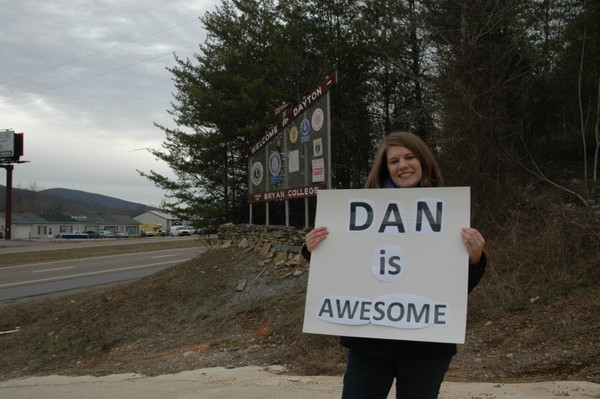
In verse 23, a “Proverbs 31” woman is described as someone whose husband “is respected at the city gates”. Here, blogger and author Rachel Held Evans praises her husband “Dan” at the Dayton, Tennessee welcome sign.

Perhaps I am not qualified to write  about this?   After all, I am a guy, and I have no clue what really goes on with women.  Just ask my wife. But the topic of “biblical womanhood” comes up from time to time, and it concerns all of us in the Body of Christ.

A. J. Jacobs wrote a New York Times best seller a few years ago, The Year of Living Biblically, about his humorous, tongue-in-cheek attempt to follow all of the Bible literally for one year. In like manner, Rachel Held Evans titled her second book, A Year of Biblical Womanhood: How a Liberated Woman Found Herself Sitting on Her Roof, Covering Her Head, and Calling Her Husband “Master”. Here she recounts her story of spending an entire year trying to follow the Bible as literally as possible as a woman in every intricate detail. Along the way, she interviews other women who try to follow a particular pattern of “biblical womanhood”. What you do not find in the book generally winds up on her popular blog. We introduced Rachel Held Evans here on Veracity not too long ago. How well did her one year experiment go? What is Rachel Held Evans wanting to say?
Continue reading


A Year of Biblical Doubting #1

Rachel Held Evans first book.  She's young, church-going.... and not very sure about her faith.   Does she represent the future of "evangelical Christianity"?

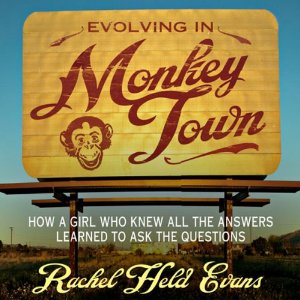
Rachel Held Evans first book. She’s young, church-going…. and not very sure about her faith. Does she represent the future of “evangelical Christianity”?

How do you handle doubt? Some want to shove it under the rug. Some, frankly, never really go through serious periods of doubt. Others wallow in their confusion. Some simply rebel as an escape mechanism. Others are driven to God’s Word, study, prayer, and fellowship to find answers. Where do you go when you begin to second guess everything, if you ever do?

Part of what we are trying to do with Veracity is to provide tools to help folks to get into God’s Word so that God’s Word can get into us. What resources are available that can equip us to better understand our faith so that we can better serve the Lord in our worship and witness? However, there are times where doubt can plague us in our spiritual journey and threaten to derail us spiritually. Perhaps an explanation about the Bible we once heard no longer makes sense anymore. Or is there some assumption that we have made about the Christian life that no longer appears to be working? Perhaps we expected God to do something and things did not turn out the way we think it should.

Doubt is an enormous topic to tackle in a single blog posting. So I will be content for now to give you a partial case study.
Continue reading
