Tag Archives: Personal Discipleship

Keeping the Faith

The Race, 2004

Therefore, since we are surrounded by such a great cloud of witnesses, let us throw off everything that hinders and the sin that so easily entangles, and let us run with perseverance the race marked out for us.
Hebrews 12:1 (NIV)

Hebrews 12:1 reveals so much about the character of God.  This short, pivotal verse tells us about the heavenly realm; the ability of those in that realm to ‘see’ what we are doing; that God has a plan for our lives; that he knows it is not easy; and that he values our striving.  The race we are directed to run gives us a purpose and a mission.  In context it’s about keeping the faithHebrews Chapter 11, often called the Great Faith Chapter, precedes the ‘therefore’.  If you pay attention to the ending of Hebrews Chapter 11, you’ll notice that all the saints mentioned “were commended for their faith, yet none of them received what had been promised. God had planned something better for us so that only together with us would they be made perfect.”

God works by processes.  He wants us to run a race that he knows will be difficult.  Some believe this to be unfair—why doesn’t God just poof everything to be easy for everybody?  But God plays by his own rules.  That’s what the sacrifice of Jesus Christ is all about.  And we have a role in that sacrifice—we’re supposed to keep the faith.

Who wrote the Book of HebrewsOpinions vary considerably, but my personal hunch is Barnabas.  It’s hard to say, but one thing is certain—the apostle Paul knew and appreciated this theology. Continue reading

Your Move

Chess

How are you doing with your decision-making?

I have a long daily commute, with lots of time to fill running the Interstates of eastern Virginia.  Four months ago Veracity’s bass player, Clarke Morledge, got me into podcatching, and life hasn’t been the same since.  It’s definitely getting to me—there have been several times lately when I’ve been happy to be stuck in traffic.  Really.  I plug my iPhone into the car stereo and dive into a world of wonder, mentally shielded from the wacky races occurring all around me.  On-demand theology, philosophy, apologetics, interviews, sermons, and some of the world’s finest teaching.

If you need a how-to primer, check out our previous post on Podcasts & Podcatching, and give your spiritual life a real booster shot.  Try it, really.  If you want some great sources of Podcasts, check out Veracity’s Top 10 Scorers.

So What’s the Point of This Post?

OK, now that we have the mechanics out of the way, let’s get to the content.  One of my favorite (free) podcast subscriptions is Andy Stanley’s Your Move. Continue reading


Personal Discipleship

The Life Line

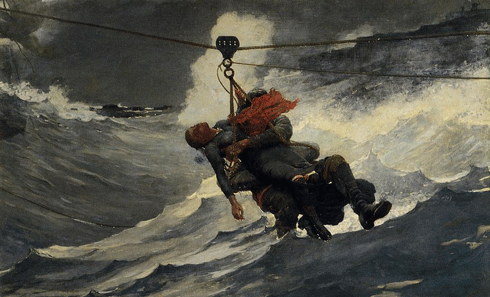
The Life Line by Winslow Homer, 1884

Personal discipleship has been a lifeline for me between what had become a comfortable and complacent Christian experience, and one that became vibrant, exciting, and very real.

If you search for “personal discipleship” on the Internet, you’ll find a variety of  not-very-standardized definitions.  So up front, here’s my homegrown definition: personal discipleship is the process in which a believer or seeker takes personal responsibility for investigating the claims and content of the Bible.

While we all appreciate hearing a well-turned sermon in a moving worship service, sitting in a pew is a passive experience.  None of us would get very far academically if all we ever did was attend lectures.  We have to read, study, work some problems through, write, engage others in discussion, apply ourselves, and prepare to be tested.  And so it is with our faith.

Kierkegaard argued that Christians should take the initiative to work out our own relationship to God.[1]  But this wasn’t Kierkegaard’s original idea, it came from the Apostle Paul.

“Therefore, my beloved, as you have always obeyed, so now, not only as in my presence but much more in my absence, work out your own salvation with fear and trembling, for it is God who works in you, both to will and to work for his good pleasure. Do all things without grumbling or questioning,”
Philippians 2:12-14 (ESV)

Here the more literal ESV translation of the text leads to great doctrine.  This is not the Talmud instructing students to “Find thyself a teacher.”  It’s the author of half the New Testament telling disciples to work out our own salvation with fear and trembling.  Not to make up our ideas of God, but to reverently and humbly work on our relationship with him.  Not to have anyone do the work for us, but to do it ourselves. Continue reading


Cherry Picking Kierkegaard

The Coffee Gathering Pombo

“La tertulia del café de Pombo” by José Gutiérrez Solana, 1920

Generally I’m more apt to hang out with grill-in-the-driveway, figure-it-out-yourself, change-your-own-oil, workaday kind of guys than intellectuals. When I was younger and thought I knew what was important, I developed an anti-intellectual prejudice that continues to the present day. But as Tim Keller says, “You cannot be a Christian without using your brain to its uttermost,” so game on.

Many of us have a tendency to read Bible passages simplistically, without empathizing or thinking beyond the sacred page. Teachers like Michael Card encourage reading “at the level of our imaginations,” but that takes time and work.

Take the story of the testing of Abraham in Genesis 22 for example.  Danish philosopher, theologian, and Lutheran ethicist Søren Kierkegaard thought about the anguish that Abraham felt while walking for three days to Mount Moriah to sacrifice Isaac.  To Kierkegaard this is not a simple story to be read dryly or mechanically from one punctuation mark to the next.  Kierkegaard thought about the huge weight being placed upon Abraham’s conscience, and posited ideas about the teleological suspension of the ethical.  This isn’t (actually) a post about Kierkegaard, but just to help set the background, here are a few of his quotes: Continue reading
