Tag Archives: Genesis

Does the Bible Speak Definitively On the Age of the Earth?

Albert Mohler

Albert Mohler: Theologian and defender of a Young Earth view of Creation.

C. John Collins

C. John Collins: Old Testament scholar and defender of an Old Earth view of Creation.

I recently listened to a debate between Dr. Albert Mohler and Dr. C. John Collins, with the provocative title, “Genesis and the Age of the Earth: Does the Bible speak definitively on the age of the universe?” Christians have very different views on this topic, and sadly, a lot of debates of this sort tend to descend into either rancor, or simply talking past one another, particularly for debates with non-believers. But this debate, intended for an audience of Christian pastors, was different, and for that reason, I thought it worthwhile to make some notes and share them here on Veracity. You can view the debate yourself at the Trinity Evangelical Divinity School’s website, and I would encourage you to do so to get the most out of my following comments and observations (another synopsis of the debate is available here).

Al Mohler, the president of the Southern Baptist Theological Seminary, answered the debate question with “yes.” But in doing so, I appreciated what Mohler had to say about the very nature of this debate. As he put it, there are three different orders of theological debates that have an impact in the church:
Continue reading


Bill Nye Visits the Ark Encounter

Exactly three years ago today, the arguably most recognizable popular advocate for modern science, Bill Nye, debated one of the most controversial leaders in evangelical Christianity, Ken Ham, of Answers and Genesis, on the topic of creation. Since then, this debate has received nearly 6 million views on YouTube, which is a lot for a two-hour debate on science and the Bible.

This past year, Bill Nye returned to Kentucky to take a tour of the new Ark Encounter exhibit, just days after its opening. Cameras were rolling as Answers in Genesis recorded the casual, yet often heated, discussion between these two iconic men. Bill Nye and Ken Ham represent two very opposite ends of the pole on this topic, so I frankly found the discussion rather frustrating and exasperating. It felt like the two sides were just talking past one another. Nevertheless, it gives a good example of the type of challenges Christians face when defending their faith, with skeptics who are enamored by the prospects of modern science.

UPDATE: April 2018.  I originally posted a 2o-minute edited version of the discussion, which has since been taken down. Here is the full 2-hour version, from Answers in Genesis:


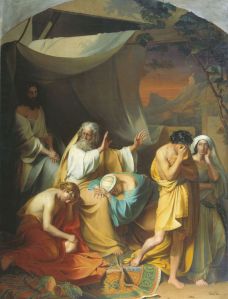
Noah’s Curse

Noah curses his son Ham, a 19th-century painting by Ivan Stepanovitch Ksenofontov. Ham looks pretty white to me here, but for thousands of Christians in the American South from at least the 19th century to recent times, thought Ham had black skin.

Noah curses his son Ham, a 19th-century painting by Ivan Stepanovitch Ksenofontov. Ham looks pretty white to me here, but thousands of Christians in the American South, from at least the 19th century to even fairly recent times, thought Ham had black skin (photo credit: Wikipedia).

When Noah awoke from his wine and knew what his youngest son had done to him, he said,

“Cursed be Canaan;
a servant of servants shall he be to his brothers.”
He also said,

“Blessed be the Lord, the God of Shem;
and let Canaan be his servant.
May God enlarge Japheth,
and let him dwell in the tents of Shem,
and let Canaan be his servant.” (Genesis 9:24-27 ESV)

It was my first Christian retreat in college. I met another student just a few years older than me the first night of the weekend, and we struck up a friendship. But the next day, we had a conversation that has stuck with me for years. I have no idea how it got started, but it was about whether or not the Bible allows interracial marriage. My new friend, growing up in a rural part of southern Virginia, insisted that God absolutely forbids white people from marrying black people.

Where is that in the Bible?,” I asked with curiosity and amazement. I had only recently started reading  the Bible, so perhaps there was something in there that I had not seen yet. His response bothered me:

Well, I am not exactly sure where it is. But I know it is in there.”

Later that weekend, I asked him again if he could show me the verse.

He never was able to find it.

Let me rewind a few more years. I was a mere toddler when the famous Loving v. Virginia case was resolved in 1967, overturning Virginia’s statute forbidding “miscegenation.”  The Lovings, a black and white couple, from Caroline County, about an hour away from where I grew up, had driven up to Washington, D.C., to get a marriage license, where interracial unions were permitted. Upon returning to Caroline County, Virginia police raided their home, but the couple responded to their arrest by going all the way to the Supreme Court to defend their case … and they won.

Such action to change the law that had been embedded in the culture of the so-called “Bible Belt” was not a concern to my new college Christian friend in the early 1980s. In his mind, the Bible still forbade mixed marriages between people of different skin colors, and that was all he needed to know. He had no animosity towards African-Americans. He was really a nice guy, and a devout believer. It was simply and clearly taught in the Bible that God does not allow interracial marriage, according to him.

The problem was… and still is…. he had no verse from the Bible to back up his belief.

So, where did this whole thing about the Bible forbidding interracial marriage come from?
Continue reading



Your Desire Shall Be For Your Husband

Katharine Bushnell (1855-1946). Missionary to China and activist for women's equality, spent a lot time studying the original Hebrew meaning of Genesis 3:16 (photo credit: Boston University)

Katharine Bushnell (1855-1946). Missionary to China and activist for women’s equality. Bushnell spent a lot time studying the original Hebrew meaning of Genesis 3:16 (photo credit: Boston University)

To the woman he [God] said,

“I will surely multiply your pain in childbearing;
    in pain you shall bring forth children.
Your desire shall be for your husband,
    and he shall rule over you.” (Genesis 3:16 ESV)

The beauty and simplicity of the early chapters of Genesis ironically leads to a pitfall when reading these chapters. The story of Adam and Eve is very terse and yet captivating. The details are sparse, but the narrative is engaging, as well as being foundational to Christian theology and practice. The story invites the reader to explore the imagination, going deeper in trying to figure out what it all means. But sometimes, the imagination can take you far away from the text itself, and thereby importing an alien sense of meaning that does not belong there.

For years, I have wrestled with the meaning of the curse given to Eve in Genesis 3:16, subsequent to the Fall. In contemporary Western culture, where concerns about women’s rights flourish, many readers bristle over the idea that Eve might somehow be the one to blame for the Fall of Humanity. After all, she interacted with the serpent and then offered the forbidden fruit to Adam. Does Genesis teach that Eve was truly at fault?

More specifically, by asserting herself so forwardly in her dialogue with the serpent, was she subverting her role as a supportive helpmate to Adam? If one reads the Apostle Paul in one of his letters to Timothy,  you might get the idea that Paul really believes that it was all Eve’s fault (1 Timothy 2:13-15).

But even when reading Paul, such a neat conclusion is not so simple. In fact, such a conclusion would be wrong. In his most profound work of theology in his letter to the Romans, Paul squarely places the responsibility for the Fall on Adam’s shoulders (Romans 5:12-17). Eve is not even mentioned.

So, perhaps the wisest conclusion to make is that both Adam and Eve share in the downfall of humanity, though in different ways. You can not pin it all on Eve.

But then there is the whole matter of the curse placed on Eve, specifically, that “your desire shall be for your husband, and he shall rule over you.” What is that all about?

This past summer, our church held a Summer Bible Study on Genesis 1-11, and this very question came up. Here is a TableTalk session where Tommy Vereb, our worship leader, poses the question to our lead pastor, Travis Simone:

Continue reading


The Nephilim and the Wisdom of Not Knowing

Darren Aronofsky's Nephilim in his 2014 film, Noah. Rock-creatures that look like the tree-creatures in the Lord of the Rings?... Yeah, right.

Darren Aronofsky’s Nephilim in his 2014 film and environmentalist manifesto, Noah. Rock-creatures that look like the tree-creatures in the Lord of the Rings?… Yeah, right.

This summer, our church has been doing a “summer Bible study” on Genesis 1-11. Interestingly, the sermons have skipped over the part about the Nephilim, in Genesis 6:1-4:

When man began to multiply on the face of the land and daughters were born to them, the sons of God saw that the daughters of man were attractive. And they took as their wives any they chose. Then the Lord said, “My Spirit shall not abide in man forever, for he is flesh: his days shall be 120 years.” The Nephilim were on the earth in those days, and also afterward, when the sons of God came in to the daughters of man and they bore children to them. These were the mighty men who were of old, the men of renown (ESV).

I can understand that there are good reasons for skipping this passage. First, this passage is … uh.. a bit… weird. Secondly, no one really has a clue as to what this really means…. That is right. No one really knows for sure what Genesis 6:1-4 is all about… and neither do I.  Still, I think there is something we can still learn from the Nephilim passage. Continue reading