Tag Archives: Christmas

When Did Advent Celebrations Start?

Have you ever wondered where and when the season of Advent started? Reformed Theological Seminary history professor, Ryan Reeves, puts together some really helpful videos on church history related topics, and the following 5-minute video introducing Advent is really good.

My only quibble with the video is professor Reeves’ statement that “no one, by the way, believed that Jesus was actually born on December 25,” at the the 1:20 mark in the video.  Actually, there was quite a bit of speculation in the early church as to the correct date of Jesus’ birth, as I learned in researching an early Veracity post on the topic. In the early 200s, roughly 150 years before the Western church officially designated December 25, as the celebration feast for Jesus’ birth, the church father Hippolytus calculated December 25 as the correct date for Christ’s birth, from his Commentary on Daniel (Reeves is primarily an historian of the Reformation, and not the early church, so I will give him a pass). But Reeves’ larger point stands, centuries later, that we simply do not know when Jesus’ birthdate was with any firm degree of certainty, once you examine the Bible, and other arguments made by other commentators.

The celebration of Advent is not contingent on the exact date of Christmas. Rather, it is about encouraging the community of believers to dedicate some time to spiritually prepare for the coming of the Christ. Syncing the birth of Jesus with one of the shortest days of the year has great symbolic importance, in that as the days just begin to get longer (in the Northern Hemisphere, at least, where Christianity grew the most in the early centuries), it corresponds to the idea that Jesus is the light that has come into the world, and thus overturning the darkness of the present age.

Come, Lord Jesus!

Nunc Dimittis, As Sung By Natalie Dessay

Worship the coming Savior…

Simeon, an elderly Jew, had received a promise from the Holy Spirit that he would not die before laying eyes on the Messiah. So when Mary and Joseph bring the child Jesus to the Temple for the purification, specifically the Jewish consecration of the first born male, pidyon haben, Luke 2:22-28, Simeon took Jesus into his arms and uttered the Nunc Dimittis, named after the first phrase in Saint Jerome’s Latin translation of the Bible, the Vulgate (Luke 2:29-32), translated here by the English Standard Version:

“Lord, now you are letting your servant depart in peace,
    according to your word;
for my eyes have seen your salvation
    that you have prepared in the presence of all peoples,
a light for revelation to the Gentiles,
    and for glory to your people Israel.” 

Johann Sebastian Bach wrote a cantata, Ich habe genug, meaning in English, “I have enough,which was first performed in Leipzig in 1727. Bach’s text is only loosely based on Luke’s text, but it conveys the meaning intended by Luke rather well: God had kept His promise to Simeon.

I have enough; I have taken the Savior,
the hope of the Gentiles, into my yearning arms.
I have enough; I have seen him, my faith has held Jesus to my heart;
now I desire but even today to depart with joy from here.
I have enough!

French opera soloist, Natalie Dessay, sings the Aria from Bach’s classic work, from the German:

Ich habe genug.
ich habe den Heiland, das Hoffen der
Frommen, auf meinen begiergen Arme genommen;
ich habe genug!
Ich hab ihn erblickt, mein
Glaube hat Jesum ans Herze
gedrückt, nun wünsch ich noch
heute mit Freuden von hinnen zu scheiden.
Ich habe genug!

Behold, the Messiah, the Savior, has come! Merry Christmas, from your friends at Veracity.

Jesus’ purification in the temple serves as a Scriptural model for the increasingly popular practice of “baby dedication” in many of today’s evangelical churches. Other posts in this blog series, based on the “Gospel in Song” preaching this year during Advent in the local church where I worship, include the Magnificat, the Benedictus, and the Gloria.


Krampus: “Santa’s” Dark Side

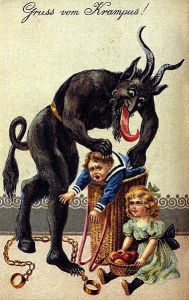
A 'Greetings for the Kampus' Christmas postcard from the early 1900s (source: Wikipedia)

A ‘Greetings from the Kampus’ Christmas postcard from the early 1900s (source: Wikipedia)

Just in time for this Christmas season, there is a new movie in theaters with a twist on Santa, Krampus (view trailer here). Krampus is actually an ancient, Alpine pagan character from pre-Christian Austria, a horrific beast who comes once year to scare children into good behavior. As the Gospel spread in that part of Europe centuries ago, the legend of Krampus got intertwined with the celebration of the Christian feast day for Saint Nicholas, on December 6. Old habits are hard to break! National Geographic has an informative write-up on the revival of Krampus celebrations, which generally takes place the night before Saint Nicholas’ day.

As Western culture continues to loosen its moorings to Christendom, it should not surprise us that Krampus makes his way to America. Krampus is yet another attempt in postmodernity to distract us from considering the mystery of the Incarnation. But it would be wrong-headed for Christians to dismiss Christmas itself as simply being of some pagan invention because of Krampus. We really need to be a bit “tongue in cheek” about this. So, I thought it might be helpful to relink a couple of older Veracity posts that dive into the history:


The Real Saint Nick

American cultural icon every December, or beloved Christian pastor in southern Turkey  in the 4th. century?

American cultural icon every December, dangerous pagan tradition, or Christian pastor in southern Turkey in the 4th. century who exemplified a love for the poor by following the way of Jesus?

Growing up as a little kid, my mother left a big chocolate chip cookie out on a plate in front of the living room fireplace one Christmas Eve. When I woke up the next morning, the cookie was half-eaten, with crumbs unmistakably left on the plate.

When I came to having personal faith in Christ in high school, I looked back on the childlike belief in Santa Claus as a type of feel-good fairly tale. Jesus was the “real thing” while this jolly “Saint Nick” figure was simply a product of cultural imagination… merely an urban legend.

It must have been my dad who ate part of that cookie.

In the contemporary era of the so-called “War on Christmas,” Christians have faced the awkward challenge of what to do with “Saint Nick.” Secularists for years had suggested that old “Saint Nick” was simply a pious invention having no relevant historical basis. Roman Catholics and Eastern Orthodox Christians, however, have argued that Saint Nicholas was indeed a real historical figure from the 4th century, and so only vaguely related to the “ho-ho-ho” North Pole type glamorized by the old 1931 Coca-Cola ads. Evangelical Protestants, who tend to frown upon the veneration of saints, have sought to distance themselves somehow from Saint Nick in different ways, some even dismissing the history of the original figure as being of pagan origin (just as some secularists still do). Indeed, perhaps one of the reasons why the ancient Saint Nicholas evolved into the jolly guy with an obesity problem driving a bunch reindeer around in a sleigh filled with merchandise from Target and J.C Penny’s is because the majority of American Christians since the 19th century have been reluctant to associate with the practice of venerating dead saints.

Various attempts have been made in recent years to rehabilitate the true history of the original Saint Nicholas and get at what Paul Harvey called “the rest of the story.” Campbell University’s Adam C. English has probably done the most thorough research into Saint Nicholas to give us the detailed scoop. In The Saint Who Would Be Santa Claus, argues that the evidence shows that actually the original “Saint Nicholas of Myra” did come from 4th. century southern Turkey, serving as a Christian pastor and a popular bishop who advocated for the poor. Beyond that, the exact details get a bit murky.
Continue reading


The Christmas Truce of 1914

They said that the war would be over by Christmas…

This Christmas marks the 100th anniversary of the so-called “Christmas Truce” between the German and British armies along the Western Front during the “Great War.” When the fighting began in August, 1914, both sides were expecting a fairly quick outcome. But by the time the bitter cold of December set in amid the muddy trenches near the Marne River, devastated by terrible casualties resulting from the horrors of modern warfare, it became clear that the bloody end was still some years away.

But why the war in the first place? As Baylor University historian Philip Jenkins argues in the The Great and Holy War: How World War I Became a Religious Crusade, the typical narrative offered by secular historians, that the war was basically a great imperial contest among European colonizing empires, fails to adequately and fully explain what happened. Jenkins maintains that “the First World War was a thoroughly religious event, in the sense that overwhelmingly Christian nations fought each other in what many viewed as a holy war, a spiritual conflict” (Wall Street Journal book review, by D. G. Hart, June 6, 2014, but also consider this review from Reformation21).

Prior to the war, the majority of Christians were optimistic about the future spread of the Gospel changing societies for the better, an essentially postmillenial view of the “End Times.” But after these supposedly “Christian nations” of the world had managed to annihilate millions of people, at least indirectly all in the “name of God,” the mood and perspective of many Christians began to change. A type of pessimism took over, so it should come as no surprise that the great “Christian nations” of Europe would eventually enter a steady decline towards apostasy. It was as though the “War to End All Wars” had compromised the witness of the church. But what was not so evident at the time was that in the aftermath of the war, the spread of the Gospel would increase rapidly across the “Global South”, where the Christian faith continues to expand even today all across Africa, Asia, and Latin America.

Is there anything we can learn from all of this?

For me, the event during that war that most captures the contradictions and the absurdity of “Christian nations” fighting one another, while still offering a glimmer of hope, is in that unusual truce between the German and British armies that lasted for several days beginning Christmas Eve, 1914. What started off as German soldiers singing Christmas carols to one another became a type of peaceful interchange between the warring parties.

The truce would turn out to be brief, as the fighting renewed just a few days later… Charlottesville, Virginia folk singer, John McCutcheon, tells the tale of the Christmas Truce:
