Tag Archives: apologetics

Personal Discipleship

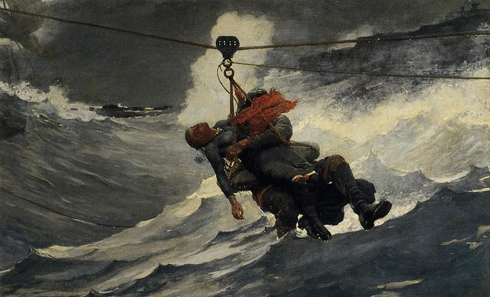
The Life Line

The Life Line by Winslow Homer, 1884

Personal discipleship has been a lifeline for me between what had become a comfortable and complacent Christian experience, and one that became vibrant, exciting, and very real.

If you search for “personal discipleship” on the Internet, you’ll find a variety of  not-very-standardized definitions.  So up front, here’s my homegrown definition: personal discipleship is the process in which a believer or seeker takes personal responsibility for investigating the claims and content of the Bible.

While we all appreciate hearing a well-turned sermon in a moving worship service, sitting in a pew is a passive experience.  None of us would get very far academically if all we ever did was attend lectures.  We have to read, study, work some problems through, write, engage others in discussion, apply ourselves, and prepare to be tested.  And so it is with our faith.

Kierkegaard argued that Christians should take the initiative to work out our own relationship to God.[1]  But this wasn’t Kierkegaard’s original idea, it came from the Apostle Paul.

“Therefore, my beloved, as you have always obeyed, so now, not only as in my presence but much more in my absence, work out your own salvation with fear and trembling, for it is God who works in you, both to will and to work for his good pleasure. Do all things without grumbling or questioning,”
Philippians 2:12-14 (ESV)

Here the more literal ESV translation of the text leads to great doctrine.  This is not the Talmud instructing students to “Find thyself a teacher.”  It’s the author of half the New Testament telling disciples to work out our own salvation with fear and trembling.  Not to make up our ideas of God, but to reverently and humbly work on our relationship with him.  Not to have anyone do the work for us, but to do it ourselves. Continue reading

Conflict Avoidance: Pluralism #2

OK. I admit it. I hate conflict. John Paine does not like it either, so I am glad I am not alone.

Cowboys or the Redskins? Duke or North Carolina? Red Sox or the Yankees? Me? I’ll just watch the ball game, thank you. Some love a feisty contest. But it is one thing to engage in competitive sports talk. Conversing about “God” in a pluralistic culture is a much more serious ball game.

Nothing like some good ole’ competition!

There is much at stake when it comes to conflicting truth claims regarding religious belief … or “non-religious” belief … let us not forget atheism. The consequences are great. Eternal matters hang in the balance. Heaven and hell. Life and death.

Imagine you are at a water cooler somewhere in corporate America, and the topic of religion comes up. A disagreement emerges. You feel the tension in the hallway as the conversation heats up. Someone tries to resolve the tension in the conversation and says, “You know, I believe that all religions basically teach the same thing.”

The “conflict avoidance” part of me wonders….”What a powerful and attractive idea”…..
Continue reading


Common vs. Saving Grace: Pluralism #1

Perhaps you have been around this “conversation killer”. You are at the water cooler with a group of co-workers and the subject of “religion” comes up. Someone jumps in and declares, “You know, all of the great religions of the world teach basically the same thing. There are many different paths to God. No one path is better than any other”. A second person responds with, “But the Bible says that there is only one way to God. Jesus said ‘I am the Way, the Truth, and the Life. No one comes to the Father except by me‘ (John 14:6)…. Christianity beats any other religion. All other religions are false, demonic lies!”

Bumper Sticker Theology for a New Age…. To borrow from Rodney King during the 1992 Los Angeles riots, “Can we all get along?” … How does the Christian apologist respond to the challenge of religious pluralism?

Silence enfolds the water cooler. Awkward glances abound. A couple of folks begin to straggle off back to their offices. Another person tries to break the silence with, “Did you see the Virginia Tech game last night? How ’bout them Hokies??” The first person turns away and mutters, “Christians. They are such narrow people. Why do they think they always have a lock on the truth?”

Continue reading


Why Does God Allow Evil and Suffering?

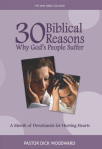
When God gave us His Word, He was not in denial regarding the suffering of His people. Have you discovered the Bible is filled with Scriptures that answer the ‘why’ questions the people of God ask when they are hurting? I have been in a wheelchair since 1983 and have been totally paralyzed for many years. What I have written here is not unproven theory from passages in the Bible. I have personally needed to search the Scriptures and find these “Thirty Biblical Reasons Why God’s People Suffer.” If you are suffering, or you know someone who is, join me as I explore thirty biblical responses of God to people with hurting hearts.
Dick Woodward, 30 Biblical Reasons Why God’s People Suffer

30 Biblical Reasons Why God's People SufferHow can an all-powerful and good god allow evil and suffering?  As William Lane Craig points out, the problem of evil and suffering is the primary argument against the existence of God.  In this presentation he argues that “Christian theism is man’s last, best hope for a solution to the problem of evil,” distinguishing between the intellectual and emotional versions of the problem of evil.

But the question is so profound that it can be particularly difficult to separate emotions from intellect.  It can gnaw at our soul. Even those who accept the existence of God can have a hard time resolving evil and suffering. Continue reading


Apologetics 101

Here’s an interview with Dr. William Lane Craig in which he answers basic questions about the importance of Christian apologetics, the resurrection of Jesus, the problem of evil, and the lack of atheistic explanatory models.  He also gives some practical advice for those interested in apologetics.

Enjoy!