Tag Archives: apologetics

The Case For Easter Wrap-up

The Case for Easter

We had a very interesting evening of apologetics last night at the Williamsburg Community Chapel. Lee Strobel, Mark Mittelberg, and Michael Licona presented the Case for Easter in a simulcast to churches throughout North America.

Please use this post to make comments, ask follow-up questions, or share anything related to this event.  We also offer the following materials and resources from the simulcast producers:

Based upon questions from attendees after the event, here are a few apologetics resources we recommend:

For larger lists, check out our Toolbox, or this post.  If you’d like to dive into apologetics, here’s a sampling of Veracity’s apologetics posts.

For those new to—or unsure of—the Christian faith, here is a presentation of the Gospel in an interactive ebook that uses apologetics to share the joy of personal discipleship.
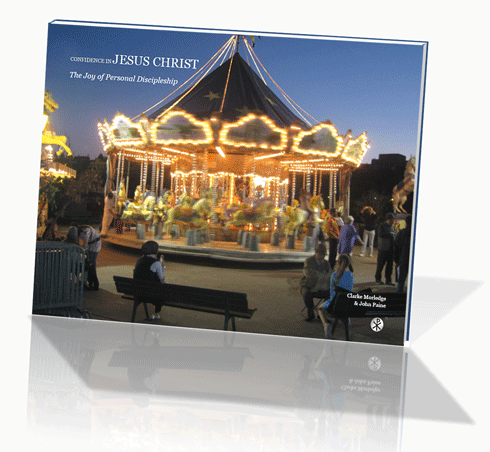
Confidence in Jesus Christ

Have a question, comment, or something to share? Please use the “What do you think?” box in the Comments section below. We look forward to sharing with you!


HT: Shirley Vining, Judy Williamson, Martha Karam, Dave Rudy, Clarke Morledge, Cliff Roebuck, Arlene Vander Loon, Eileen Grant, Andy Flint, Kevin Wilkins, Steve Flanary




Time for Apologetics

“Our greatest ability is our availability.”
Dick Woodward, Marketplace Disciples, pg. 324

Time

Have you ever considered how much time it takes to reach unbelieving people for Jesus Christ?

William Lane Craig Interview

William Lane Craig Interview

William Lane Craig recently did an interview on Fox News to promote his latest book, A Reasonable Response: Answers to Tough Questions on God, Christianity, and the Bible. In a few minutes, he made an articulate and defensible case for believing in God and for the Christian faith. What strikes me most about the interview is how well prepared Dr. Craig is to engage thinkers—there are forty-five years of intense study behind his eight-minute interview.

Don’t get me wrong, I’m all for going out there and laying it on the line like Billy Graham or D.L. Moody. Let the Holy Spirit work. Preach the Word! Absolutely.

But frankly there are many times when apologetics can open doors to the Christian faith that might otherwise be closed. If I’m going to have my faith challenged—or even mocked—by a non-believer, responding with logic and reason carries more sway than quoting Scripture. I’m not counting on my intellect to get me through; I’m just saying it may be wiser to prepare the soil, sow the seeds, and water the crop before calling for the harvest. Jesus intended that we should ‘sow’ when He gave us the Great Commission. When He said that the greatest commandment is to love God with all our heart, mind, soul and strength, He meant for us to work at renewing our minds.

So why don’t more people appreciate apologetics as a tool for sharing their faith? Apologetics takes a lot of time. We don’t hear much in the way of apologetics from our pulpits. It’s more of a personal discipleship sort of thing. Truth be told, most people don’t even know what apologetics is. So what is apologetics, really, and why should we care? Continue reading


The Quirinius Question

Titus Flavius Josephus, 37 – c. 100 A.D. (Wikipedia)

Titus Flavius Josephus, 37 – c. 100 A.D. (Wikipedia). Primary historical source for establishing Quirinius as Governor of Syria in the time of the census according to the Gospel of Luke at 6 A.D. But was Josephus confused on his dates?

One of the more problematic issues with the Christmas story is the question of the Census of Quirinius in Luke 2:2. According to the Jewish historian, Josephus, there was indeed a Quirinius who served as governor in Syria starting in 6 A.D., and in that year there was a Roman census during the time of Jesus’ birth by Luke’s testimony. However, then compare this to the infancy narrative in Matthew and try to line it up with the record of Josephus concerning Herod’s death around 4 B.C., which Matthew says is after Jesus’ birth. This gives you about a ten year discrepancy regarding the actual date of the birth of Jesus.  Was Jesus born around 6 A.D. according to Luke or before 4 B.C. according to Matthew? What are we to make of this?

We already know that the Christian calendar, which has no year “0” in it, was orginally meant to be started in agreement with Jesus’ birth prior to the death of Herod, but that appears to be off by a few years. We can thank “Dennis the Dwarf”, a 6th century monk, for getting us sidetracked with that one (look here for more nerdy details about the story of the Anno Domini system). But most Bible scholars agree that Luke’s apparent birthdate for Jesus in 6 A.D. is far too late to be correct. What then do you do with the census of Quirinius?

The consensus in critical scholarship has concluded simply that Luke somehow got this wrong. Skeptics run with this and conclude that the Gospels are unreliable as historical documents. UNC Chapel Hill scholar and former evangelical Bart Ehrman, for example, argues that Luke is using the whole census idea as a theological device of fiction to get Mary and Joseph to Bethlehem for the birth of the heir to the Davidic throne, namely Jesus. The virgin birth then is starting to sound, well,…. uh… rather contrived. Mmmm… Does this mean that I got all of those ding-dang Christmas decorations down out of the attic for nuthin’? Bummer.

But what if a closer look at all of the evidence suggests an alternative way of looking at the Quirinius Question?
Continue reading


2013 National Conference on Christian Apologetics

“As iron sharpens iron, so one person sharpens another.”
Proverbs 27:17 (NIV)

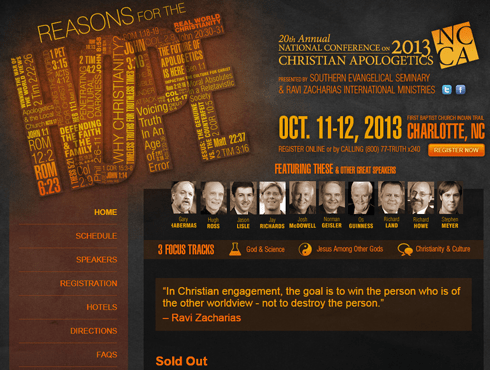
2013 National Conference on Christian Apologetics

If you want suggestions about how to keep your devotional life fresh, try apologetics. Specifically, try attending an apologetics conference. I just returned from the 2013 National Conference on Christian Apologetics in Charlotte, North Carolina, and thoroughly enjoyed thinking and dialoguing at high levels of reasoning for two days.  As an active blogger, I really don’t have issues with my spiritual life becoming stale, but I have to admit it was a truly uplifting experience.

John Paine, Norman Geisler, Ken Petzinger

Dr. Norman Geisler and Dr. Ken Petzinger (a physicist).  Our rocket scientist friend did not wish to contribute to my wife’s embarrassment by posing with us.

I was travelling with some wonderful people, including a rocket scientist (no kidding), a physicist, a lawyer, and a librarian (who is also an interpretive dancer). We had some conversations; wish you could have been there with us.

For whatever reasons there was a doubling of registrations (to 2,000) from the prior year, so we stopped by Thursday evening to see if we could register before the crowd on Friday morning.  We ran into Dr. Norman Geisler roaming the halls, and he graciously agreed to pose for a photo.  After we parted I thought of all the things I should have said to him. You know, like: thanks for architecting the Chicago Statement on Biblical Inerrancy, and thanks for several books that have shaped my thinking (like Making Sense of Bible Difficulties and From God to Us, How We Got our Bible). Continue reading


Examples and Warnings

  • These things happened to them as examples and were written down as warnings for us, on whom the fulfillment of the ages has come.
    1 Corinthians 10:11 (NIV84)
Kisses

Essential Tools

Melinda Penner has a poignant observation on the Stand to Reason blog this morning, about a recent post by Rachael Slick—the daughter of apologist Matt Slick, the founder of CARM.

CARM is one of the sites I use frequently in my devotional research. I value their work, and respect their opinions. Sometimes they make me uneasy, but that’s Veracity—we don’t have to accept everything someone thinks, or their style, to benefit from their example or teaching. We’re about sharing resources, not telling people what to think.

Rachael Slick’s post, describing her upbringing and journey into atheism, is undoubtedly heartbreaking for her parents. As Melinda Penner notes, the post is one-sided. That it garnered over 2,300 comments in two days on the atheist channel of Patheos.com demonstrates the voracity of atheist sentiments in our culture. (If we accept the Great Commission and are laboring only in fields full of Christians, here’s a wake-up call.)

Melinda’s observation is that there is no Gospel in Rachael Slick’s story. How anyone can learn 800 Bible verses and all the apologetic doctrine she describes without getting the Gospel is…(I don’t have an adequate adjective).

Dick Woodward has a lot to say about examples and warnings in the Bible. A few months ago, Dick and I were talking about Matthew 23 and the Law of God. Dick made the point that, “The Law of God must always be run through the Love of God.”

I couldn’t help thinking about those words as I read Rachael Slick’s story. I’m not judging Matt Slick and the way he raised his family. I will take this example and apply it to the relationships in my life, particularly where I have a tendency to make a point or press an agenda without stopping to love the other person first. One more time for my own edification—I will try to do better at loving the other person first.

The Apostle John quoted Jesus, “By this all men will know that you are my disciples, if you love one another” (John 13:35, NIV84). The Apostle Paul put it even more strongly, “The only thing that counts is faith expressing itself though love” (Galatians 5:6b, NIV84).

Thank you Rachael Slick for the example and warning—not about how you or your dad might have messed up, but about how less important an agenda is compared to a heart.