
I do not know where all readers of the Veracity blog live, but here in my native Virginia, it is blazing hot now in mid-July!
In between sweating through yet another shirt, I ran across a fascinating article by Washington University biologist Joshua Swamidass at Christianity Today magazine: “Setting Our Scopes on Things Above.” I was reminded that exactly one hundred years ago this week, that the “trial of the century” took place in an extremely hot Tennessee, long before courtrooms had air conditioning!
John T. Scopes, a high school biology teacher, was charged with violating Tennessee’s Butler Act, which prohibited the teaching of evolution in a public school. Scopes was found guilty, and forced to pay a $100 fine, which was later overturned, but that was not the real story.
The Scopes trial was ultimately a media event, not unlike the O. J. Simpson trials for the 1990’s. For those around at that time, people can remember television images of Simpson driving his white bronco as California police officers followed him down the interstate highway, trying to arrest the famous football player.
Likewise, the Scopes trial caught nearly everyone’s attention in 1925. While they did not have the Internet or television back then, they did have newspapers and radio, as dozens and dozens of journalists descended on the small town of Dayton to cover the trial. People were spellbound as William Jennings Bryan, a longtime presidential hopeful and conservative Christian, as the prosecuting attorney took on Clarence Darrow, an agnostic defender of science, and Scopes’ defense attorney. There was even a play written about the trial, which eventually became a movie, Inherit The Wind.
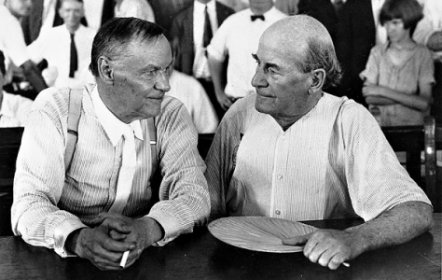
20th century cultural icons: cigarette smoking, agnostic advocate for science, Clarence Darrow vs. defender of the Bible, anti-evolutionist, populist politician, William Jennings Bryan, in the heat of a Tennessee summer.
Ironically, from today’s perspective, William Jennings Bryan was not a Young Earth Creationist. He was what might be a called a Day-Age Creationist, a form of Old Earth Creationism similar to what Hugh Ross at Reasons to Believe supports. While Scopes lost the court battle (at least initially), it was Christian “fundamentalism” which took the biggest hit, effectively pushing conservative Christians off the cultural mainstream. The sidelining of conservative Christianity would not show signs of reversing until the emergence of the “neo-evangelical” movement, embodied in personalities like Billy Graham, in the late 1940s and 1950s.
A few years ago, I wrote about the Scopes trial, along with a transcript of the (in)famous cross-examination of William Jennings Bryan conducted by Clarence Darrow, so I will not rehearse the details here. But the conversation about the Bible and its relationship to science has been a big part of the history of the Veracity blog over the past thirteen years. There are over a hundred blog posts about this conversation! Are the concepts of biblical creation and evolution compatible or incompatible with one another?
I thought it might be a good time to reflect on where I am now on the conversation. I have pretty much come to a similar conclusion that Dr. Swamidass has advocated for in his book, The Genealogical Adam and Eve: The Surprising Science of Universal Ancestry, one that I have reviewed and can highly recommend.
I think I can call him “Joshua” now, as I have personally corresponded with him before. Joshua helps to run a discussion board website at PeacefulScience.org. On the one hand, Joshua is critical of others, whether they be scientists or bible scholars, who argue against the historicity of Adam, particularly a certain subset of Christians (but not all) associated with Biologos, a Christian think-tank started by Francis Collins. The argument against historical Adam is that genetic studies have shown that the human population could not have arisen from just two people, Adam and Eve, in that modern humanity arose from a much bigger population of hominids.
Joshua challenges that assertion against the historicity of Adam by citing an argument made centuries ago, that there were other humans living alongside of Adam. In other words, the first humans created were not just Adam and Eve in Genesis 2. There were other humans, too, mentioned in Genesis 1.
There are several advantages to this solution: First, there is no need to tie all human descent as coming genetically from just two people. Other humans are involved as well. But what Joshua brings to the table is that all humans today, and even in Jesus and Paul’s day are all genealogically related to Adam and Eve, not necessarily genetically. The Bible is concerned about genealogy, not genetics.
Secondly, it resolves the difficulty made famous during the Scopes trial, when Clarence Darrow questioned William Jennings Bryan as to where Cain got his wife. Many Christian apologists today propose that Adam and Eve must have had an unnamed daughter, so that Cain must have married his sister. Various creationist groups, including the Young Earth Creationists at Answers in Genesis, as well as Old Earth Creationists at Reasons to Believe, hold to that apologetic proposal. There is no Bible proof text which explicitly supports this, as there is no mention in the Bible of Adam and Eve having daughters.
Yet this common proposal causes a big problem for historically orthodox Christianity, in that it effectively argues that God has changed his mind regarding the sexual morality status of incest. For if incest was okay for Cain, but then later declared by God to be sinful according to the Law of Moses, then this suggests that God can and has changed his mind regarding the definition of marriage. Many advocates of same-sex marriage today among Christians make the same sort of argument, saying that God could also change his mind regarding same-sex relations, condemning them all in the Bible times, but changing his mind today by accepting same-sex marriage now in the 21st century. Whole denominations of progressive Christians have gone down this route of biblical interpretation.
Joshua’s proposal is not a hill I am going to die on. But I do think it makes the best sense, considering other alternatives. A lot of Christians wrestle with the creation/evolution discussion, but Joshua’s book is one of the best I would recommend reading. I read Joshua’s book five years ago, and since then I have not found any proposal better than his. What makes Joshua’s proposal also helpful is that you can be a Young Earth Creationist, an Old Earth Creationist, or an Evolutionary Creationist, and still hold to a genealogical Adam and Eve and affirm the inerrancy of the Bible.
You might be interested in the following interview of Dr. Joshua Swamidass by another fellow scientist, who is a Christian, Rice University’s Dr. James Tour. Dr. Tour does not agree with Joshua’s take on Genesis, but the following conversation shows that the two have more common ground as believers who affirm the bodily resurrection of Jesus. It is a great conversation showing how believers, with different views of Creation, can find a common bond between each other. Check it out!
UPDATE August 26, 2025:
Well, I have to say that YouTube and Tik-Tok sensation Dan McClellan actually gave me something to think about, which confirms my conclusion as to how best to interpret the rise of humanity in Genesis. McClellan argues that Genesis 4:1-2 teaches that Adam and Eve had sexual relations to produce Cain and then Abel. However, the next time Genesis says that Adam “knew his wife again, and she bore a son and called his name Seth” is in Genesis 4:25. However, the birth of Seth is after when “Cain knew his wife, and she conceived and bore Enoch. When he built a city, he called the name of the city after the name of his son, Enoch” (Genesis 4:17 ESV).
This rules out the traditional explanation that Cain married his sister. For the text says that the third child born to Adam and Eve was long after Cain got married, and so Cain could not have married his sister, if his sister had not been born yet, assuming Adam and Eve actually had a daughter to begin with.
Now that is something to ponder!!!
Some might object by saying that Adam and Eve could have had sexual relations prior to Eve’s pregnancy with Seth, thus allowing for another birth in between Abel and Seth, but not mentioned in the text, but the Hebrew does really allow for that kind of distinction, as the verse links both the sexual act and the pregnancy together with the “again,” thus indicating that this was Eve’s third pregnancy, and not a possible fourth pregnancy.
Or some might object that the third pregnancy mentioned is only regarding male children, and that the text simply ignores girls. Okay, that might be possible. But how do you know?
McClellan goes onto say that the author of Genesis 4 knows nothing about a global flood, for there were clearly other humans living during the time of Adam and Eve, who are not represented in the genealogies of Genesis 5, and who are not destroyed in a flood event described by Genesis 7-9. This would indicate that if there really was a flood, it is local in nature (a large regional flood), and not a global flood.
Now, McClellan goes onto assert that these various discrepancies indicate that there were different authors involved in writing these various texts within Genesis, which explains what McClellan believes are contradictions in the text. But what if there were other humans living during the period of Adam and Eve and there was a local, and not a global flood, and that this is what Genesis is actually teaching? Then there is really no contradiction in these texts.
This does not specifically rule out the possibility of multiple hands involved in the writing of Genesis, but it does take away the strength of the argument, if it depends on the existence of supposed contradictions in the text, which really are not there. Something to think about!!





 Veracity