
A pretty powerful moment. Listen for the cicadas and tree crickets. The late John Lewis crosses the bridge in Selma, one final time. He originally tried to cross the bridge, on the way to Montgomery, before being stopped by a police riot, 55 years ago.
What is “Critical Theory”?
Have you ever heard the term “critical theory”? Specifically, have you heard of “critical race theory”?
With all of the discussion about “Black Lives Matter,” many are not aware that the concept of “critical theory” has made “BLM” the watchword for today. For some, critical theory is simply a tool for understanding how power dynamics work between oppressor and oppressor groups, in societies. Historically, this is fairly close to how Christians have talked about “social justice” and “fighting racism,” etc. Yes, there are genuinely oppressed people…. and yes, justice is a theme that runs all through the Bible, as is combatting racism. In this sense, we as Christians can surely affirm the idea that “black lives” really do “matter.” What could be wrong with that?
But is there more to this movement? Many are not aware that “critical theory,” whether it is applied towards race, gender, or sexual orientation, also has its roots in postmodern philosophy (think Michael Foucault, Jacques Derrida, JeanFrancois Lyotard, etc).
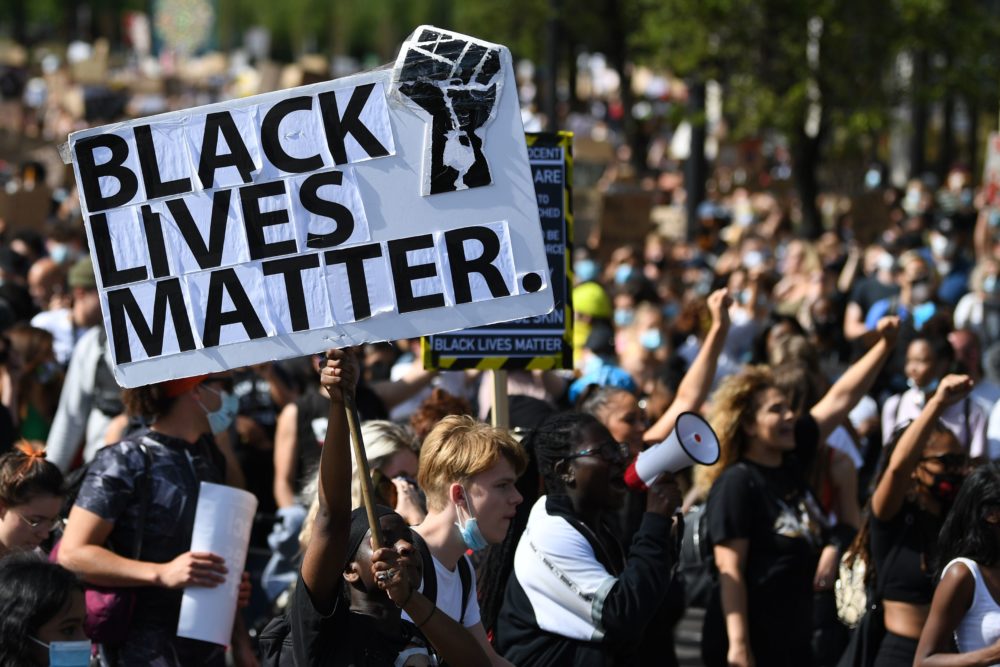
(Photo by DANIEL LEAL-OLIVAS/AFP via Getty Images)
As it has been taught in many American universities, since about the early-mid 1990s, “critical theory” in this sense has come across as being very, very different, even to the point of being antithetical to the Gospel. According to James Lindsay, a scholar at New Discources, this version of critical theory has almost become a new religion, where there is no such thing as absolute truth. In this sense, “critical theory” goes even beyond “politics.” Many Christians lump all of this into “identity politics,” but this is merely a symptom of a deeper problem, rooted in postmodernism.
So, what is the fundamental idea, associated with the “critical theory” approach to postmodernism?In a nutshell: Claims to truth are simply attempts by an oppressor group to oppress others, in order to hold onto their power. Gone is the vision imagined by Martin Luther King, Jr., whereby a person should be judged, not by color of their skin, but by the content of their character. Now, the color of a person’s skin means everything. In other words, what Christians have historically meant by “social justice” does not mean the same thing as what “critical theorists” today mean by “social justice.”
So, what do people actually mean when they say, “Black Lives Matter?” I do not really know. Perhaps it means something like what Dr. Martin Luther King Jr. envisioned… OR, perhaps it means a NeoMarxist view of reality. The meaning appears to differ from person to person.
Confusion about critical theory is causing a crisis for Christians. Sadly, as a result, critical theory is dividing the evangelical church today. Some, like popular Christian author Jemar Tisby, referenced in an earlier Veracity blog post, believe “critical theory” to be very useful for Christians. Monique Duson, of the Center for Biblical Unity, on the other hand, rejects this use of “critical theory,” as actually undermining Gospel.
What makes this even more difficult is that a growing number of secular thinkers are catching onto what is going on (see atheist, mathematician James Lyndsay, in this provocative and alarming YouTube video) , while many Christians remain puzzled. When we can not even agree on what the words mean, we get into serious trouble (Where is C.S. Lewis, when you need him?).
We need a conversation about this. How should we respond, yet as followers of Jesus?
In recent months, I have blogged about conspiracy theories, on the right, that fascinate a number of my fellow Christians. But the “uncritical” acceptance, without sufficient nuance, of critical race theory, among other of my fellow Christians, has a lot of the same properties of being a conspiracy theory, but this time, on the left. It is as though we are all caught in the middle of ideological cross-fire, where one extreme is the mirror image of the other extreme. We live in strange times, that require great amounts of wise, Spirit-led discernment.
Here below is a helpful video, where Christian apologist Alisa Childers interviews Monique Duson, of the Center for Biblical Unity, who explains, why she, as a black Christian, rejects critical race theory. If the first 10 seconds of the video do not interest you, I do not know what will.
YES: I recognize that the video is an hour long. I am sorry, but this type of stuff is exceedingly complex, and can not be summed up in a Twitter tweet or a sound bite. But if you really only have 4 minutes to spare, I have also included a 4-minute clip of an interview by Bobby Conway with Neil Shenvi, one of the top Christian thinkers who understands critical theory, where he sums up his advice for Christians and Christian leaders (link to full interview):
Let the conversation begin: What do you think?:
J. I. Packer…. In His Own Words, In 15 Minutes
Crossway Publishers has one of the last videos of J. I. Packer, sharing his life in 15 minutes. We have lost one of the great ones, of the faith. I offered an in-depth review of a biography of Packer’s life, this past weekend. Well done, good and faithful servant!!
“I should like to be remembered as someone who was always courteous in controversy, but without compromise.” — J. I. Packer
Comet NEOWISE!!
Last night I had the chance to go out to a bridge crossing the Chickahominy River, and view Comet NEOWISE (C/2020 F3), as it followed the sunset. What makes this astronomical event so wonderful is that the tail of the comet could be viewed by the naked eye.
We have not had something like this in 23 years, when Comet Hale-Bopp flew by in 1997, and we may not see anything like this again for another 10 years. I first got turned onto comets when I saw Comet Kohoutek just over the horizon in 1973.
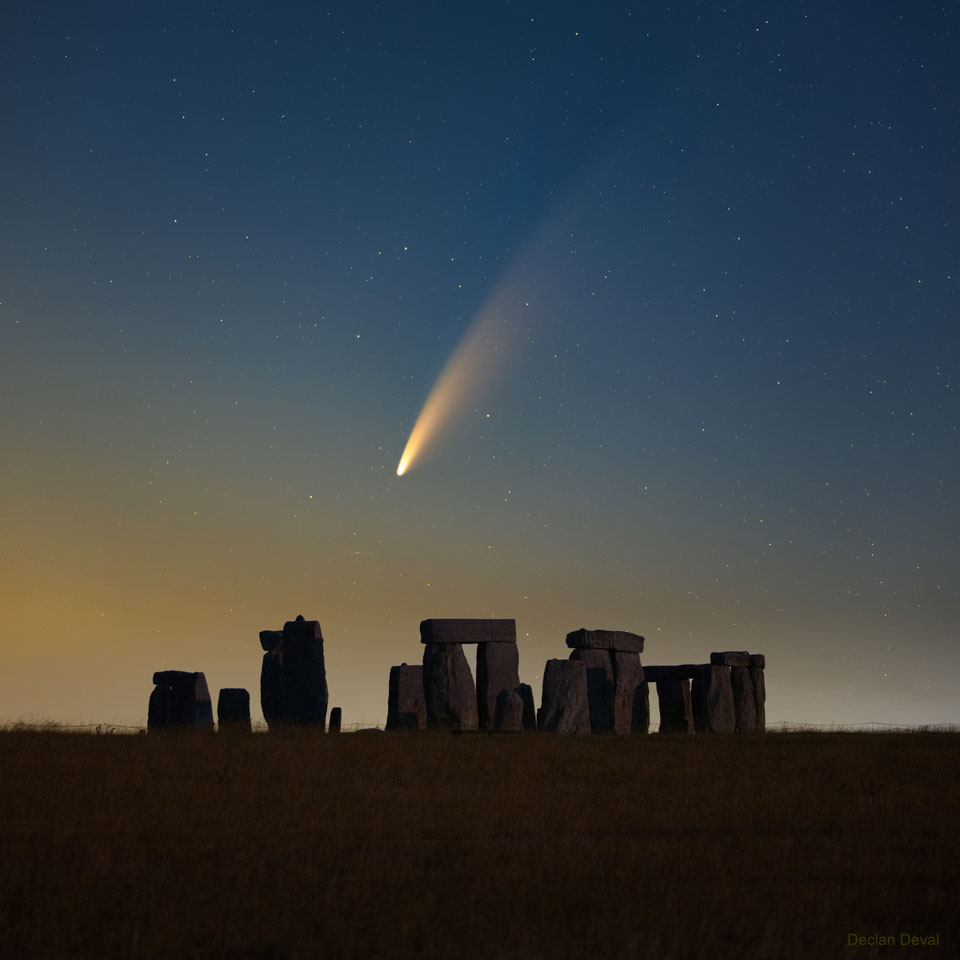
I had a pair of binoculars, which helped me to spot Comet NEOWISE, around 10pm, below the Big Dipper, in the northwest sky. Cars passing occasionally on the bridge, with their lights, took away from some of the experience, but it was still really special. Unfortunately, I had no decent camera with me, but I really like this photo below taken by photographer Declan Deval, at Stonehenge, in the UK.
Comet NEOWISE is a 5-kilometer wide ball of ice, traveling 40 miles per second, leaving a trail of gas and other particles, that produce its tail, as it has recently gone around the sun, and is now on its way out to the far reaches of the solar system. For the next week or so, it will be making its closest approach to earth, so if conditions are right, it could become spectacular. But do not wait too long, as you will not see NEOWISE again for another 6,800 years.
Some other fun comet stuff below….
A brief church history note on comets: 17th century theologian William Whiston alarmed citizens of London when he predicted that a comet would crash into the earth (he turned out to be wrong). Whiston was one of the first researchers of comets, during the era of Isaac Newton, and his work in astronomy helped him to promote work in identifying methods for ships to determine their exact longitude at sea.
Whiston also sought to connect comets with events in the Bible, where he notably suggested that the Great Flood of Noah was caused by a comet, publishing a book on the topic that received praise by philosopher John Locke. Whiston suggested that the earth must have passed reasonably close to the tail of a comet, such that the atmosphere became soaked with moisture from the passing comet, thus triggering the great deluge. A similar proposal was also advocated by Edmund Halley, the astronomer who identified the periodic comet that bears his name. Whiston was also known for translating some of the works of Josephus, which are still in print. Whiston’s other theological ideas became suspect, however, as he was known to be an advocate of denying the doctrine of the Triune nature of God.
Balance: J. I. Packer
One of evangelicalism’s leading lights, James Innell Packer, died yesterday at 93. Having just finished reading a biography via audiobook about Packer’s life no less than two weeks ago, I offer my review of this book, as I honor one of the most remarkable, influential, and balanced Christian authors in my life.
My first encounter with J. I. Packer was during my freshman year in college in the 1980s, when I read his classic work Knowing God. My InterVarsity group was mainly absorbed with the writings of C.S. Lewis and Francis Schaeffer, both of whom were primarily oriented towards apologetics.
But Packer was different. I walked away from reading Packer with a greater desire to know Scripture, as a means of knowing God.
Packer’s life is remembered in Leland Ryken’s J.I. Packer: An Evangelical Life. Looking back over his long life, J. I. Packer, serves as a wonderful example of a Christian life lived consistently well. Leland Ryken, a professor emeritus of English at Wheaton College, has done the church a great service by telling the story of J. I. Packer (I also just finished reading one Packer’s final books, Grounded in the Gospel, co-authored with a former student of Packer’s, Gary Parrett, late last month, that I reviewed recently here at Veracity).

Feel free to share our book…

Join the Conversation
Clarke Morledge on The Stain of Antisemitism in… Clarke Morledge on The Septuagint: What It Is and… Did God Crush His On… on Did God Kill Jesus? The Cross… Did God Crush His On… on Authorized: The Use and Misuse… Did God Crush His On… on Reviewing Bart Ehrman’s… Did God Crush His On… on The Septuagint and the Origina… Did God Crush His On… on The Septuagint: What It Is and… Clarke Morledge on Does Science Make the Biblical… Clarke Morledge on From Genesis to Junia: An Hone… Clarke Morledge on What About Those “Lost S… jdelias on Did Kirk Cameron Just Deny the… Clarke Morledge on “Inconceivable” Fa… 
Document everything… on Paul, A Biography, by N.T. Wri… Clarke Morledge on Christianity Along the Rhine:… Build A Hooper on Christianity Along the Rhine:…


 Veracity