Dogs Who Know the Lord

Dooty Morledge.  1996-2013.

Dooty Morledge. 1996-2013.

We had to put our dog down today. Our little Italian greyhound, Dooty, was seventeen years old, and he had lived a full life. He was a sweet little dog, and he particularly gave my wife a lot of comfort and joy.

Ever since we got back from the vet, I have been weepy. I keep expecting him to chase me around the house, wagging his tail.

But he is not here anymore. Gulp.
Continue reading


Biblical Tension

“It seems easier to go to a consistent extreme than to stay at the center of biblical tension.”
Robertson McQuilkin

Scaling El Capitan, photo by Bronson Taylor Hovnanian, 2011


A sagacious Veracity reader recently served up the above quote while discussing perspectives on the role of women in church leadership.  I hadn’t heard it before, but it sounded profound and worthy of some quiet-time bird dogging.  I quickly traced it to Robertson McQuilkin, a man of great integrity.

The Christian faith inherently involves biblical hermeneutics—simply put, we have to interpret the text in the Bible.  In wrestling with our different interpretations there seems to be no limit to the chasms we create over issues large and small.

So this new quote from Robertson McQuilkin seemed to hold potential as a way to work though our differences.  Jesus was the master of big thinking, never getting lost in the details.  When we disagree, one tact is to find a higher principle, teaching, or value upon which we can agree.  We can use tension to elevate to a higher common ground.  Lots of things don’t work without tension.  Maybe biblical tension is prescribed for our health and well being.  The left versus the right, with peace in the middle.  No more getting stuck in the parking lots of our own arguments. Continue reading


Christian Imagination?

Imagination.  Is there such a thing as a godly imagination in the life of a believer in Christ?

Imagination. Is there such a thing as godly imagination in the life of a believer in Christ?

Is there a place for imagination in the spiritual life of the Christian?   Some critics argue that Christian faith stifles human creativity.   Does the use of imagination in worship and prayer lead to spiritual transformation or spiritual depravity?

On the one side, the Bible consistently warns that a misplaced imagination will distract the Christian from true worship.  For example, everywhere in the classic King James Version, in contrast with more modern translations, the English word imagination from the original Hebrew and Greek phrases always carries a negative meaning (then contrast with ESV). For example:

But they hearkened not, nor inclined their ear, but walked in the counsels and in the imagination of their evil heart, and went backward, and not forward (Jeremiah 7:24 KJV).

Clearly, it is possible to become so engrossed in our own imagination, or someone else’s imagination projected towards us, that we fail to hear God. In our television-saturated world and ultra-realistic CGI animation movies, the massive feast before our eyes can easily clog up our ears to God’s Word. Even in the church, if in our Sunday morning services we find ourselves remembering more about the vivid illustration used by the preacher, and yet still unable to recall what Bible passage was being expounded upon, then I think we have a deadly serious problem.

OK.  So far, given this overview, the concept of imagination does not bode well in the life of a Christian.   But does this mean that all imagination is contrary to God’s purposes? Is there a more positive, biblical, even godly approach to imagination? Sometimes, in an effort to fight off counterfeit spirituality, we can easily throw out the baby with the bathwater.
Continue reading



Under the Hood

Head Gasket Repair

Push Rods and Rockers, 2008


I spent a couple of weeks writing this post, adding and removing parts, only to end up with an over-spiritualized, not-very-good penultimate result.  After some painful edits, how about I just get right to the point?

The original idea for this blog was to have a place for “Sharing resources that corroborate the Bible.”  While we remain quite committed to that theme, we’re finding our voice in a slightly different major chord.  Consequently we are changing the tag line for Veracity to “Sharing the Joy of Personal Discipleship.”

What is personal discipleship?  It’s an answer to the darkness of man we see all around us every day.  It’s keeping our eyes on the only thing that counts—faith expressing itself through love (Galatians 5:6b, NIV84).  We define personal discipleship as the process in which a believer or seeker takes personal responsibility for investigating the claims and content of the Bible. Continue reading


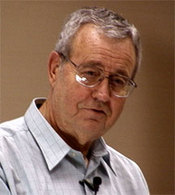
Transformation: Dallas Willard

Dallas Willard. Pioneer for the renewal of spiritual formation in the contemporary church.

Dallas Willard. Pioneer for the renewal of spiritual formation in the contemporary church.

Can you tell the difference between someone who says that they are a Christian, and someone who is not?

The Apostle Paul challenges us:

Examine yourselves, to see whether you are in the faith. Test yourselves. Or do you not realize this about yourselves, that Jesus Christ is in you?—unless indeed you fail to meet the test! (2 Corinthians 13:5, ESV)

Whoa.  I am not sure I like this type of test. Do you meet the test? Or does it only apply to the really “spiritual” people out there?

The existence of many people who are Christian “in name only” is a serious problem in the contemporary church, even among so-called “Bible-believing” congregations. Dallas Willard, who died on May 8, 2013, believed that he had pinpointed the source of the problem.
Continue reading