
Transmission Sphygmograph, c. 1900
Do you ever think about your spiritual health? Spiritually speaking, how are you doing? How about those around you? How about your church? Are you making a difference? Are you trying hard enough? How good is good enough?
I do. I think about spiritual effort a lot.
Dick Woodward used to call this kind of thinking “a checkup from the neck up.” (Dick had a way with words.) Spiritual diagnosis was a prerequisite for the Sermon on the Mount—it’s all about attitudes. And Jesus Christ had a lot to say about attitudes and spiritual effort.
“I know your deeds, that you are neither cold nor hot. I wish you were either one or the other! So, because you are lukewarm—neither hot nor cold—I am about to spit you out of my mouth.”
Revelation 3:15-16, NIV84
That sounds frightfully harsh…but wait a minute. No need to worry, we have Sola Gratia. What about Ephesians 2:4-5 and Romans 3:23? It’s all about grace, right? We don’t have to be good enough. Gimme a break, we all fall short. I’ve got a job that wears me out, responsibilities…I don’t have the time or energy to do more. Besides, salvation doesn’t depend on our works.
The problem with that kind of attitude about spiritual effort is that it constitutes what Dietrich Bonhoeffer called “cheap grace.”
“Cheap grace is the grace we bestow on ourselves. Cheap grace is the preaching of forgiveness without requiring repentance, baptism without church discipline. Communion without confession. Cheap grace is grace without discipleship, grace without the cross, grace without Jesus Christ, living and incarnate.”
Dietrich Bonhoeffer, The Cost of Discipleship
Grace without Discipleship? How can we diagnose grace without discipleship? Well, it could look like serving your church or ministry in a leadership position and feeling a little too complacent. How is your personal discipleship coming along? Is there urgency in your service? Are you working effectively to promote discipleship—or are you part of an organization that’s largely going through the motions? Isn’t it best if everyone just gets along and serves in harmony? It’s best not to rock the boat. Maybe. But if we heed Christ’s words to His churches in Revelation, this is indeed serious business. So how hard should we row? There’s that checkup from the neck up again.
An Ethic for Ministry
Marion and I recently had dinner with Drs.
Andreas and Marny Köstenberger. Not surprisingly, we got around to talking about personal discipleship and the Veracity blog. When I mentioned the spiritual basis for the blog in
Philippians 2:12, Andreas told us about a book he had written that expands upon these ideas.
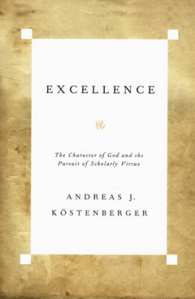
Excellence: The Character of God and the Pursuit of Scholarly Virtue is an exhortation written to scholars, but with broad application to anyone involved in ministry. The burden of the book is to “urge all of us who sense God’s call to scholarly labor to pursue earnestly, and with God’s help, the scholarly virtues discussed in this book.”
We don’t really talk about virtues anymore. It’s as if the word went out with parasols and medicine shows. But the pursuit of biblical virtues constitutes an appropriate cornerstone for personal discipleship.
The biblical basis for Excellence is the apostle Peter’s exhortation for believers to “grow in the rich knowledge of God and of Jesus our Lord” (2 Peter 1:2).
“For this very reason, make every effort to add to your faith excellence, to excellence, knowledge; to knowledge, self-control; to self-control, perseverance; to perseverance, godliness; to godliness, brotherly affection; to brotherly affection, unselfish love. For if these things are really yours and are continually increasing, they will keep you from becoming ineffective and unproductive in your pursuit of knowing our Lord Jesus Christ more intimately. … Therefore, brothers and sisters, make every effort to be sure of your calling and election.”
2 Peter 1:5-8,10a (NET Bible)
Just as Paul instructed believers to work out our own salvation with fear and trembling (Philippians 2:12), Peter directs us to work on our faith. And he sets the bar very high—the first virtue is the pursuit of excellence in increasing measure. With this scripture in focus, we have the answer to “how hard should we row?” and we have an ethic for ministry. Complacency has no place in the church, so go ahead, rock the boat if need be, but appreciate that Christianity is serious business.
One of the things I appreciate most about Excellence is the passionate humility with which Dr. Köstenberger paints the text. A book exhorting readers to steadfastly pursue excellence and Christian virtues could easily have swayed between dogmatic cheerleading and impersonal instructions for self-help. But it doesn’t. Without pulling any punches, he makes the point that mediocrity is not pleasing to God but does so with a gentle and genuinely humble voice. The book is extremely well written and thought out.
Dr. Köstenberger also offers practical suggestions for keeping the work of the ministry from becoming stale and getting off track. I particularly appreciated what he had to say about the importance of balancing purposeful rest with hard work. In fact, the book is full of well-formed balancing points. For lots of reasons, I read the text at just the right time.
The following quotes from Excellence: The Character of God and the Pursuit of Scholarly Virtue should give some indication of how helpful this text can be in thinking about spiritual diagnosis and spiritual effort.
Being set apart unto God as a scholar also entails a rejection of the false modernist dichotomy between faith and scholarship, a wholehearted pursuit of truth, complete dependence on the guidance and empowerment of the Holy Spirit, a balanced life that does not turn our scholarship into an idol, an awareness that the primary orientation of our work is to be missional, and an engagement in spiritual warfare through faithful witness to the truth.
Without the Spirit’s empowerment, our pursuit of holiness and excellence through growth in godly virtues will devolve into mere human self-effort that invariably results in pride and failure.
The primary spiritual disciplines advocated by Scripture are prayer and the obedient study of God’s Word.
We need to cultivate the discipline of rest, of regular time set aside for reflection, planning, and relaxation. In the long run, this will ensure that we will be at our most productive. I often find that after a week or two away from the office, I return invigorated, sharper, and more focused and alert.
The principle, then, is this: rest in God’s grace, look to him for guidance, and then do the work (in that order!). Don’t put self-effort and striving ahead of listening to God. And balance hard work with regular rest and relaxation (which means don’t forget to take a vacation once in a while, or take a day off on your son’s or daughter’s birthday or on your anniversary).
Mediocrity, sloppy workmanship, and a half-hearted effort do not bring glory to God or advance his kingdom.
The message here is not simply to try harder, to put in more effort, and to make things happen through sheer force of will. Salvation is entirely by God’s grace (Eph. 2:8–9), and sanctification is by grace as well (Eph. 2:10). This means that the pursuit of scholarly excellence must be undergirded by a keen sense of God’s continual grace in the personal and professional spheres of our lives and that we should pursue scholarly excellence in an environment of grace, not in a spirit of self-effort or unhealthy competition.
As evangelicals, we have too often, in Franky Schaeffer’s words, been “addicted to mediocrity,” and this mediocrity has in many cases become a curse—a curse that has kept us from reaching our personal, creative, and academic potential given to us by God, and has prevented us from impacting other believers as well as unbelievers for the glory of God and for his kingdom.
To your wisdom, add grace. Everything a Christian does should be characterized by grace. Grace should permeate our thoughts, words, and actions, and make a noticeable impression on those with whom we come in contact, both believers and unbelievers.
What are you and I going to do? Will our scholarship be characterized by a mean-spirited, confrontational, and harsh attitude? The writings of some evangelicals show little love for their scholarly opponents; in fact, one might almost conclude that they despise them. Unfortunately, these brothers in Christ do not seem to realize that the scholars on the other side of a given issue are, ultimately speaking, not the enemy. Satan is our common enemy.
Graciousness in response to criticism requires that we take ourselves out of scholarship to some degree and leave the results in God’s hands.
This balance, of course, is hard to achieve. It is much easier to spend long hours in one’s study and to ratchet up an impressive record of scholarly publications while neglecting one’s family. Conversely, someone may be a great father and husband but only a mediocre scholar (though, if a choice has to be made, the latter is, of course, to be preferred over the former).
While dangers are doubtless lurking ahead, commit yourself to excellence. The God you serve is himself characterized by excellence, and that same God has called you to the pursuit of excellence for his glory and for the good of others. If you pursue excellence and progress in it, you and others will be blessed, and God will be glorified.
HT: Dr. Andreas Köstenberger, Museum of Historical Medical Artifacts (transmission sphygmograph photo)