The Beautiful Gate: Holy Week, Ezekiel, Mary, and the Return of Christ

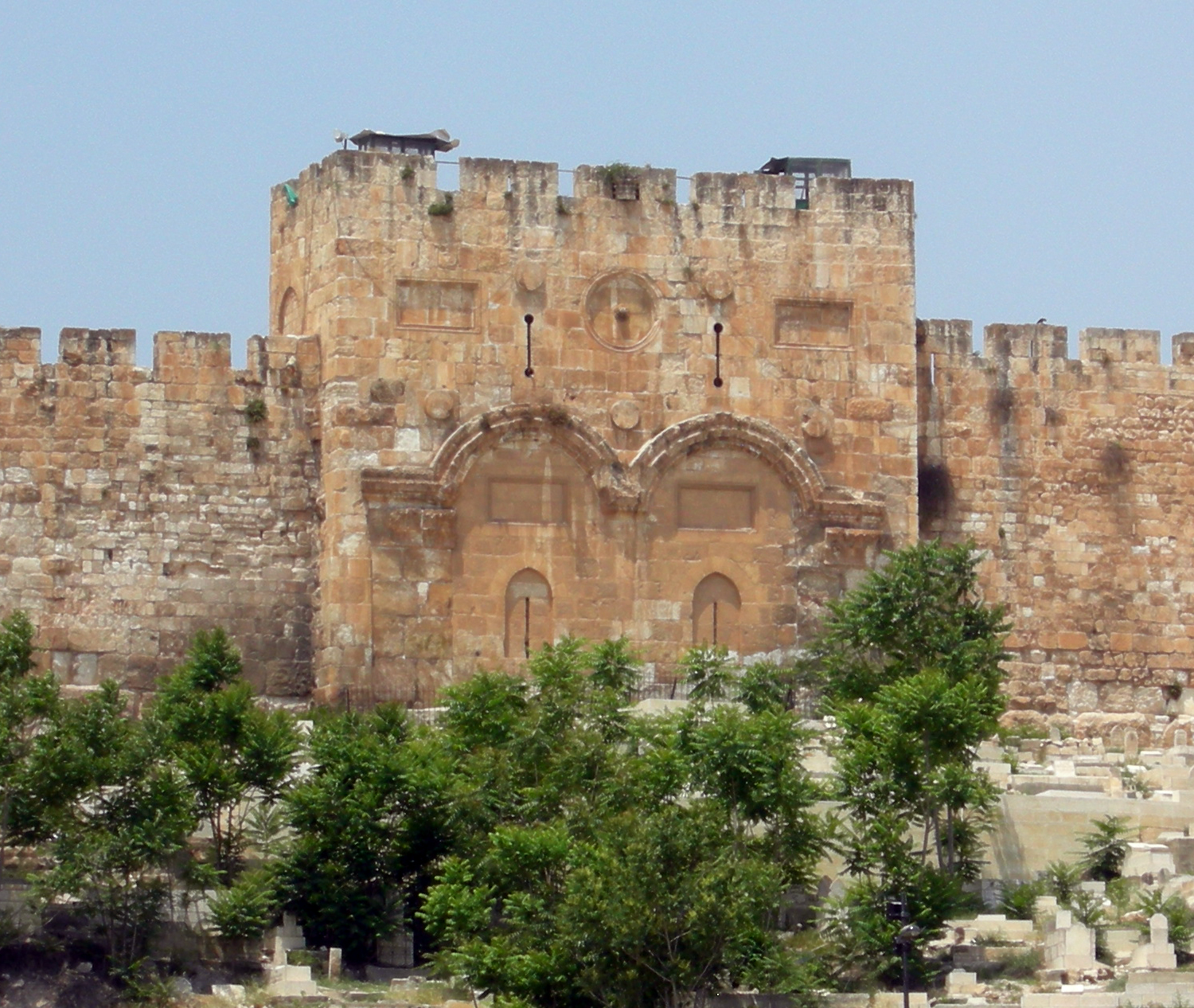
The Golden Gate of Jerusalem, that some identify as being the Beautiful Gate of Acts 3, where Jesus will return at the end of the age (credit: Wikipedia)

In Acts 3, some followers of Jesus met a lame beggar, at the Beautiful Gate, as the man was asking for alms of those entering the temple. Peter stunned the beggar by saying, “I have no silver and gold, but what I do have I give to you. In the name of Jesus Christ of Nazareth, rise up and walk!” (verse 6). The man was healed, and Peter boldly proclaimed the news that Jesus was and is indeed the Risen Messiah, to those who saw this miracle.

The man was “leaping up” (Acts 3:8), anticipating that this is one of the signs indicating the beginning of the messianic age, as foretold in the Old Testament, as in Isaiah 35:6 (ESV):

..Then the eyes of the blind shall be opened,
    and the ears of the deaf unstopped;
then shall the lame man leap like a deer,
    and the tongue of the mute sing for joy.
For waters break forth in the wilderness,
    and streams in the desert;..

The Beautiful Gate is not directly mentioned elsewhere in the Bible, and unfortunately, scholars are divided as to the exact location of the Beautiful Gate. As the Temple Mount area was largely destroyed in 70 A.D., it is difficult to establish the location with much certainty. However, there are at least one (or two) theories, though I am hardly qualified enough to be sure of them, that tell very interesting stories.

Some say that the Beautiful Gate is the same as the Golden Gate, located on the eastern side of the Temple Mount, sitting above the Kidron Valley, across from the Mount of Olives. Though not clearly specified in Scripture, tradition suggests that when Jesus made His triumphal entry into Jerusalem, starting from the Mount of Olives, that He entered the city through this gate, on Palm Sunday (Luke 19:28-44), the beginning of what many Christians call “Holy Week.” Within that following week, subsequent events would lead to the Crucifixion and, finally, the Resurrection of Jesus.

Proponents of this theory also suggest that when Jesus returns at His Second Coming, that he will appear on the Mount of Olives again (Zechariah 14:4), and travel the same route he took on Palm Sunday, entering the city again through this same gate, into the temple area.

What caught my attention with this theory was something that you will notice about this gate. As you see in the photograph, the gate has been walled off, and sealed shut.

This Golden Gate was sealed shut in 1540-41 AD, by Suleiman the Magnificient, an Ottoman Empire sultan. The story goes that Suleiman sealed the gate, and even placed a Muslim graveyard into front of the entrance, in order to prevent the Jewish Messiah from entering the city.

If you are familiar with the Book of Ezekiel, you will know that Ezekiel mentions a gate or entrance to the city, on the east side, facing presumably the Mount of Olives (Ezekiel 10:18-19, 11:23, 43:1-5). But then in Ezekiel 44:1-2, we read a fascinating passage:

Then he brought me back to the outer gate of the sanctuary, which faces east. And it was shut. And the Lord said to me, “This gate shall remain shut; it shall not be opened, and no one shall enter by it, for the Lord, the God of Israel, has entered by it. Therefore it shall remain shut.

Many Christians have read this to believe that Suleiman’s actions were actually a fulfillment of prophecy, though he did not realize it. Then when Jesus returns again, the gate will be opened for the returning Messiah (Ezekiel 46:12).

Such interpretations are not without their problems. A long standing, older interpretation, going back to the early church, understands that the shutting of the gate in Ezekiel 44:1-2, is about something completely different.

A number of early church fathers saw this as Ezekiel’s prophecy regarding the perpetual virginity of Mary, a belief shared today by Catholics and Eastern Orthodox alike, that Mary was not only a virgin before the birth of Jesus, but that she remained a virgin her whole life, as taught here by Saint Augustine of Hippo, in the 5th century AD.

“It is written (Ezekiel 44, 2): ‘This gate shall be shut, it shall not be opened, and no man shall pass through it. Because the Lord the God of Israel hath entered in by it…’ What means this closed gate in the house of the Lord, except that Mary is to be ever inviolate? What does it mean that ‘no man shall pass through it,’ save that Joseph shall not know her? And what is this – ‘The Lord alone enters in and goeth out by it,’ except that the Holy Ghost shall impregnate her, and that the Lord of Angels shall be born of her? And what means this – ‘It shall be shut for evermore,’ but that Mary is a Virgin before His birth, a Virgin in His birth, and a Virgin after His birth.” 

But I recently learned that the Beautiful (or Golden?) Gate figures prominently in the apocryphal story of the Annunciation of Mary, to her parents (see below). Not too many evangelical Protestants would accept this particular interpretation today.

Well, there is a lot of speculation here, I must freely admit. Various Christians have long debated and will continue to debate the details on these matters.

Nevertheless, the momentous events during Holy Week, from Palm Sunday to the Resurrection, give us a lot to think about. The entire message of the Bible, from the Old Testament, to the very end of this current age, puts a laser focus on this very special week in world history. No matter where you land on the true meaning, location and history of the Beautiful Gate, where Peter healed the lame beggar, this gate points to the central themes of the Bible that are worth the efforts of our meditation.
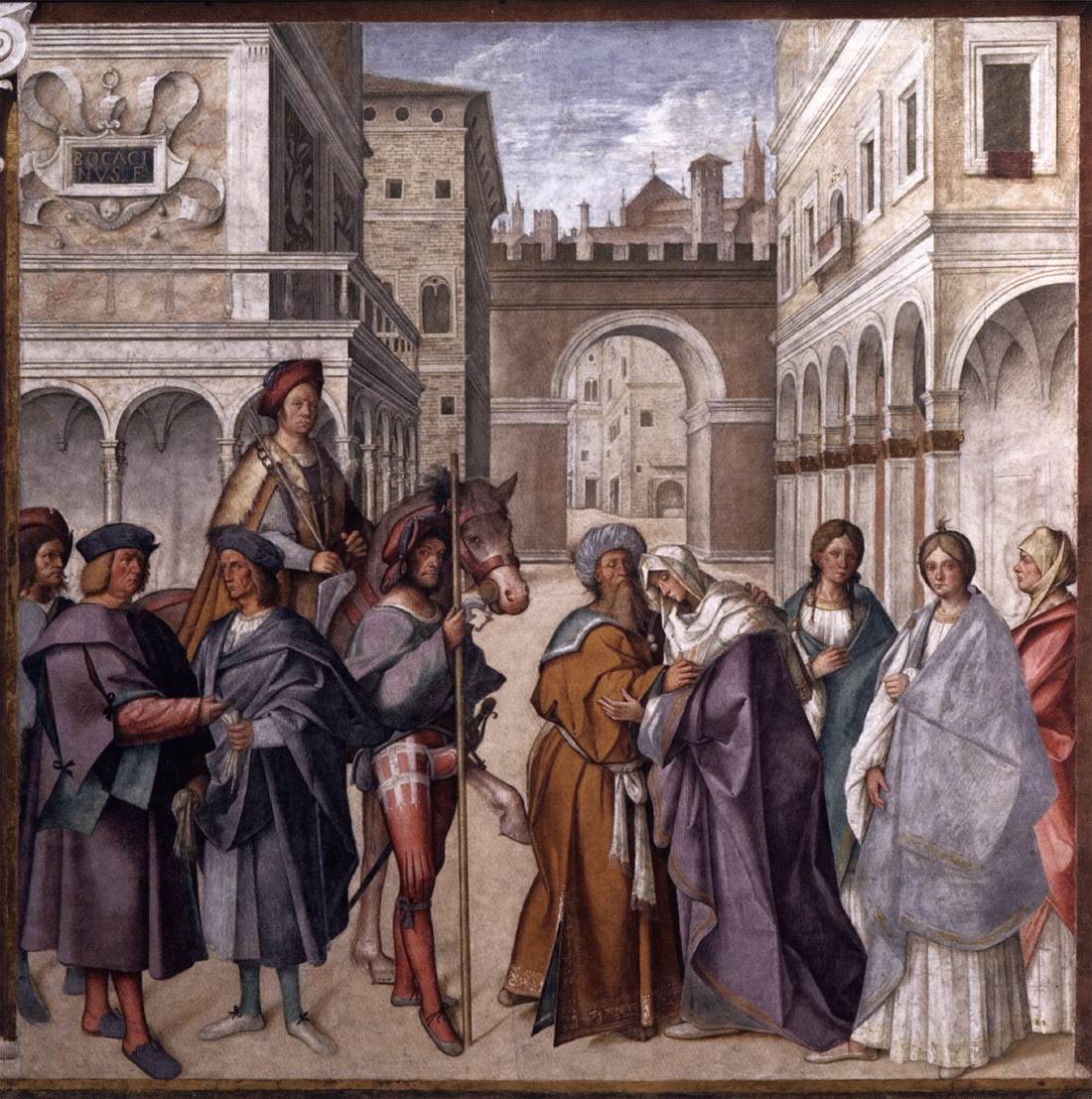
Meeting at the Golden Gate, by Boccaccio, 1514-1515, at Cremona Cathedral. In the New Testament apocryphal literature, the Protoevangelion of James, the parents of the EverVirgin Mary, Joachim and Anna, met at the Golden or Beautiful Gate, after both received a visit independently from the Archangel Gabriel, promising them the birth of their child. Though not a part of the Bible, the Protoevangelion of James was a popular text in the medieval church, for thinking about the life of Mary, the mother of Jesus. (credit: Web Gallery of Art).

Egypt’s Coptic Christians, and the Unity of the Body of Christ

Palm Sunday terror in a blood-stained Coptic Christian church in Egypt, 2017 (credit: Agency France-Presse)

Tragedy gripped the world when Islamic State militants killed 44 Coptic Christians in Egypt, while worshippers gathered to celebrate Palm Sunday (New York Times). But a few of my Christian friends were probably wondering, what is a “Coptic Christian,” and are they really Christian?

Joe Carter, a blogger at The Gospel Coalition, has a great FAQ summary, explaining what happened, and who the Coptic Christians are. But I want to focus on answering some of the specific concerns of my friends. More importantly, I want to have you think about what it might teach us, for evangelical Christians. Continue reading


Why Different Christians Recite the Lord’s Prayer Differently

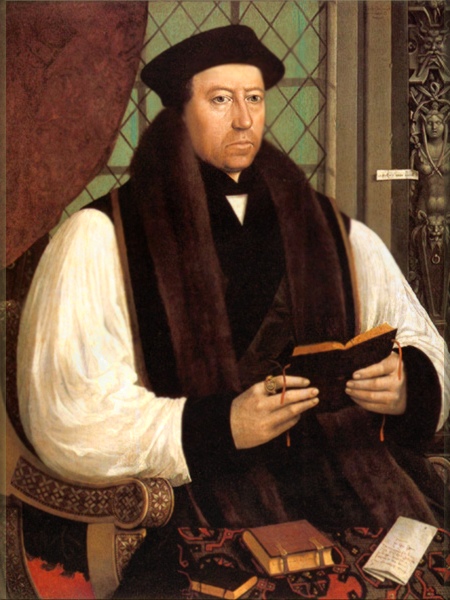
Thomas Cranmer, 16th century Archbishop of Canterbury, who guided King Henry VIII’s efforts to standardize an English version of the Lord’s Prayer.

Have you ever been a little confused when it comes to saying the Lord’s Prayer in a church service?

I remember when I first visited an evangelical church, that did not have a fixed, liturgical tradition. When it came to reciting the Lord’s Prayer, one group was still saying, “And forgive us our trespasses, as we forgive those who trespass against us….,” while the other group had finished their, “And forgive us our debts, as we forgive our debtors…,” several seconds earlier. The “debtors” waited patiently until “trespassers,” like me, had finished, before continuing together.

So, why the cacophony of voices among Christians?

Protestant Christians have been known for having multiple methods of saying the so-called, “Lord’s Prayer,” what many Catholics call the “Our Father,” based on the first two words of the prayer. My Catholic friends often tease me for the endless varieties of worship among English-speaking Protestants.

But it really was not meant to be that way. Much of the story goes back to the period of the Reformation, in 16th and 17th century England. Continue reading


Vatican II, Embracement, and Pope Francis: Roman Catholicism Today

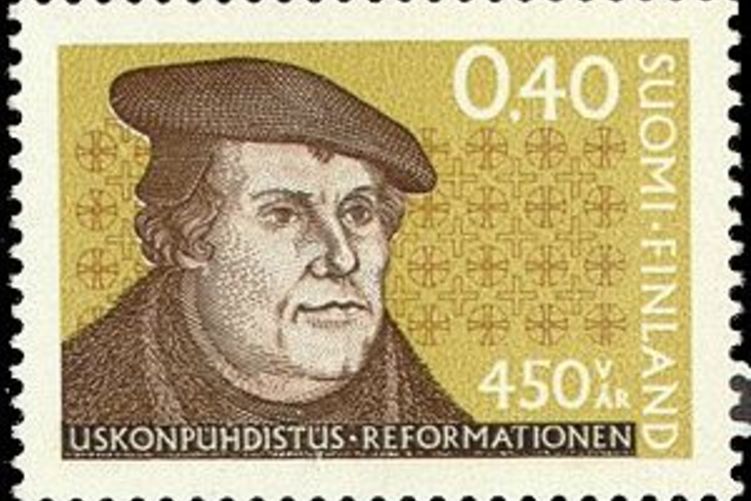
Martin Luther, a “heretic” or “a witness to the Gospel?” How has the Roman Catholic communion changed in 500 years? (credit: Finland stamp from 1967, from a ETWN web page)

I need some help from my Roman Catholic friends. It is difficult to figure out exactly what is going on in Rome today.

An Italian evangelical leader, Leonardo De Chirico, gave a very thoughtful 30-minute message at a recent Ligonier Conference, in this year of remembering the 500th anniversary of the start of the Protestant Reformation. In the video below, Chirico argues that in order to understand Roman Catholicism today, we need to have in mind three concepts/names:

  • Vatican II: The 16th century Council of Trent codified for hundreds of years what has been traditionally understood to be Roman Catholicism, the high water mark for the Catholic Counter-Reformation, a formulation of doctrine that sought to refute many of the reforms of Martin Luther and other Protestants. The next major council, Vatican I, set much of Roman Catholicism against the changing modern world of the 19th century, affirming the work of the Council of Trent, and reinforcing traditional boundaries. But the early 1960s, Vatican II council changed all of that. However, Vatican II did so, not by altering the doctrine of the church, but rather, by changing the tone and attitudes towards those outside of the Roman communion.
  • Embracement: Vatican II set the wheels in motion, whereby this change of tone and attitude has characterized the trajectory of the Roman church for the past fifty-plus years. Pope John Paul II and Pope Benedict put the brakes on much of this Vatican II trajectory, embodying the doctrinal commitments that have traditionally defined Rome. Still, incremental changes in smaller ways, in terms of a warmer spirit of embracement and inclusiveness of others, made their way into the church. But the doctrine remained effectively the same.
  • Pope Francis: Now however, unlike his recent predecessors, Francis has downplayed the doctrine and turned up the warmth of this new spirit of embracement. Arguably, Francis is the first truly “Vatican II”-like Pope. In the past four years since his ascendancy, Francis has hinted at or suggested various reforms in the church, some that point towards reconciliation with other parties in the universal Christian community (like Protestants and Eastern Orthodox), some that thrill liberals and others outside of  the church, and some that horrify Catholic conservatives.

What are we to make of all of this?

Briefly stated, on the one hand, Roman Catholicism has never been a monolithic movement, even during the era of the Council of Trent. On the other hand, Protestants can easily misrepresent what Roman Catholics believe and think, and that does harm to efforts to try to heal the divisions of the last 500 years. That being said, here are two things that come to mind as examples of what puzzles me, as to what is coming out of Rome in the Pope Francis era:

  • A generation ago, those Catholics who experienced the tragedy of divorce, were conscience-bound to go through the process of securing an annulment for improper Catholic marriages. Nowadays, fewer divorced Catholics even bother with the annulment proceedings. Also, according to authoritative Catholic tradition, regular confession is a required sacrament of the Catholic Church, and yet, I know many Catholic friends who rarely, if ever, go to confession. What are we to make of all of this?

Leonardo De Chirico offers some insights from a Reformed Protestant perspective. I can imagine that many traditional Catholics might be terribly dismayed by all of the changes. Can any of my Roman Catholic friends help me out here? Are Chirico’s observations correct?

Ligonier Ministries, associated with Bible teacher R. C. Sproul, has some great resources, particularly for those with interest in the theology of the Protestant Reformation. In this year, the 500th anniversary of the Reformation, Ligonier sponsored their annual conference, with the theme of the Reformation, and you can even view all of the videos of the conference on YouTube.


A Modest Defense of the “Billy Graham Rule”

There is quite a bit of chatter in social media recently about Vice President Mike Pence’s adherence to the so-called “Billy Graham Rule.” Many have mocked Pence’s statement that “he never eats alone with a woman other than his wife.” Briefly, the “Billy Graham Rule” was an unwritten pact between the early members of Billy Graham’s evangelistic team, that they would avoid even the appearance of infidelity. These men pledged not to eat, travel, or meet with any woman alone, except their wives. This rule, which covered more than just the issue of sexual infidelity, served to protect this ministry from the allegations of impropriety, for a long string of decades, that many Christians have admired as basic, common sense.

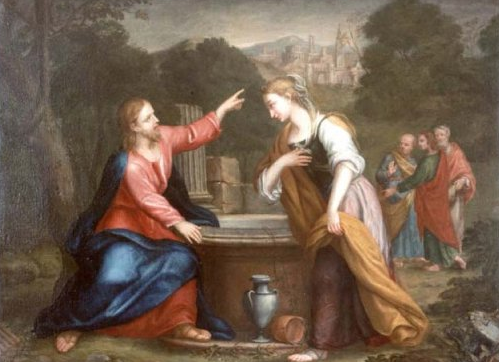
Surprisingly, the criticism of this rule has come, not simply from secular sources, but from Christians as well. Much of the furor concerns the endless egalitarian versus complementarian debates that consume the energies of many of today’s Christians (I tell some of my story here). Progressive Christian blogger, Rachel Held Evans, tweeted that “Jesus scandalized the disciples by meeting with a woman for a drink,” a reference to Jesus’ meeting of the Samaritan woman at the well, in John 4.

The critics have a point. The “Billy Graham rule” arose during a time when it was relatively uncommon to find women in the work force, in the late 1940s. When I began my career in engineering in 1980s, things had drastically changed in society. For about five years, I shared a large office with three other women engineers. There were times when I was alone with one of these women in the office, and neither of us thought anything about it. It was just part of our jobs to work together. So I get it.

But such critics have obscured something essential, in their defense of seeing women fully integrated in the workplace. The “Billy Graham rule” should not be lost as some legalistic concept, to be discarded as being sexist. Rather, we must be mindful of the principle that undergirds the rule, namely, that all people, men and women, who wish to honor their Lord, should not put themselves in compromising situations.

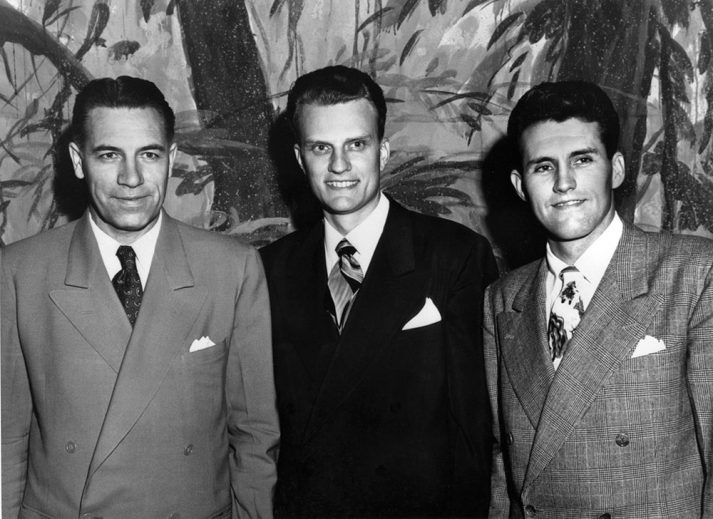
George Beverly Shea, Billy Graham, and Cliff Barrows, the young evangelists, who sought to live lives above reproach.

Fundamentally, people like Pence and Graham have been simply protecting their marriages, protecting themselves, and protecting those who have come under their familiar influence. As followers of Jesus, we should all do the same. The human tendency towards sin is much stronger than we are willing to admit to ourselves and realize. What often starts off as legitimate and harmless in our interpersonal relationships, business or otherwise, can easily slip into something completely inappropriate, over a period of time. The principle behind the Graham rule is that we should have those checks and balances in place that will keep us honest. All of us need healthy boundaries, to keep us from crossing lines of behavior, that we would soon regret. Just ask those former pastors and ministry leaders who failed to keep an appropriate version of the “Billy Graham rule,” starting counseling relationships privately, with those of the opposing gender, who after a small indiscretion here and there, eventually lost their jobs, scandalized their ministries, and destroyed their families.

The drawings of those specific boundaries will change as cultural conditions change, and such “rules” may still look strange to outsiders. Jesus met with the woman at a public well, not a dimly lit, secluded room. Yet the concept of a public well, in first century Palestine, seems strange, when contrasted with the contemporary American workplace or ministry setting. We will need to tweak certain applications of the principle behind the “Billy Graham rule,” in a culturally contextual manner. But the principle of avoiding compromising situations is a good thing to keep. Let us not mock that.