I am pausing a moment before I publish a long book review tonight to acknowledge the death of a dear friend of my late parents, Professor David L. Holmes. Professor Holmes taught for many years in the religion department at the College of William &Mary, where I work on staff as an Information Technology specialist. Professor Holmes and my father, George Alan Morledge, had a mutual interest in colonial churches in Virginia. They taught classes together at William & Mary, my dad being the historical architect and Professor Holmes being the church historian. As a middle-school kid, I survived several long car rides across Tidewater Virginia to visit colonial churches that would become subject matter for those Holmes-Morledge classes.
Before Professor Holmes retired from William & Mary nearly a decade ago, he and I had some spirited conversations about Christian faith. Professor Holmes grew up in an historically orthodox Christian home, but he moved theologically away in a more progressive Christian trajectory. I, on the other hand, went in the opposite direction, raised in a liberal mainline church to becoming more conservative evangelically minded. We disagreed on certain theological matters, but Professor Holmes was always gracious and kind, and his warmness was felt by the many students, including conservative evangelical believers, who enjoyed his classes.
He had once visited All Souls Church in London, England, the home parish of John Stott, perhaps one of the most influential evangelical spokespersons of the 20th century, and one of my theological heroes. Stott was not there preaching that Sunday, and unfortunately, Professor Holmes was not impressed with Stott’s stand-in replacement regarding the sermon, as the Professor recalls in a 2003 article for Anglican and Episcopal History, “Where the Trumpet Gives No Uncertain Sound.” In the Professor’s estimation to me personally, he lamented that in the sermon’s “understanding of the Bible, it sounded like something out of a far distant era.” While Professor Holmes loved the singing, the liturgical atmosphere, and friendly congregants, he could not intellectually affirm the message that he heard that day. Not having heard the sermon myself, I might definitely agree with Professor Holmes on certain points. But in the end, it may come down to the difference that I have more confidence in the overall intellectual integrity of the classic, historic, orthodox message of Christianity than Professor Holmes had.
Peggy Agouris, provost at William and Mary, wrote a wonderful remembrance of David L. Holmes’ life and service at William & Mary, and I am including portions of this remembrance below. Rest In Peace, Professor Holmes. May he be received well in Christ’s Eternal Kingdom.
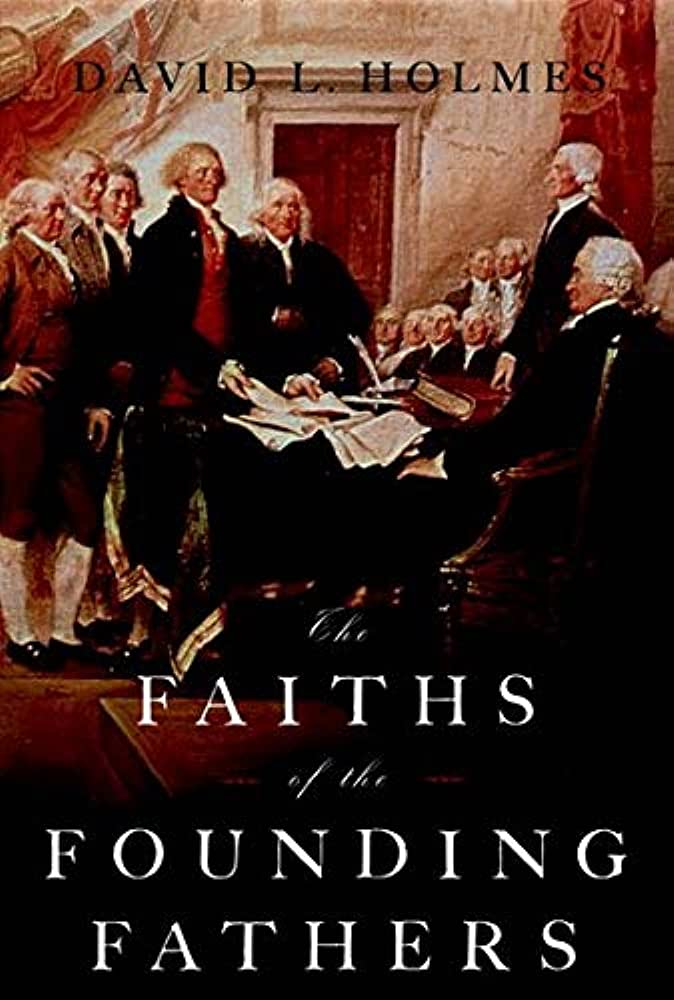
David L. Holmes study of The Faith of the Founding Fathers is an excellent survey of the theological attitudes of America’s colonial era leaders.
The Branch Davidians for days had been repeatedly asking for word processing supplies. When the supplies finally arrived the night of April 18, 1993, David Koresh got back to work writing his manuscript, in an agreement to end the crisis. Less than 24 hours later, a horrific tragedy was played out on national television….
Back when I was doing youth ministry in early March, 1993, I was setting up one night to lead a discussion with some parents. In the home we were meeting, a story had flashed up on the evening news, and all of us had stopped to learn about what was going on in Waco, Texas. The Bureau of Alcohol, Tobacco, and Firearms (ATF) had a few days earlier led a raid against the Mount Carmel Center, the home of David Koresh and the Branch Davidians. All of the television networks described the group as an extremist religious cult.
One parent leaned over to me, perhaps in incredulous jest, and asked something to the effect of, “So, what keeps this youth group [that I was leading] from becoming something like these crazy people in Texas?”
Well, I was just as bewildered about this news report as this parent was. For a total of 51 days, the drama between Branch Davidians and the federal government (the ATF and the FBI) kept many Americans glued to their TV sets each night, wondering how this bizarre story might unfold. At the end of the siege, on April 19, 1993, federal forces tried to flush out the Branch Davidians using tear gas, but the plan went out of control. A fire erupted, killing 76 Branch Davidians, including 28 children.
Was this simply a story of looney anti-government activists bent on attacking the United States? Or was there more to the story?
Flames erupt from the Branch Davidian compound in Waco, Texas after a raid led by federal officials, on April 19, 1993.
Why the Tragedy at Waco, Texas Could Have Been Avoided
The popular story had been that this Branch Davidians group, led by a charismatic leader, David Koresh, a 33-year old guitar player turned wild-eyed preacher, had been stockpiling weapons to be used against the United States. The initial raid in February, 1993, had resulted in the deaths of not only a few Branch Davidians, but several federal agents as well. David Koresh had raped several married women, and also a few teenagers, fathering a number of children, and holding them as hostages. Government agencies felt compelled to step in to seize Koresh’s weapons and release the vulnerable from under his manipulative control.
What had always bothered me about this narrative was that of those who survived the final, fiery destruction of the Waco compound, very few renounced their allegiance to David Koresh and his teachings. In fact, the raids by the government only confirmed the prophetic insights that Koresh had shared with his followers.
How could that be? Could they not see that David Koresh was a nut case?
It just did not add up. A more careful look at the evidence has been needed. As it turns out, the story is far more interesting and complex than the traditional, government-sanctioned narrative. It had to do with how David Koresh read his Bible, and in particular, how he interpreted the Book of Revelation, and how other Branch Davidians became convinced by his teachings.
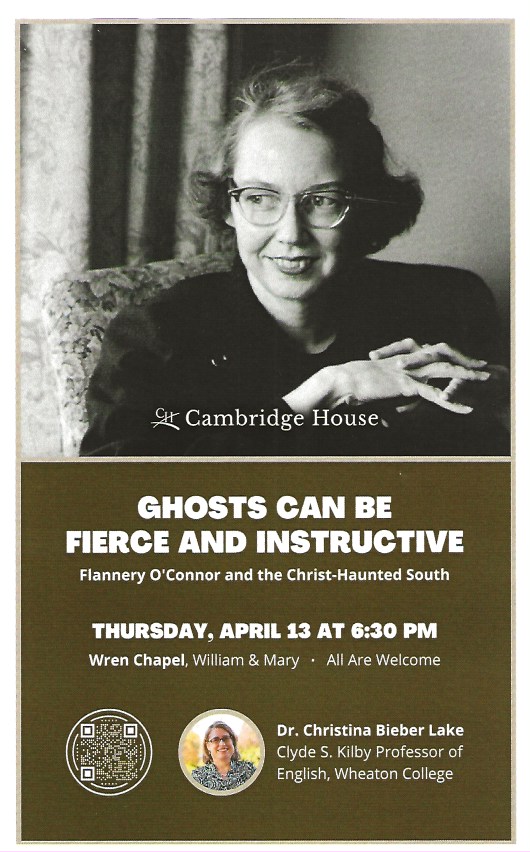
The Southern writer Flannery O’Connor wrote: “While the South is hardly Christ-centered, it is most certainly Christ-haunted. The Southerner, who isn’t convinced of it, is very much afraid that he may have been formed in the image and likeness of God.”
On Thursday, April 13th, at 6:30pm, at the Wren Chapel, on the campus of William and Mary, the Cambridge House at the College of William and Mary will sponsor its first public lecture, a talk given by Dr. Christina Bieber Lake, professor of English, at Wheaton College entitled “Ghosts Can Be Fierce and Instructive: Flannery O’Connor and the Christ-Haunted South.”
Flannery O’Connor is widely regarded as one of America’s greatest fiction writers of the 20th century. O’Connor, who died at age 39 after a long, debilitating battle with lupus, was not simply a master of her literary craft, she was a devout Roman Catholic, living in the predominantly Protestant Deep South, in Georgia. For you diehard Protestants, do not let Flannery O’Connor’s confessional loyalty dissuade you. O’Connor wrote dark yet funny stories about Southerners, where she was able to communicate a subtle Christian theological vision of what it means to be human, in a way that still fascinates secular critics decades later. Her short-stories, such as the 1955 gothic tale “A Good Man is Hard to Find,” have become classics of American literature.
Dr. Lake specializes in the area of Flannery O’Connor scholarship. A brief reception at the Wren Chapel will follow her lecture. All members of the William and Mary community, students, faculty, staff, and friends and neighbors of the College are welcome to attend, to find out what the work of the Cambridge House is all about.
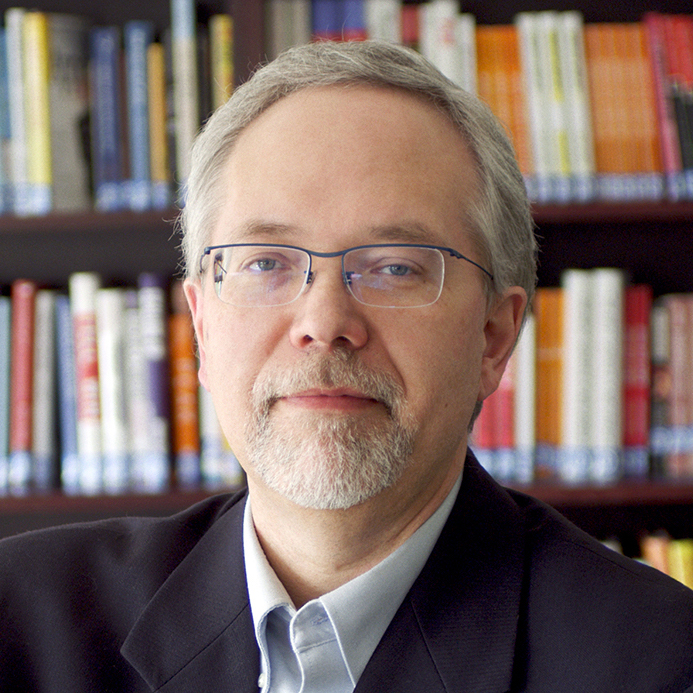
After about a year and a half battle with cancer, Dr. Michael S. Heiser has died. If I had to pick one evangelical biblical scholar who has impacted me the most over the past twenty years, it would be Michael Heiser.
Michael Heiser. Semitic languages and Old Testament scholar.
I first heard of Dr. Michael Heiser through a podcast that was recommended to me some eight or nine years ago, where Heiser went chapter-by-chapter through a book of the Bible, not quite verse-by-verse, but close enough, bringing his scholarly acumen to bear on the passage under discussion. This was before I ever sat down and read his mind-changing book, The Unseen Realm, that I finally got around to read just a few years ago. The Unseen Realm, along with the shortened, less academic version of the same, Supernatural, are books that have forever changed the way that many Christians have read their Bibles for the better. I am one of them.
In The Unseen Realm(read my review), Dr. Heiser tells the story of how as a graduate student in ancient history, Semitic languages, and the Hebrew Bible, while earning advanced degrees at the University of Pennsylvania and the University of Wisconsin-Madison, he stumbled on a different way of reading Psalm 82, that changed the way he read the whole of the Bible. To his amazement, after spending years in academic study, he had previously missed the Bible’s teaching about the “Divine Council” of God. This teaching was known among the ancient Israelites and Second Temple Jews of the Old Testament, but it had somehow become obscured or even lost among many Christian thinkers. As Christianity spread in the Gentile world within the first few centuries of the church, fewer and fewer believers adequately understood the uniquely Jewish context behind the Second Temple and early Ancient Near East cultural world of the Hebrew Scriptures.
As Mike, as he liked to be called, often said about the Old Testament: “Our contexts are foreign. They derive from church tradition that is thousands of years removed from the people who wrote Scripture and the audience to whom those people wrote.”
This supernatural world of the Bible explored by Dr. Heiser opened the door for me to understand a number of confusing Bible passages, that remained nothing more than mysteries to me. To summarize one of Dr. Heiser’s main ideas behind doing Bible study: “If it is weird, it is important.” Everything from the Nephilim of Genesis 6 to the head coverings passage of 1 Corinthians 11, Dr. Heiser was able take a lot of the best evangelical scholarly research on the Bible, and put it on the lower shelf, to help explain some of the stranger parts of God’s Word.
Furthermore, Michael Heiser has probably been one of the best apologists for the Old Testament, combining evangelical faith with academic rigor. Unlike many other scholars like him, Dr. Heiser was not raised in an evangelical church home. He was pretty much as unchurched as they can be when he finally gave his life to Jesus as a teenager. Yet unlike many other young teenagers who became believers, he nerded out quickly. He would take biblical commentaries with him to high school, in order to squeeze every minute he could to try to gain a better understanding of the text of Scripture. He never settled for accepting everything that was said from a church pulpit. Instead, he plowed deep into scholarship, avoiding pat answers to difficult questions, in an effort to fact check what he was being taught in various church settings. This nerdy love for the Bible would serve him well as a first rate Bible scholar later in life.
Like almost any scholar, I have not always agreed with Dr. Heiser on every point he was trying to make, or else he simply was not able to convince me. His primary interest in the biblical theology of the Divine Council often led him to ignore or sidestep other important issues in the interpretation of Scripture. At times, Dr. Heiser tended to shortchange or be overly dismissive of the tradition of the early church and certain elements in Reformation theology, and he even promoted a kind of despair that we can know anything about eschatology with any level of confidence: that is, regarding how believers should think about the specifics of the Second Coming of Christ (my basic answer can be found here).
But such criticisms should not take away from the valuable contribution he has made to reinvigorate my love for Scripture, as well as encourage others to dive deeper into God’s Word. Dr. Heiser’s insights into the “Unseen Realm” excited him more about the deep truths taught within Scripture, and in his passion and confidence in that teaching he was adamant not to get bogged down in other never-ending debates among believers that might distract from the core principles of Bible study he was trying to instill within his readers and podcast listeners. I really can not fault him for that.
His death will leave a big hole in the world of taking the best of evangelical scholarship and putting it down on the bottom shelf, making it accessible to mere mortals. Yet thankfully, Dr. Heiser has given the church a great gift through his teaching ministry, and his influence will continue, and hopefully encouraging other gifted scholars to serve God’s people with exceptionally powerfully and helpful content. If you are new to Dr. Heiser, check out his YouTube channel, the MIQLAT.org website (geared primarily towards newer Christians and non-believers), or the “Live in Context” video curriculum, the first video which begins below:
Over the past week, I have been thinking about the death of the United Kingdom’s sovereign, Queen Elizabeth II. There might be some lessons for Christians in this time of mourning.
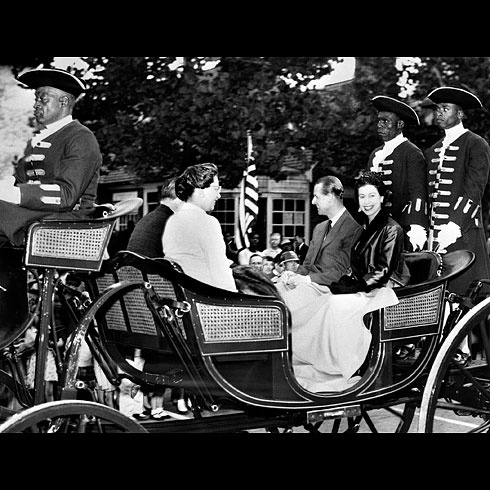
First, a quick and curiously fun anecdote: The right-most carriage attendant, in a tricorne hat, in the above photograph was a dear friend of my parents. His son works in my building, where I work at the College of William and Mary today. This man had the opportunity to accompany the carriage that carried Queen Elizabeth II through Colonial Williamsburg some 65 years ago. Elizabeth is seated, smiling and facing the camera. Her husband, Prince Philip, is seated to her right.
At age 31, in 1957, just five years after she was declared as Queen of the British Empire (1952), Elizabeth II made this visit to Williamsburg, Virginia, to commemorate the 350th anniversary of the founding of the English colony at Jamestown. My parents’ friend years later told me that it was quite a spectacle to be with the Queen, and ride down Duke of Gloucestor Street, through the center of town.
During those years, Elizabeth II had begun to oversee the dissolution of the British Empire, as one-by-one, former colonies declared their independence from the English island. This led to the modern creation of the United Kingdom, with its associated British Commonwealth of Nations. Some today still protest that the British monarchy has not done enough to apologize for the injustices inflicted during those centuries of British colonial rule. After all, the monarchy is not very democratic. The whole idea of having a “king” or a “queen” seems really quirky to some, even unfair…. even unjust!
Perhaps this will pigeon-hole me, and typecast me as a hopeless traditionalist, but I have been profoundly moved by the Queen’s death. Elizabeth’s first prime minister, Winston Churchill, was born during the Victorian era in 1874. Elizabeth’s last prime minister, the current Liz Truss, was born in 1975, just over a hundred years later. The span of time that Elizabeth II has served has been breath-taking. The events during her lifetime, from her service as a driver and mechanic for the Auxiliary Territorial Service, during the crisis of World War II, to the 2020 Coronavirus pandemic have been world changing.
Her life encompassed 30% of the entire history of the United States.
Staggering.
She even parachuted into the London 2012 Olympics with James Bond…. well, sort of...
But as an American, Queen Elizabeth was not my sovereign. So, I am left trying to figure out why I have been so emotionally struck by her death. Why have I been so choked up about her? I have a few thoughts, so I await your comments in the comment section of the blog.
What strikes me the most about Queen Elizabeth II was that she served out of a profound, even sacred sense of duty, even in the most spiritual way. She assumed her role in the most sacramental manner, in the best sense of the word. She was a type of guardian of traditional values over a long period of time, during a period of great cultural upheaval. For 70 years as chief monarch, she was able to rise above partisan politics, surviving many prime ministers and political shifts. But there she stood, resolute in her duty, and in every Christmas message, she was quite explicit in making her Christian faith known.
I found her testimony comforting. Was this sense of comfort completely rational? Probably not. Does the idea of a monarch in a democratic society makes sense today? Not really. But intuitively, I believed that the Queen was right. I believed that she carried with her a strange sense of moral authority…. kind of weird, if I think about it. But the sacramentality of it all is indeed real.
We Americans have something to learn from our former overlords in the U.K. In many ways, the institution of the monarchy today in the U.K. is merely a figurehead type of reality. Most of the real work that gets done in the U.K. is in Parliament. Nevertheless, the role that Elizabeth II served reminds us that we need something, or someone, to help lift us out of our never-ending political scandals, squabbling, and social media frenzies.
We Americans on the other hand have responded differently. We scrapped the monarchy, but what have we gained from it? Instead of Kings and Queens, we have Presidents. But each and every President has appeared to be captured by some form of partisan politics.
I am not saying that we should go back to a monarchy. I like my baseball and American apple pie, thank you very much. But sadly, we have tried to substitute the notion of duty, that Elizabeth II so ably embodied, with a kind of celebrity culture that continues to disappoint. Elizabeth II, on the other hand, managed to rise above it all.
OK. She was not perfect. No one is. No one, but Jesus, that is. But for most of her time as the United Kingdom’s Queen, she was held above reproach.
Sadly even more still, Christianity particularly in America suffers from the same type of celebrity culture, that knocks us down when Christian leaders fail us. Unfortunately, the celebrity culture system in our churches has created a crisis where many have left Christianity, not because they no longer really believe in the Christian faith to be true, but rather, because they no longer trust that our churches are being led by godly, loving people.
The democratic ethos that drove the Great Awakenings in America’s Christian history has not been without its faults. The celebrity culture system, especially in Protestant evangelical circles of Christianity, has and continues to put enormous pressures on pastors of churches and ministry leaders. They are expected to be superhuman, when they are not. So, when we read about yet another megachurch pastor or evangelist falling from grace, or find out about yet more reports of spiritual or other abuse perpetrated by burned out Christian leaders, it demoralizes us.
For years now, I have been puzzled as to why the New Testament teaches that local Christian churches should have elders. Upon reflection of the Queen’s death, I think I have a better idea as to why the New Testament insists that churches need elders.
See what you think.
Elders exist out of a sense of duty, to make sure that the teachings of the Christian faith are being passed down from one generation to the next, rising above the challenges posed to us by celebrity culture. Elders, or to use the New Testament Greek term, presbyters, are there to act as guardians of sacred tradition. It is a sacramental duty that they perform. It has been that way since the days of the early church.
Sadly, we have forgotten or obscured this aspect of Christian teaching and practice in our day. Too many elder church boards have adopted the mentality that they are first and foremost like a board of directors for a corporation, where the head pastor is like the CEO. The local church looks more like a business than a spiritual family.
Now, every institution does need a board of directors. Every organization needs something like a CEO. Administrative decisions still need to be made. It is still a noble and crucial calling to serve in that capacity. But when this administrative aspect of being an elder crowds out the New Testament requirement that an elder be above reproach, to be that spiritual guardian of the faith that was once handed down to the saints, to make sure that the traditions of historically, orthodox faith are properly being passed down to a new generation, then we risk missing out on why the New Testament teaches that local churches need to have elders to begin with.
It is not about power. It is not about exerting control. It is about being a spiritual example. Perhaps the New Testament understands something about how human psychology and sociology really works, at a deeply mysteriously spiritual level.
Evangelical Christians are divided as to whether or not women should serve as elders in a local church. To think that only qualified men should serve as elders seems really quirky to some, even unfair…. even unjust! But perhaps our biggest problem is that we view the notion of being an elder as a matter of competence, when really it is about something else entirely.
Being a Queen of a Commonwealth is not the same as being an elder of a local church, as the New Testament teaches. Far from it. But there is some overlap of ideas here.
What the U.K. has been able to figure out is something Christians churches need to figure out. We need spiritual “Queens” that offer stability in a rapidly changing world. Perhaps this is partly why the New Testament teaches that a local church needs elders.
Just something to think about. Let the comments section below be filled the voices of those decrying me as a hopeless traditionalist!






 Veracity