J. I. Packer, at 89 years old, is still one of the great statesmen of the Christian faith today. A Christian book publisher, Crossway, has done a series of short, 3-minute interviews with Packer looking back over his substantial career as a theologian for the church, containing much wisdom for any and every Christian, old and new. Topics include, “What is Repentance?” and “What is Faith?”
Now, there is a twenty minute film reviewing his life… “In His Own Words.”
Recently, I was invited to go to a Halloween party this coming weekend. I need your help. What do I dress up as for this party?
Now, I know that a lot of Christians are deeply suspicious of Halloween: Is it not connected, at least remotely, to some kind of Satanic practice?
Well, the question has a point to make. After all, the timing of Halloween goes back to an ancient pagan festival, some say that was originated in Ireland, marking the beginning of winter. Samhain, pronounced “SAW-in,” from what I have learned, also celebrated the end of the harvest season. Since Samhain is at the same time of year as the traditional date for Halloween, the overlap gives the impression that Halloween has a pagan connection…. And since anything that distracts the believer from whole hearted worship of Jesus Christ could be considered “Satanic,” it only makes sense to raise such suspicion.
All Saints Day was celebrated by early medieval Christians to remember those Christian martyrs and other exemplary Christians who had gone on before them. All Saints Day, though originally in May, was moved to November 1st, under Pope Gregory (731-741 A.D.). All Souls Day, a related Christian festival to remember the faithful departed, particularly deceased relatives, was set on November 2nd. During the Reformation, the All Souls Day fell out of favor. But All Saints Day was held on by the English Anglican Church. All Saints Day is otherwise known as “All Hallows Day,” (Hallows=Holy, or Saint), which is how we get “All Hallows Eve,” or “Halloween,” for the night before on October 31st.
Halloween today is basically secularized, as are most holidays now, but as the 21st century merges into what appears to be a “post-Christian” era in the West, the revival of pagan practices associated with the ancient Samhain festival have started to reappear, such as among contemporary Wiccans. But even most honest observers admit that neo-pagan spirituality is in a continued state of flux, morphing and changing quite a bit.
We can have endless debates about how “Satanic” all of this is. Or we can take a tip from this 3-minute video at John Piper’s desiringgod.org ministries. Do you see Halloween as something to be avoided, or do you see it as an opportunity to be a witness for the Gospel?
Here is my spin on that this year: If Christians really want to “take back Halloween,” then we might want to take a few lessons from church history. I suggested to my wife that instead of a ghost, or something like that, she can dress up as a Christian saint at the party, such as Saint Thecla. Early accounts are sketchy, with various elaborations, but Thecla was surely one of the Apostle Paul’s most well-known converts to the faith, first meeting Paul in what is now modern day Turkey. According to this Eastern Orthodox source, Thecla was forbidden by her mother to go out into the street to hear Paul preach. But she was able to listen outside of her bedroom window, where she heard the Gospel. So, if someone asks my wife, “Who are you supposed to be?,” well, then, she has an opportunity to talk about Thecla’s story as she heard the Gospel of Jesus Christ, and had her life set free from the fear of darkness and death.
The point is this: perhaps one of the best ways to celebrate “All Hallows Eve” is to remember the examples of remarkable Christians who have died and gone before us. If you receive an invitation to a Halloween party, perhaps you can read up a bit on church history, dress up as some Christian figure from the past, and then use the opportunity to share the story of that person you came dressed as, with others at the party. Sure, it sounds a bit geeky, but it is a whole lot more interesting than dressing up as some “Superhero.”
For more on the origins of Halloween, New Testament scholar Ben Witherington has some perceptive comments to share in 3 minutes. In the meantime, I need to figure who I should be… and find a costume!
UPDATE: November 3, 2015
I need to make correction to an earlier statement, which suggested that the original All Saints Day spring celebration was moved to November 1st, partly to counteract the Samhain fall festival. A recent post at the Anxious Bench blog, references a work by historian Nicholas Rogers, arguing that while the Irish world, where Samhain came from, originally celebrated a feast for saints in April, the Germanic world, that did not recognize the Irish Samhain, had a feast for saints in November. This undermines the idea that All Saints Day was placed in November in order to try to supplant the Samhain festival. I am glad to be corrected, and so I modified the rest of the blog post. The study of history reveals some interesting surprises and busts a lot of pious fiction.
I went to my first InterVarsity Urbana missions conference some thirty-one years ago, in 1984. It was one of the last times Billy Graham ever spoke at Urbana, where he kept the attention of nearly 18,000 college students, challenging us to consider God’s call to go make disciples among all of the nations (Matthew 28:19-20). I can not think of any better place to gain a global vision of what God is doing in our world.
On December 27 to 31, 2015, InterVarsity Christian Fellowship is sponsoring yet again, another Urbana missions conference in St. Louis, Missouri, having outgrown the facilities at the University of Illinois Champaign/Urbana. Speakers include a worldwide representation of Christian mission leaders, including pastor David Platt, church planter Francis Chan, French Islamic studies professor Evelyne Reisacher, former Muslim Abdu Murray, missionary to the LGBT community Christopher Yuan, missionary trainer Paul Borthwick, and over 180 more. Hundreds of missionary organizations will be represented to give people thinking about a call to missions the perspective they need to understand where God might be calling them.
If you know of someone who should go, particularly a college student, then contact Urbana.org, and pray for God to work in the hearts and minds of these students. What is God doing in our world, and are you where God is at work?
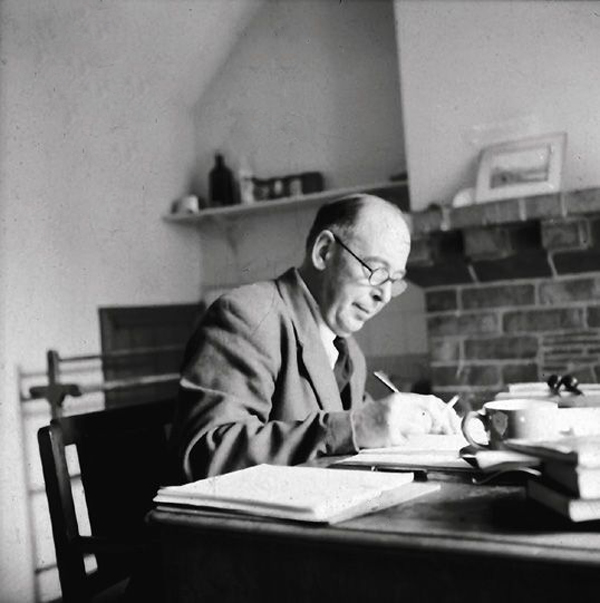
Why would C.S. Lewis take the time to correspond with a young American girl he did not know? Would his four letters, including the one he wrote to her just 11 days before his death, have any consequence?
In our culture we are taught to swing for the fences. Blast the game-winning home run high over the center field wall. Instant gratification and recognition. Great work if you can get it.
But a life lived in obedience to God is seldom like that. It’s much more like the butterfly effect—where one small change can make a big difference in the way things turn out. Consider the chain of events in the following story.
In the 1960s, a somewhat under-appreciated (at the time) Cambridge don, deep thinker, and writer of children’s literature gets a fan letter from a 12-year-old American girl. Despite all he has going on, he takes the time to write back to her.
The young girl begins to read some of his other work, including his Christian writings. She writes more letters, he writes back.
Through subsequent publishing he becomes one of the most influential Christian thinkers of the 20th century.
Because he took the time to write to the little girl, his corpus has a profound effect on her faith and her ability and desire to defend her Christian worldview.
The little girl grows up, marries a small town preacher, and has a profound effect on him.
The small town preacher becomes one of the most influential Christian writers and thinkers of the 21st century.
We really don’t take enough time to correspond with people. Taking the time to write someone can have significant and lasting consequences—much more so than hitting a dramatic home run.
For those unfamiliar with Jim’s story, he is best known as the founder of Lackey Free Clinic, which provides “skilled, compassionate health care and counseling to the medically disadvantaged in a manner that honors the name of Jesus Christ.” He was also a husband, father, grandfather and respected pulmonary specialist. For their compassion and humanitarian efforts, Jim and his wife, Cooka, received the Daily Press Citizen of the Year award in 2007. Lackey Free Clinic just celebrated its 20th anniversary, racking up quite an impressive list of awards and accolades along the way.
I served with Jim as an elder in our church. He commanded respect. He was smart, humble, and determined to make a difference in this world. He was steadfast in his faith—not just in the hearing of the Word, but in the doing. Jim modeled what he read in the Bible.
If a brother or sister is poorly clothed and lacks daily food, and one of you says to them, “Go in peace, keep warm and eat well,” but you do not give them what the body needs, what good is it? So also faith, if it does not have works, is dead being by itself. But someone will say, “You have faith and I have works.” Show me your faith without works and I will show you faith by my works. (James 2:15-18 NET)
Jim had a very long battle with cancer, chronicled in the links above. He fought the disease bravely, intelligently, and with conviction. He found a way to take all the pain and suffering and turn it into good in the name of Christ. Not unlike Dick Woodward.
The butterfly effect? My most profound memory of Jim is one in which, truthfully, I was a little peeved at him. It was a couple of decades ago when a group of volunteers would meet every Saturday morning to cut the grass at the Church. We saw all the comings and goings of people from the business end of our lawnmowers. Jim was one of those who kept coming. He had a lot of questions about Christianity, and he would show up Saturday mornings, Bible in hand, to meet with our senior pastor. I remember thinking, “Bill doesn’t have time to meet with this guy every Saturday. He’s got sermons to prepare and a church to pastor.”
Shows how much I know.
Chi Rho, Jim. Our community is far better off on your account, and you completely succeeded in honoring the name of Jesus Christ. We will miss you.
HT: Bill Warrick, Tuck Knupp, Lackey Clinic, Daily Press (Photo)





 Veracity