As Christians remember the darkness that covers Good Friday, let us prepare ourselves for the light of Christ’s Resurrection.
I am not always encouraged by how he interacts with other points of view, on non-essential doctrines, but in this 90-second video, promoting his latest book, California pastor John MacArthur draws out a key verse from Isaiah 53, to explain the heart of the Gospel, the death of Christ. The only thing I would tweak would be to clarify that the Son of God was in complete union with the Father, such that the Father and Son fully gave together, to satisfy the requirements to deal with sin, and reconcile us to God.
I include the caveat of “most” Protestants rejecting purgatory, as there have been notable exceptions in the minority. The influential 20th century apologist C.S. Lewis was known to be drawn to the doctrine. In the early 21st century, Protestant theologian Jerry Walls has written extensively defending what he believes to be a “biblical” view of purgatory. Then there are the views of Charles Augustus Briggs, a late 19th century American Presbyterian theologian, whom we will focus on in this blog article, who raises some interesting questions, suggesting some form of purgatory, though not exactly like what Roman Catholicism teaches.
So, what is purgatory, generally speaking? Purgatory is not hell, but neither is it exactly heaven. It is more like a preparatory stage before a believer can enter heaven. The lingering effects of sin, after death, must be “purged” before a believer fully and finally enters the presence of God.
The Protestant Reformation rejected the medieval, Western Christian view of purgatory, largely because the Scriptural support for it was found to be lacking. Purgatory owed more to the accumulation of Western tradition than it did to solid exposition of the Bible. Just ask any informed Protestant Christian.
But does the Bible specifically rule out purgatory, as a possibility? That turns out to be a very interesting question, too. It stems from the fact that not all Protestants agree on what is the best, most Scriptural alternative to purgatory. The reality is, the question of what happens when we die, for believers, remains somewhat of a mystery. Continue reading
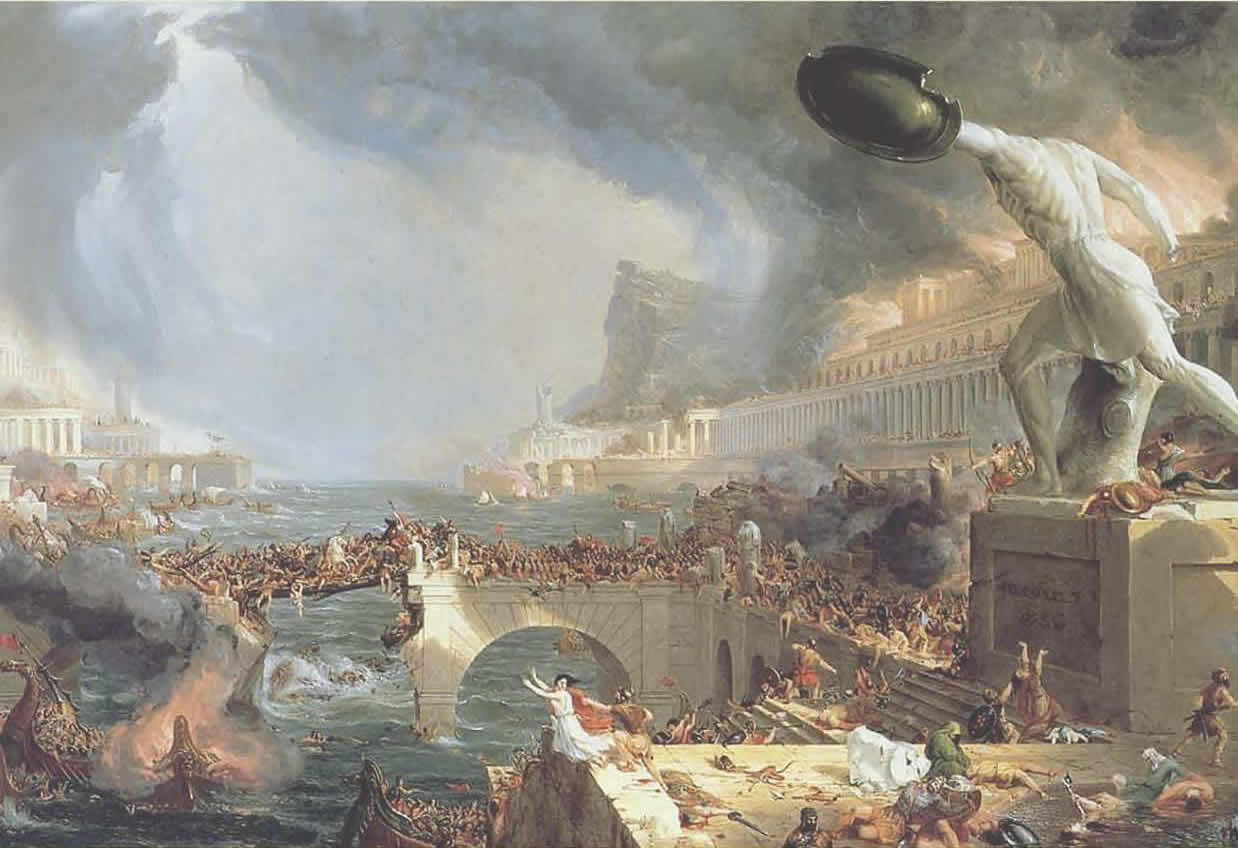
“The Course of Empire: The Destruction.” Thomas Cole, 1836, showing the Sack of Rome in 410 A.D. Click to enlarge for more detail.
It was the year 410 A.D. The Visigoths had come down from the north, sacking the city of Rome, the capital of the world’s greatest empire. People all over the Mediterranean were in shock, as they heard the story of the ruins and dead corpses laying in the streets. This was the “9/11” event of their day.
The pagans blamed the Christians, and they had their reasons…… Pardon some of the anachronisms, but I can imagine their rant…..
“Within a few decades, these Christians had gained the political power of the emperorship. Rome’s centuries of pagan gods were then officially abandoned by the government. Now these Christians had messed up everything. They had put a bunch of ‘Bible-thumping’ idiots into power, offending our pagan moral sensitivities, and leaving the empire vulnerable to their northern enemies.
The once-great empire was now on the verge of total collapse, no thanks to these ‘Bible thumpers.’ These Christians are to blame for our troubles!”
….. so thought the pagans, in their mockery.
Most Christians were unable to effectively respond to these charges. After all, Christianity had finally ascended to the top echelons of Roman society, and now it looked like the whole Roman world was falling apart! The Christian community provided the perfect scapegoat for Rome’s collapse.
Augustine’s defense of the faith, however, came with a twist. Put in today’s terms, Augustine appeared to have “gone liberal.” But Augustine would not have seen it that way at all. After some reflection, Augustine came to believe that many Christians had misinterpreted the meaning of the “millennium,” the 1000-year reign of Christ, described in Revelation 20:1-6. Augustine, once a confirmed believer in a literal millennium, had basically flip-flopped, and changed his mind. But why?1 Continue reading
I had never heard of him until a few weeks ago, when an explosive TV interview with him by British journalist Cathy Newman went “viral,” as folks like to say these days. I finally got a chance to see it, and it really is worth the 30-minutes. Jordan Peterson is a clinical psychologist at the University of Toronto, promoting his new book, 12 Rules for Life: An Antidote to Chaos. Peterson made waves over a year ago when he publicly opposed a new Canadian law designed to protect transgendered persons from being exposed to offensive speech. Peterson is definitely not “PC,” and his most provocative thesis is that there is a crisis of masculinity in the West today, and that so-called “identity politics” are fundamentally wrong.
In my view, public discourse on important topics is now at an all-time low. Cathy Newman is surely an intelligent, competent and engaging woman, but apparently there were some serious problems afoot in the Channel 4 newsroom that day. The Peterson interview by Newman might be the most eggregious example of an increasingly common rhetorical style, that so captivates both conservative and liberal news media, and that makes up a good chunk of what you find on social media. As Conor Friedersdorf put it in The Atlantic,
First, a person says something. Then, another person restates what they purportedly said so as to make it seem as if their view is as offensive, hostile, or absurd.
Was Cathy Newman’s aggressive style simply a case of not being able to understand what Peterson was saying, kind of like how I do not “get” what people are saying when they are speaking in a foreign language? Or, was it because she understood Peterson’s message, but was intent on trying to verbally destroy him? Or, was it because she is so ideologically driven that it rendered her incapable of really hearing what Peterson was trying to say? Much of public discourse today takes on one or more of these characteristics, though in Cathy Newman’s case, my guess leans toward the latter.
More and more, words rarely carry meaning in public discourse. Rather, words are mostly used to create an emotive effect. However, in this interview, whether you agree with all that Peterson says, or not, this interview style is a complete disaster. Watch the interview and judge for yourself:
I highlight this YouTube video because it teaches us some very important lessons. First, Christians are foremost to be people of the “Word.” The Gospel is a message to be proclaimed, and not a mood to be effused about. Unfortunately, public discourse today tends to elevate mood over the actual meaning of words, making it often quite difficult to share the Good News with our neighbors, much less talking about anything else of substance. More and more of this worldly style of communication is creeping into the church, whereas Peterson, a secular psychologist, rejects the cultural trend. At one moment, Peterson stated, “I’m very, very, very careful with my words.”
I admit a struggle with how to properly interpret the Bible, with respect to history. If someone has been a Christian for awhile, who has struggled with how different Christians have interpreted the Bible, this should not come as a surprise. For example, some Christians understand the Book of Jonah to be historical narrative, whereas others see Jonah as fictional, a type of parable meant to teach spiritual truth, and others contend for a mixture of history and fictional elements . Not all interpretations of the Bible are created equal, so trying to sort out how different passages of Scripture should be understood within their historical context, is an essential (and probably life-long) task. But if we sever the link between myth and history, when such a move is unwarranted by the evidence, we risk distorting the very essence of the Gospel. Peterson takes his cues from Carl Jung, Dostoyevsky, Nietszche, and evolutionary psychology. This is powerful stuff. Deep stuff. I need to think about it a lot more. But I am not so sure Peterson’s message can be completely sync’ed up with orthodox, evangelical faith.





 Veracity