Category Archives: Topics

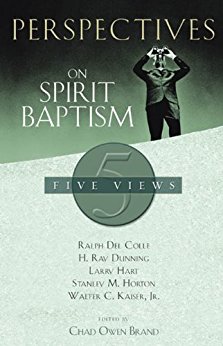
Perspectives on Spirit Baptism: Five Views; A Book Review

Last summer, I wrote a seven part blog series on the “Baptism in the Holy Spirit,” with links that you can follow here (the Intro, then #1, #2, #3, #4, #5, #6, and #7). To recap a year later, I thought I would recommend a book, where you can explore this issue in more depth.

The “Baptism of the Holy Spirit” is a controversial topic among evangelical Christians. Most people associate “Spirit baptism” with the charismatic renewal movement, and the “miraculous” gifts of the Spirit, such as “speaking in tongues,” and a very emotionally expressive style of worship, with lots of raised hands and swaying to the rhythm of praise and worship music in church. There are basically two camps on this issue, the continuationalists and the cessationists. Let me briefly break this down for those unfamiliar with the terminology.

Theologically speaking, those who believe that such miraculous gifts of the Spirit continue be operational in the church today are continuationalists. From the Bible, continuationalists believe that the “signs and wonders” displayed throughout the Book of Acts did not stop in the first century of the early church (see Acts 2:22; 2:43; 4:30; 5:12; 6:8; 8:13; 14:3). In other words, if folks like Peter and Paul witnessed remarkable miracles performed by the Holy Spirit, why would we not expect at least some of the same thing happening today?

On the other hand, those who believe that such gifts “ceased” to operate after the era of the original apostles ended are cessationists. The “go-to” verse for cessationists is 1 Corinthians 13:8, which they argue teaches that the “gifts of the Spirit,” like speaking in tongues, would eventually “cease,” according to the Apostle Paul, once the last of the first apostles died, and the New Testament writings were completed.

Continuationalists come in all shapes and sizes, some more low-key than others. Some downplay the miraculous gifts of the Spirit, even finding a way to fit in with more traditionally cessationist churches. On the other side, among the cessationists, are vocal opponents of the charismatic movement, who wish that anything even hinting of “speaking in tongues” would just completely go away! One of leading proponents of cessationism, is Southern California Bible teacher, John MacArthur, who contends that the charismatic movement today is similar to the false worship practice of Nadab and Abihu in Leviticus 10:1, who used “strange fire” in the worship of the God of Israel.

But “Spirit baptism” is a more fundamental issue than whether or not “speaking in tongues” is valid for today. “Spirit baptism” deals with the role of the Holy Spirit in giving spiritual life to the believer. Do we get “all of the Holy Spirit” when we first begin a relationship with Jesus, or should Christians look forward to a subsequent experience where we encounter the powerful presence of the Holy Spirit, in our Christian walk?
Continue reading



Podcasts for the Thinking Christian (2018 Update)

This is the age of the Internet podcast. About four years ago, I published a review of some of the most thoughtful and engaging Internet podcasts available at the time. Now is a good time to update the review.

What I like about podcasts is that I can download the MP3 material right to my phone, or even stream them directly from the Internet, even fire up a YouTube app in the background and just listen, either while I am driving around town in the car, or out pulling weeds in the yard. There has never been any other time in world history where someone can have such excellent access to the Bible and great Christian theological content.

What I do not like about podcasts is that there are too many of them, and the quality varies greatly, not just in terms of style, but more importantly, in terms of theological quality. The sheer volume and variety of options, with “Christian” themes, creates a crisis: Is the podcast done by some random person with a microphone, an Internet connection, and pages missing from their Bible? Or is it done by someone who actually knows what they are talking about, having a love for God, with Scripturally informed scholarship backing them up? Who can I trust?

My time is important, and probably, so is yours, so I have narrowed down to some of the better podcasts you can get. Depending on the category, I would recommend finding one or two podcasts you like, and subscribe to them, or otherwise, download select, archived material. So here is the update on the best Christian podcasts around… Continue reading


What Did You Think of The Royal Wedding Sermon?

The May 19, 2018 sermon by U.S. Episcopal bishop Michael Curry, at the wedding of Prince Harry to Meghan Markle, might have been the most watched Christian sermon, in world history. I am not a morning person, so I never bothered to get up for the wedding. But I have listened to a number of people give their opinions about the sermon, including a few evangelical Christians.

It just amazes me that two believers can listen to the same sermon, and get a completely different message out of it. Some Christians heard Bishop Curry give a powerful testimony to the love of God, a fiery display of the nature of the God of the Bible. Others heard a vague call to the power of human love, white-washed with Christian language, a camouflage over the false teaching it really was. Others just registered a “no comment” vote.

It was interesting that Curry appealed to Dr. Martin Luther King, Jr. (no surprise, really), as well as the controversial Roman Catholic paleontologist and priest Pierre Teilhard de Chardin, who was censured by the papacy, in the 20th century, for his writings in support of evolution, but who today has received calls for his rehabilitation, among some Roman Catholics, and other calls to retain his censure.

My thoughts are best reflected by the following witty, intelligent remarks by British evangelist Glen Scrivener (catch his Richard Niebuhr quote — right on!). What did you think of the sermon? Let me know in the comments section below. Bottom line: may we all have discernment and search the Scriptures for God’s Truth.

If you have not seen or heard the sermon, here it is:


Did King James Order His KJV Translators to Conceal the True Meaning of Baptism?

A baptismal font in England, dating back to 1405, large enough to be used for full infant immersion, throughout the Reformation period. Note the table top on the left hand side of the photo, to gain some perspective as to how big this baptismal font really is: Saint Bartholomew the Great Church in London.

This might be a bit nerdy, but it is a pet peeve of mine: Is the proper mode of baptism by pouring, sprinkling, or full immersion? What follows is an example of how an arguably plausible theological doctrine can be improperly justified with a flawed piece of historical “evidence.” The actual history of baptism is far more interesting, and it makes for a good rallying point for discussing the Scriptural mode of baptism.

I recently listened to a YouTube sermon whereby the pastor claimed that King James, the early 17th century English king, who authorized the famous 1611 King James Version translation of the Bible, purposely sought to obscure the true meaning of baptism. King James “did not allow [his Bible] translators to translate [the word] ‘bapto’” into English. The Greek word “bapto” is where we get the English word “baptism,” which is basically a transliteration from Greek into English. Most concordances, such as Strong’s, will translate “bapto” as to “dip” or “immerse.

So, why did King James steer his translators clear from actually translating this Greek word into English?  The pastor went onto explain, “Because the Anglican Church did not practice what [baptism] means. The Anglican Church sprinkled.”

My ears perked up. But the pastor continued…

The problem with leaving “bapto,” or our “baptism,” untranslated is that it has encouraged people to interpret the word however we imagine it to mean. As a result, this ambiguity about “baptism” has led English-speaking Christians, since the time of King James, to be unsure as to how baptism should be practiced in the churches. Should we practice sprinkling, pouring, or full immersion? Readers of the King James Version of the Bible, the pastor concludes, are left in this state of confusion. What a tragedy.

Well, when I heard this, my fallacy-o-meter started to register near the red-zone. I will not link to his sermon, as this is pure bunk. Things like this just annoy me….

Obviously, this pastor rejects any form of baptism that is not full immersion, which would implicitly include most modern practices of infant baptism. My longtime pastor, Dick Woodward, from years ago, told the story of a Baptist kid, who had a cat that had gotten himself entangled in some pile of garbage, and the cat came out smelling just awful! The Baptist kid wanted to wash this cat, before letting him into the house. He tried to immerse the cat into a tub of water, but the cat resisted. He tried to pour water on the cat, but the cat kept dodging the water. Frustrated, to no end, and scratched up by the rebellious cat, the Baptist kid finally uttered, “Cat, you stink so much, that I will make a Presbyterian out of you, and just sprinkle you, and let you go to hell!Continue reading


The Jerusalem Question: What is “Covenant Theology” vs. “Dispensationalism”?

On May 14, 2018 the United States moved its embassy in Israel to Jerusalem, the first nation to do so, since the creation of the modern state of Israel in 1948, seventy years ago. Christians are divided as to the significance of what this means. According to a 2017 LifeWay research study on “Evangelical Attitudes Toward Israel,” many older evangelical Christians support Israel, and their right to the land, based on their understanding of the Bible. Therefore, the U.S. recognition of Jerusalem as the capital of Israel is generally considered to be a good thing. But a growing number of mainly younger evangelical Christians do not share any “strong views” about Israel, based on their understanding of the Bible. These Christians are less enthusiastic about the U.S. move.

Why do Christians not agree about Israel, and Israel’s right to the land, with Jerusalem as its capital?

To get at the heart of the debate, you have to know something about the decades old discussion between “covenant theology” and “dispensationalism.” If you no have idea what “covenant theology” and “dispensationalism” are about, the following video would be a good place to start.

Greg Koukl is the director of Stand to Reason, an apologetics ministry that I find has very helpful resources. If you were looking for a short primer to explain the difference between covenant theology and dispensationalism, then this would be a great investment of less than nine minutes of your time. Greg leans more towards the dispensational side of the equation, but he succinctly and fairly represents both sides.

About two years ago, I embarked on a blog series study on “Christian Zionism,” the idea that God has a plan to restore the ancient borders of ethnic, national Israel. The story of “Christian Zionism” requires a basic knowledge of “covenant theology” and “dispensationalism.” Over the coming year, I plan on posting the remaining drafts of that series, interspersed among other posts. If you want to explore more as to how I got interested in this discussion, you can start here.