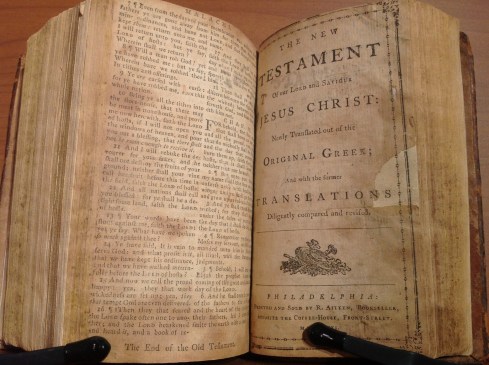
The Aitken Bible, the “Bible of the American Revolution,” a vital artifact in the ongoing discussion as to the notion of America being founded as a “Christian nation.” Evangelical historian Mark David Hall’s Did America Have a Christian Founding?: Separately Modern Myth from Historical Truth, corrects some missteps made by secular-minded authors, who obfuscate the contribution of Christianity to America’s founding. But in his provocative analysis, does Hall overcorrect?
Any discussion about the religious thought of America’s Founding Fathers is fraught with controversy.
On one side are those, like the Cornell University authors of The Godless Constitution, Isaac Kramnick and R. Laurence Moore, who maintain that the Founding Fathers envisioned creating “an utterly secular state” unshackled from the intolerant bonds of religious thought. Such writers base their ideas on the assumption that the vast majority of Founding Fathers were hard-core Deists, or otherwise religious skeptics of some sort, who wished to completely separate the public aspect of civil and political life from privately held views, concerning matters of religion.
But such a thesis stands in the extreme, disregarding historical evidence showing, that while the U.S. Constitution decidedly did not endorse Christianity, in any explicit manner, the Founding Fathers all grew up in a world where the Christian faith was openly discussed, variously practiced, and celebrated by the vast majority of American colonists. While the evangelical form of Christianity, as best expressed through the revival tradition of the First Great Awakening, made up perhaps only a minority of Americans, even the more nominal forms of Christianity demonstrated the pervasive influence of a Scripturally-formed worldview. I am reminded of the proposal set forward by the evangelical and noted Notre Dame historian, Mark Noll, that while no form of Christianity was explicitly set forth by the U.S. Constitution, nevertheless, Protestant Christianity functioned as the de facto national religion of the United States, in the founding era. Christian faith was simply in the air they breathed, and the water they drank, for the Founding Fathers.
Just as extreme, there are also those on the other side of the discussion, who propose a revisionist type of “Christian nationalism.” Selective quotes and facts, concerning the Founding Fathers, are used to read too much into the intent of those Founding Fathers, regarding their beliefs about religion, and their commitments to orthodox, evangelical Christian faith, in particular.
Among evangelical Christian audiences, the standout proponent of this “Christian nationalist” thesis is David Barton of Wall Builders, whom Time magazine named as one of the 25 most influential evangelical leaders, back in 2005. Barton, who is not an academically trained historian, and who does not support the principle of academic peer review, even among other evangelical Christian historians, has toured the country extensively for several decades, visiting churches with Powerpoint presentations directed at convincing Christians of his thesis, through the use of what might be characterized as “creative” citations of evidence to make his case.
For example, David Barton has claimed on numerous occasions that “[of the] 56 who signed the Declaration, 29 actually held seminary degrees … more than half of them held Bible school degrees.” One might draw from this and other claims by Barton, that perhaps the Founding Fathers were like New Testament apostles, wearing knee britches. However, a close examination of Barton’s claim reveals several misunderstandings that obscure the type of knowledge regarding American church history, that should be well-known among evangelical Christians, but that sadly remains often neglected in American churches.
In this example, Barton assumes that a “seminary” and “Bible school” degree during the colonial period meant the same thing as we would assume they mean today. However, what Barton does not tell his audience is that the ONLY type of colleges and schools in colonial America were such “seminar[ies]” and “Bible school[s].” In the 1770s, every single institution of higher learning in the American colonies was founded by churches, with the expressed purpose of training ministers for the spread of the Gospel. Over time, such institutions began to expand their educational vision to include the training of lawyers, and other professions, that were not primarily directed at clergy or missionary activity.
In other words, those 29 Founding Fathers represent the ONLY 29 who actually received a formal college level education, of any sort, though it is important to recognize that a number of Americans in the colonial period received the rough equivalent of a “home-school” education, through the use of private tutors or apprenticeships, instead of attending college.
In particular, most historians today recognize that John Witherspoon was the only Founding Father to have received the modern equivalent of a seminary-level education, for the purposes of Christian ministry. Furthermore, the whole concept of a “Bible college” or “Bible school” is anachronistic, as such institutions do not appear on the American landscape until well into the 19th century, when higher education tended to stratify more aggressively into multiple, emerging disciplines.
Barton’s example also fails to recognize that a decline of Christian orthodoxy was already starting to take place among a few of the colonial American colleges. Accusations of heterodoxy at Harvard University, to take one example, led to the formation of Yale University as early as 1701. When Thomas Jefferson attended the College of William and Mary, in the 1760s, his primary tutor, William Small, was actively engaged in exposing Deistic philosophy to the young law student, despite the fact that William and Mary was originally founded to be an Anglican school, serving the Christian missionary interests of the Church of England.
In short, claims by those like David Barton, who wish to beef up the Christian orthodoxy of the American Founding Fathers, rely on a dubious reading of the historical data. Barton has had a history of making this and other claims, that have been addressed on Veracity (here, here, and here). To be as fair as possible, Barton does get a number of things right. But as repeated mistakes continue to mount and remain uncorrected over the years, Christians should learn to not to trust in Wallbuilders alone for drawing conclusions about the Founding Fathers. When Christians cite David Barton as their primary source for defending their views of American church and political history, they do so on a misleading and uninformed scholarship foundation.
Those Christians who aspire to treat history with the respect it deserves, as in the case of America’s Founding Fathers, would do well to follow the example set by Wheaton College’s Robert Tracey McKenzie, who has an excellent blog dedicated to correcting popular misconceptions about the Founding Fathers, and other regularly mishandled topics, often cited as being relevant to Christianity and American history. McKenzie illustrates that we must understand history within its proper historical context, and not indiscriminately pluck out certain historical facts to serve modern purposes. As McKenzie puts it, “The bottom line is simple: Know context, know meaning. No context, no meaning.”
Nevertheless, there are reasons why populist activists like David Barton exist, as there are evangelical Christian scholars, who do follow peer-reviewed processes, who nevertheless make errors that have fueled the fire for inspiring Barton-type of revisionism. For example, Houghton College’s Meic Pearse, in his otherwise excellent historical survey The Age of Reason, a fine historical textbook that I consult frequently, states briefly that “the founding fathers were predominantly deists: Washington, Madison, Franklin, Jefferson. Yet none was overly dismissive of traditional religion” (p.330).
Leaving the latter, qualifying caveat aside, this might indeed be true about Franklin, Madison, or Jefferson, to various degrees, though certain scholars may differ. Yet to describe George Washington as “predominantly deist” goes beyond what the evidence surely indicates.
Scores of biographies have been written about George Washington, but his views concerning Christian faith remain an enigma. We clearly know that George Washington was a baptized, and dedicated church-going Anglican. Washington encouraged religious observances, and considered religion and morality as essentially intertwined.
However, certainly after the period of the Revolutionary War, George Washington never partook of Holy Communion. Historians remain baffled as to why he refrained from taking the Lord’s Supper, why he never was officially confirmed as a member of the Anglican church, and why he continued to resist efforts by Anglican clergy to rectify these issues, well into his Presidency. Washington was also a Mason, but it remains unclear as to how Masonic practices and ideas might have influenced his spiritual commitments. Therefore, to assert that George Washington was “predominantly deist” is a remarkable judgment to make, when this most important of America’s Founding Fathers remains essentially enigmatic for the vast majority of his biographers.
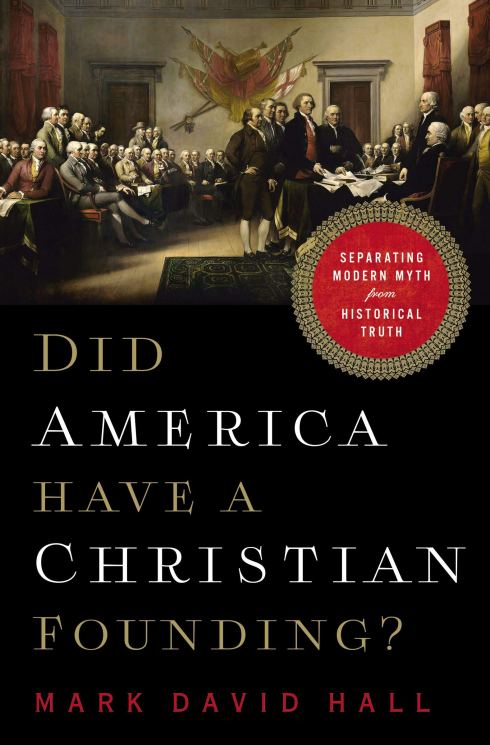
As a counter-weight to someone like Meic Pearse comes Mark David Hall, the author of Did America Have a Christian Founding?: Separating Modern Myth from Historical Truth. Hall remains critical of those evangelical Christian historians, who make too much of the Deistic influences upon America’s Founding Fathers, but he does so in a responsible way, without falling into the heavily-flawed historical methods and practices followed by non-academic historians, such as David Barton.
Mark David Hall is a scholar at George Fox University, and is also affiliated with Emory and Baylor Universities. Promotion materials for Did America Have a Christian Founding? state that “A distinguished professor debunks the assertion that America’s Founders were deists who desired the strict separation of church and state and instead shows that their political ideas were profoundly influenced by their Christian convictions.”
In the book, Hall effectively demonstrates that not all of the Founding Fathers of America, depending on who you include in that group, held to orthodox Christian convictions. Nevertheless, it is essential to understand that Christian ideas, formed by theological reflection on the Bible, deeply ingrained in colonial culture, served as the idealogical backdrop for framing America’s central documents, including the Declaration of Independence and the U.S. Constitution.
For example, many secular-minded people in our current day, regularly dismiss the Christian doctrine of original sin, as being insulting to human dignity, viewed as a particularly pessimistic way of looking at human nature. But Mark David Hall rightly shows that the Scripturally-saturated world of colonial American helped to form the ideological framework, in the design of the three branches of the federal government. The U.S. Constitution, with its emphasis on the separation of powers, through a checks-and-balances system, between the executive, legislative, and judicial branches of government, is a perfect application of how the Christian doctrine of original sin informed the Founders’ view of how government should work. Because all humans are flawed creatures, due to the effects of Adam’s sin extending down throughout human history, you simply can not trust one person, or even one particular branch of government, to make all of the right decisions.
Practices, such as who has the ability to declare and engage in war, and institutions like the Electoral College, may seem antiquated and obscure in our day, but for the Founding Fathers, these practices and institutions were designed with a specifically Christian view of humanity in mind, even if not all of the Founding Fathers, as individuals, embraced every aspect of evangelical Christian orthodoxy.
Yet while Hall’s thesis is quite compelling, the ultimate success of it depends largely on how certain critical terms are defined. Such as, what does it mean to be a “Deist?“ Were the Founding Fathers, or at least some of the most influential of them, profoundly Deist in their theological outlook, and if so, what type of impact did that have on the practices and institutions set forward by America’s core founding documents?
Merriam-Webster gives us a definition of “Deism” as “a movement or system of thought advocating natural religion, emphasizing morality, and in the 18th century denying the interference of the Creator with the laws of the universe.” Deism, in this sense, gives us an image of God as a divine clockmaker, who wound up the clock at the Creation of the world, but who simply let the clock alone to operate independently from hence going forward.
Yet in the hands of Mark David Hall, the notion of “Deism” is rather confused. Hall does attempt to set forward a definition of “Deism,” but he does so in such an amorphous manner, that it takes away from the strength of his work in Did America Have a Christian Founding?. For as to how Hall defines and uses it, the concept of “Deism” rules out any notion of God’s providential care of the world. But such a radically skeptical concept of “Deism” assumes that God’s “providence” only describes God’s supernatural intervention in human affairs, whereas a number of Deists (though admittedly not all) considered the natural processes set up by God at Creation to be perfectly consistent with a notion of providence. In contrast to Hall, a “Deism” more broadly understood assumes that the only miracle God ever performed was Creation itself, but that this same Creator set up laws of nature, such that the non-miraculous activity of the world naturally moves in the direction of the Creator’s choosing.
Gregg Frazer, an historian at the Masters College, in Southern California, affiliated with well-known Pastor John MacArthur, identifies this flaw in Mark David Hall’s thesis, through an insightful review at the Gospel Coalition website. As Frazer frames it, what Mark David Hall does is dependent on a false dichotomy that pits “Christian vs. Deist” as the two options for how to describe the faith perspectives of the Founding Fathers, with the result of favoring the former over against the latter.
For example, while Mark David Hall admits that John Adams was not an orthodox Christian, who kept his Unitarian views to himself, for most of his public career, Hall at times gives the reader the impression that Adams was more historically orthodox with his Christianity than he actually was. For Hall, if Adams was not a full throated Deist, you could safely put him in the category of “Christian,” despite Adams’ rejection of the Trinity.
However, any rejection of the Trinity is incompatible with historically, orthodox Christianity, from this reviewer’s perspective. For an evangelical Christian such as myself, Mark David Hall’s use of such categories is at best confusing, if not sometimes downright misleading.
Frazer, on the other hand, suggests a middle alternative to the orthodox Christian and skeptical Deist categories suggested, most of the time, by Hall in Did America Have a Christian Founding?. For Gregg Frazer, the majority of Founding Fathers were theistic rationalists, a belief system that is neither fully Christian, in the historically, orthodox and evangelical sense, nor is it fully Deist, in the most skeptical sense. Unfortunately, Mark David Hall conflates Frazer’s concept of theistic rationalism with Deism itself, which is unhelpful to the reader.
The College of William and Mary’s David L. Holmes, in his The Faith of the Founding Fathers, aligns closely with Gregg Frazer’s categorizations, in contrast with Mark David Hall. Holmes proposes three groups of Founding Fathers, giving examples of each group:
- Non-Christian Deists: Ethan Allen, Thomas Paine.
- Practicing, Orthodox Christians: Patrick Henry, John Jay, Elias Boudinot, John Witherspoon
- “Christian Deists” (Those Influenced by Enlightenment Deism and Orthodox Christianity Along a Spectrum): George Washington, Thomas Jefferson, John Adams, Benjamin Franklin, James Monroe

Professor Mark David Hall, author of Did America Have a Christian Founding?
Nevertheless, I learned from Mark David Hall that Roger Sherman, an often overlooked Founding Father, representing Connecticut, who participated in both the Continental Congress, with respect to signing the Declaration of Independence, and the framing of the U.S. Constitution, was a committed, Bible-believing Christian, whose understanding of Christianity directly inspired his thoughts as to what the American republic should look like. For example, Sherman’s theologically-minded convictions, informing by his Calvinist Puritan reading of the Bible, were directly linked to his vision of limited government, states’ rights, and the superior nature of the legislature, features that were embedded in America’s founding documents.
Mark David Hall intriguingly contends, that contrary to the majority scholarly opinion, the 1786 Virginia Statute of Religious Freedom, championed by Thomas Jefferson and James Madison, was not as influential in the minds of those who framed the U.S. Constitution and Bill of Rights, as is commonly supposed. Hall concludes from this that the call by Thomas Jefferson, for a restrictive type of “separation of church and state,” was not part of the consensus view of America’s Founding Fathers. So, while contemporary advocates for a more restrictive application of a “separation of church and state,” may appeal to leading, Deistically-leaning figures, like Jefferson and Madison, such an appeal is out of balance. This type of argument largely ignores the contribution of lesser known Founding Fathers, many of whom shared more orthodox Christian beliefs, than did Jefferson or Madison.
However, Hall’s claim needs to be tempered somewhat. For example, Hall asserts that Roger Williams, the 17th century founder of Rhode Island, was a “disorderly dissenter” (see Hall, Chapter 5) when he challenged the colony of Massachusetts’ leadership regarding the enforcement of the first table of the Mosaic Law, which required church attendance. Williams’ resistance to Massachusett’s attempts to legally require church attendance, eventually led to Williams’ view of “a type of wall of separation between the garden of the church and the wilderness of the world“(see Williams, The Bloody Tenent of Persecution), as a means of protecting the church from the needless and harmful interference of the state. But the most intolerable aspect of Williams’ dissent, towards the Massachusett’s authorities, were a result of private meetings in Williams’ own home, which could hardly be described as being “disorderly.”
Scholars regularly debate the influence of Roger Williams, in the minds of American’s Founding Fathers, but it should be duly noted that the concept of a “separation between church and state” was originally articulated, not by the Deist-inspired reflections of a Thomas Jefferson, but rather by the radically Puritan and Calvinist mind of Roger Williams. It would have been immensely more helpful if Mark David Hall would have carefully presented this historical evidence to his readers.
Despite this and the noted difficulty with categorization in Did America Have a Christian Founding?, with respect to how “Deism” should be properly defined, Mark David Hall’s work in this area is a welcome conversation partner in the ongoing debate as to the nature of America’s founding, with respect to Christianity and the 18th century dialogue with Deism, through the growing influence of Enlightenment philosophy. Even if not all of the Founding Fathers were consciously aware of the specifically Christian notions that guided their efforts in setting forward the principles and institutions of the American republic, and if the large majority of these Founding Fathers were less than evangelically orthodox in embracing historic Christianity, the Christian Faith still played a profoundly major role in the founding of America.
How relevant is this notion of the “Christian founding” of America, for 21st century Americans? For Mark David Hall, his answer is refreshingly sensible. Despite what might be concluded about the “Christian founding” of America, the historical evidence indicates that the Founding Fathers did not intend to try to use the power of the state to endorse any particular religious expression. Instead, for Mark David Hall, the protections regarding religion freedom were meant to allow for the flourishing of religion, without the government getting in the way. It is consistent with the vision of the Founding Fathers that the government should never penalize the religious convictions of America’s citizens, even if such convictions might prove to be disagreeable to others who share different convictions.
These protections apply towards Christians, but they also apply towards non-believers as well. For example, Christians who believe that their faith teaches them that same-sex marriage is not within the plans and purposes of God, should not be required by the State to endorse same-sex weddings, as in recent government measures requiring Christian-owned businesses to perform services, that would conflict with a Christian’s deeply held beliefs. Such government intrusion would violate what the Founding Fathers envisioned, with respect to religious freedom. Likewise, practitioners of some Native American faith traditions use peyote in their worship rituals, and the government should not unduly restrict the usage of peyote, in such religious ceremonies. Such protections are not without limits, as the use of peyote is not a blank legalization of the drug, for any purpose. Peyote use must be limited to religious worship purposes. Mark David Hall finds historical precedent to support his conclusions, and should be worthy of serious consideration, by believer and non-believer alike.
Infinitely more helpful than the often erroneous musings and hair-pulling assertions of a David Barton, and providing a helpful balance against more secular minded scholars, Mark David Hall’s Did America Have a Christian Founding?, provides a relatively brief survey that should inform all readers of various backgrounds, as to a neglected perspective of the character of America’s founding. With gratitude, Mark David Hall leaves readers with such valuable and helpful insight.








 Veracity