
Category Archives: Topics

Under the Hood

Head Gasket Repair

Push Rods and Rockers, 2008


I spent a couple of weeks writing this post, adding and removing parts, only to end up with an over-spiritualized, not-very-good penultimate result.  After some painful edits, how about I just get right to the point?

The original idea for this blog was to have a place for “Sharing resources that corroborate the Bible.”  While we remain quite committed to that theme, we’re finding our voice in a slightly different major chord.  Consequently we are changing the tag line for Veracity to “Sharing the Joy of Personal Discipleship.”

What is personal discipleship?  It’s an answer to the darkness of man we see all around us every day.  It’s keeping our eyes on the only thing that counts—faith expressing itself through love (Galatians 5:6b, NIV84).  We define personal discipleship as the process in which a believer or seeker takes personal responsibility for investigating the claims and content of the Bible. Continue reading

Taizë

This coming  Sunday, our church will sing a modified version of a Taizë worship song, “Holy Spirit, Come to Us.” Songs from Taizë are generally simple, short choruses based on the Bible. In the original Taizë community, these worshipful, chant-like songs are sung over and over again multiple times. Here is a recording of the original version of “Holy Spirit, Come to Us.”

But what is Taizë? In the spring of 1940, the German army overran the defenses of France, bypassing what was thought to be the impenetrable Maginot Line, shattering the confidence of the French people.  Roger Louis Schütz-Marsauche, who was raised in a Swiss Protestant Reformed family, was absolutely stunned by the overwhelming power of Nazi Germany’s military might. But he believed that God was much bigger than the Nazi war machine. He rode on a bicycle to the small town of Taizë in unoccupied France near Switzerland, where he spent two years hiding Jewish refugees from the grip of the Nazis. He was forced to leave Taizë for a few years, but “Brother Roger” was able to return in 1944 to start a small community of men committed to living in poverty, chastity, and obedience. From that time forward, “Brother Roger” and his band of like-minded were committed to a quest for reconciliation in the spirit of Christ.

Over the years, along with other refugees, tens of thousands of young people from all over the world have come to visit the community. What is particularly unique about Taizë is the ecumenical nature of the community, Protestants and Catholics, all living together in a monastic style focused around prayer, work and hospitality. But the most profound influence of Taizë is the music.

Various churches around the world offer Taizë services that can give you a taste of how meditative music and silence is practiced in the original Taizë community. In the Richmond, Virginia area, the Richmond Hill Retreat Center at 2209 East Grace Street offers a Taizë prayer service on the first Monday of every month at 7:30pm.


Things that Go Bump in the Night

“From goulies and ghosties and long-leggedy beasties
And things that go bump in the night
Good Lord, deliver us!”
Scottish prayer recorded in The Cornish and West Country Litany, 1926

Nightmare

Nightmare by Paul Bielaczyc. Charcoal, 2005.


There was my dentist—a normally genteel man—in the back of a military cargo plane decked in an olive-drab Level A HAZMAT suit, gesturing me into his examination chair with long, gleaming, barbaric surgical instruments. I had a hard time making out what he was saying behind his face shield, but it sounded like, “Buckle up.” I’m pretty sure he was grinning.

I’m not one much for dreaming, nor am I particularly anxious, but it’s amazing what the anticipation of a minor dental procedure did to loose my subconscious this week.

Fear is powerful, and the Bible has a lot to say about it. The words fear, afraidanxious, and anxiety appear 541 times in the ESV.

  • The fear of the LORD is the beginning of knowledge; (Proverbs 1:7)
  • Be not wise in your own eyes; fear the LORD, and turn away from evil. (Proverbs 3:7)
  • Therefore I tell you, do not be anxious about your life, what you will eat or what you will drink, nor about your body, what you will put on.” (Matthew 6:25)
  • He said to them, “Why are you so afraid? Have you still no faith?” (Mark 4:40)
  • And he said to them, “Why are you afraid, O you of little faith?” (Matthew 8:26)

Need an anti-anxiety prescription?  Here you go: fear in the right channel is prescribed—throughout Proverbs and the rest of the Bible. The apostle Paul instructs believers in Philippians 2 to, “Work out your own salvation with fear and trembling.”  We’re not supposed to be free from fear. We’re supposed to live with fear in the right context—reverence and respect for the awesome power of our Creator. That’s what Dick Woodward’s 4 Spiritual Secrets are all about.

Ready for some good news? According to Jesus, fear has an anecdote: faith.

Fear is powerful. My loving mother, who hung that Scottish prayer just outside my bedroom door, was paralyzed by fear her entire life. So many times I wished I could have helped her think through her fear. But that’s not the way it works. Overcoming fear is not a matter of our intellect or will—it’s a matter of the heart. And no one gets out alive. Apart from the grace of God and a little faith we don’t stand a chance.

Here’s a link to Whom Shall I Fear? by Chris Tomlin that gets to the heart of the matter.

Peace.

HT: Paul Bielaczyc (Nightmare used with the kind permission of the artist.)


Michelangelo: Marvel and Mystery

Michelangelo di Lodovico Buonarroti Simoni (1475-1564) remains one of the greatest artists of all time.  If you are in the Williamsburg, Virginia, area, you have a treat in store for you at the Muscarelle Museum at the College of William and Mary.    The Muscarelle has a number of the Italian Renaissance artist’s sacred and profane works on display.    You only have a limited time to see them, as the exhibit ends on April 14, 2013.    You will not want to miss the Matti Preti (1613-1699) exhibit at the Muscarelle at the same time, a collection of  paintings ranging from Christian martyrdoms to John the Baptist to the story of the apocryphal Book of Tobit.

To wet your appetite for Michelangelo, I discovered that the Vatican has put an interactive virtual tour of the Sistine Chapel on the web, with some meditative audio as a plus.   You can click and move your mouse over the image to take in different perspectives, and from the lower left corner zoom in on all of the Biblical themes in the master’s incredible work.

Also, I know that my fellow Veracity blogger, John Paine, is a known Michelangelo fan (here and here).

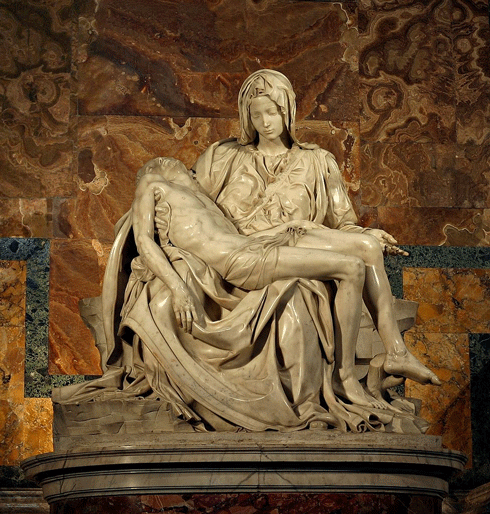
Michelangelo's Pietà

Pietà by Michelangelo, 1499

Michelangelo inspires many with his grand vision of Christian faith, an artist to marvel, and yet he remains a man of mystery. Michelangelo struggled with same-sex attraction , as suggested by a number of homoerotic poems he wrote. However, there is no known evidence that he ever acted on his carnal desires, remaining celibate his entire life.    Was he redirecting and rechanneling his sexual energies towards glorifying God through his extraordinary talents?

HT:  My mom, for the Sistine Chapel virtual tour.


Now the Green Blade Rises

Yesterday, at our worship service for Easter, we played a modern rendition of the classic hymn, Now the Green Blade Riseth.   With lyrics written by an Anglican clergyman, John Macleod Campbell Crum, in 1928, it is based on an old French Christmas Carol tune and 15th century melody, Noël Nouvelet.

The version we rocked out on yesterday was arranged by Alex Mejias for High Street Hymns, that seeks to reclaim hymns for the good of the contemporary church.   The lyrics powerfully testify to the truth of Christ’s Resurrection:

Now the green blade rises from the buried grain,
Wheat that in the dark earth many years has lain;
Love lives again, that with the dead has been:
Love is come again, like wheat that springs up green.

In the grave they laid Him, Love Whom we had slain,
Thinking that He’d never wake to life again,
Laid in the earth like grain that sleeps unseen:
Love is come again, like wheat that springs up green.

Up He sprang at Easter, like the risen grain,
He that for three days in the grave had lain;
Up from the dead my risen Lord is seen:
Love is come again, like wheat that springs up green.

When our hearts are saddened, grieving or in pain,
By Your touch You call us back to life again;
Fields of our hearts that dead and bare have been:
Love is come again, like wheat that springs up green.

When engaging with those who are skeptical about the truth of the Christian faith, it all comes down to whether or not the story expressed in this hymn is a real event in history,  fantastic wishful thinking, or a really bad April Fools joke.  I’ll go with the first option.

For a more traditional version of this hymn, enjoy this by the Choir of Ely Cathedral:

Veracity Blavatar
