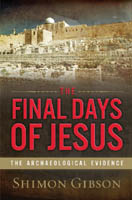
The Final Days of Jesus: The Archaeological Evidence
Every year at this time (Holy Week) there is a dramatic increase in documentaries about the ‘real’ Jesus and the meaning of Easter.
To believers, it is difficult to fully appreciate the depth of God’s love for us—his fallen creatures—that in his redemptive plan he allowed himself to be tortured on our behalf. However we accept that Jesus’ crucifixion was an historical event, and that his resurrection from death is the cornerstone of our faith (as the Apostle Paul stated in 1 Corinthians 15).
To skeptics, it’s difficult or impossible to believe.
But there are those in between that have no particular biases (or at least are willing to investigate the claims of Christianity objectively). They are interested in figuring it out—essentially adding up the evidence before making up their own mind. Undoubtedly this can be a great pathway to a strong faith. Ask Lee Strobel. Ask Hugh Ross. Ask Josh McDowell.
In prior posts, we looked at what happened when and where on Good Friday, and the importance of the Resurrection. But what I most want to share today is an example of getting to the Resurrection by subtraction.
Shimon Gibson is an esteemed archaeologist, arguably one of the foremost authorities on the archaeology of Jerusalem. In his book, The Final Days of Jesus: The Archaeological Evidence, Dr. Gibson documents his interpretation of the archaeology of Holy Week. Theologically his title is a bit provocative, but he does a good job relating the environment and settings.
I read Dr. Gibson’s book more than six months ago, but what really sticks with me is what one of his colleagues wrote about the book in a blog post. Dr. James Tabor praised the book for its scholarship stating,
“There is no doubt in my mind that the rich contents of this wonderful and engaging book will make it a standard in the field of Christian origins. It is an indispensable handbook for the scholar, and a thrilling investigative read for the non-specialist wanting to know more of those last critical days of Jesus.”
But Dr. Tabor also wrote in the same post,
“I find Gibson’s closing lines of his last chapter, “Who Moved the Stone,” somewhat counterproductive in terms of what we might be able to responsibly say as historians. He writes: “The reality is that there is no historical explanation for the empty tomb, other than if we adopt a theological one, i.e., the resurrection. I leave it up to the reader to make up his own mind.” I have to disagree here. Though I freely admit our sources might never allow us to definitely state what happened that Easter weekend, I think by definition the explanation “God took Jesus bodily to heaven,” is not one that historians can responsibly entertain, as historians.”
“The reality is that there is no historical explanation for the empty tomb, other than if we adopt a theological one, i.e., the resurrection. I leave it up to the reader to make up his own mind.” There are a lot of theologians who make just that point as the bottom line for belief in Jesus Christ and the Resurrection—the tomb is empty.
Dr. Gibson concluded his book immediately after making the empty-tomb statement with this statement,
“Some readers might think it is presumptuous of me, an archaeologist, to write about the character, achievements, and goals of such an important figure as Jesus. After all, billions of people across the planet worship him as Christ the Saviour, and the Son of God. But my views are expressed here honestly based on an analysis of archaeological and historical data available to me; I have no personal or religious axe to grind, one way or another, and I definitely have no wish to offend anyone, even though some of the things I say may be radical and controversial.”
Thank you Dr. Gibson for your honest lesson in subtraction.
Once you do your own subtraction and come to the realization that the Resurrection really is an historical event, then the evidence does demand a verdict. What was that all about? Who is that all about? Truth is a person and the tomb is empty. Happy Easter!





 Veracity