
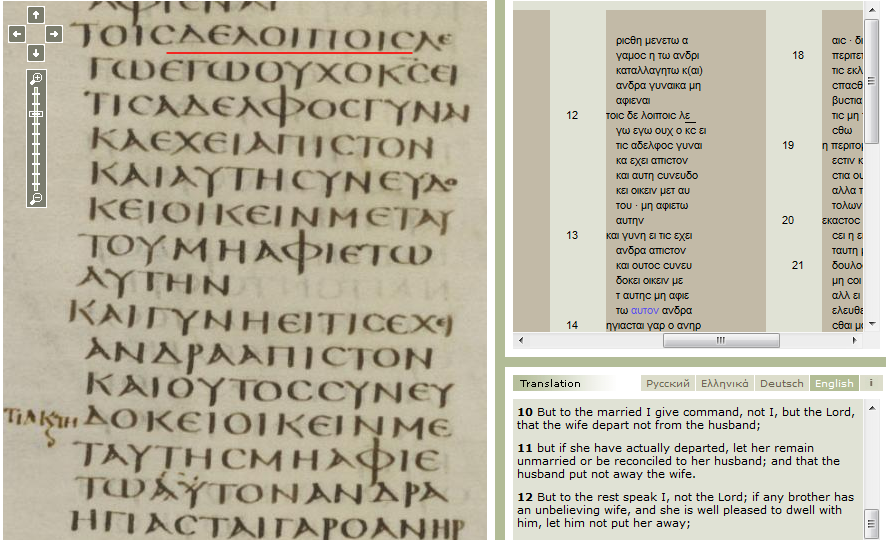
1 Corinthians 7:12 in the Codex Sinaiticus
Scripture contains some amazing context clues that point to its trustworthiness. For example, consider the Apostle Paul’s words in his letter to the Corinthians:
To the married I give this charge (not I, but the Lord): the wife should not separate from her husband (but if she does, she should remain unmarried or else be reconciled to her husband), and the husband should not divorce his wife. To the rest I say (I, not the Lord) that if any brother has a wife who is an unbeliever, and she consents to live with him, he should not divorce her.
1 Corinthians 7:10-12 (ESV)
Paul makes a point of stating that verse 10 is from the Lord. But in the very next statement (verse 12) Paul writes, “I just want to add my thoughts here.” He makes it completely clear that these are not God’s words verbatim. This does not imply that Paul’s words should be deprecated or discredited in any way—quite the opposite. Paul was careful to differentiate that which was directly from God and that which was from Paul. Not exactly the approach of someone who is making things up or playing loose with the facts, is it?
This is not a post about divorce. Divorce has to be considered in the context of what Jesus said in the Sermon on the Mount, and Paul’s words here and elsewhere have to be read in context. But what is particularly exciting is the nature of Scripture that is revealed in these verses. Continue reading





 Veracity