Category Archives: Apologetics

For Those Living in a “Post-Truth” Society: A New Book Co-Authored by Ravi Zacharias

Jesus Among Secular Gods, by Ravi Zacharias and Vince Vitale.

Jesus Among Secular Gods, by Ravi Zacharias and Vince Vitale. Addresses issues that were missed in Zacharias’ earlier work, and geared towards today’s college student.

(December 8, 2017): PLEASE READ THE VARIOUS UPDATES ON the ENTIRE POST BELOW. Thank you….

When I first read Ravi Zacharias’ book, Jesus Among Other Gods, published in 2000, others and I were encouraged by what we considered to be a very readable exploration into why Jesus Christ is so fundamentally different, in a society that is constantly exposed to conflicting and competing truth-claims. So impressive was the book, that our church made a united effort to bring Ravi Zacharias to our church, and the campus of the College of William and Mary, for a weekend of messages, followed by dynamic public question and answer sessions.

Though I still highly recommend Jesus Among Other Gods, I personally felt that the book lacked something important. Zacharias was great at showing the contradictions between various religious worldviews, but he did not adequately address the question of how one is to live in a world, where such conflicting truth-claims exist in the first place. It is one thing to consider the particular truth-claims of different religions. But why even chose any particular worldview at all? Why not just accept them all?
Jesus Among Other Gods, by Ravi Zacharias, 2000.

Jesus Among Other Gods, by Ravi Zacharias, 2000.

For example, so many Christians enter into a relationship with someone who is a professing Muslim, Buddhist, or Hindu, with the idea that the other person is “Evil Incarnate.” However, these Christians are often confused when they soon realize that their new Muslim, Buddhist or Hindu friend, is often really a nice person. Are then all religions somehow “true?” An informed response is needed to this question.

Oxford Dictionaries named the term “post-truth” as the 2016 word of the year. So, it is absolutely crucial that Christians begin to more clearly think through the relationship between “truth” and the Gospel, and start having better conversations with our neighbors about these issues.

That is why I am really excited by a new book co-authored by Ravi Zacharias, and fellow associate apologist, Vince Vitale, Jesus Among Secular Gods. With chapter titles such as “Atheism,” “Scientism,” “Pluralism,” “Humanism,” “Relativism,” “Hedonism,” and “Love the Truth,” Jesus Among Secular Gods has great potential to be a great discussion starter among our neighbors.

Ravi Zacharias and Vince Vitale travel the world, speaking before audiences, sharing their faith and answering objections to the Gospel of Christ, through Ravi Zacharias International Ministries.  Zacharias is featured on a weekly syndicated radio program, Let My People Think. Below is a 12-minute discussion about the new book. I have not read the book yet, but if you have, please share your review in the comments section below!

UPDATE: December 7, 2017. I am sorry to say that I did not adequately review the video below, before posting. For if I did, I would have caught the fact that Vince Vitale introduces his fellow co-auther as “Dr. Ravi Zacharias.” This is most unfortunate, as I knew that Ravi Zacharias, though clearly a gifted speaker and writer, and a most intelligent, Christ-loving man, has never earned the doctoral equivalent of a PhD, in any field. Ravi has received Honorary Doctorates, but this does not qualify anyone to be called a “Doctor,” especially when one’s ministry field is to students and professors in higher education. I would hope that this was simply an oversight, an honest mistake, on both Dr. Vince Vitale’s (who truly is a “Doctor”) and Mr. Ravi Zacharias’ part. I still have not read the book, but given what I have read before from Ravi, I still think it would be most helpful. Nevertheless, I regret the error on my part. For more information, please read this more recent blog article about this issue.

UPDATE: December 8, 2017. For those who have been following this, as someone who values the work of RZIM, I have had trouble sleeping, and I thought it best to try to reach out to someone at RZIM (this is the biblical way to do it). So, I contacted Vince Vitale directly and expressed my concerns, as this whole episode has been terribly frustrating to me. Thankfully and graciously, Dr. Vince Vitale took the time out of his day, and called me from Oxford (how many times does that happen?). We had a great conversation and I was thoroughly impressed by his integrity.

Vince deeply loves Ravi, and greatly respects him, so it was only natural to address him, in a manner, that would befit showing such respect, to a fine Christian leader.  However, Vince also told me that RZIM recognizes that using “Doctor” in this way is contentious in some circles, especially in academia, and that they desire to aim for complete clarity. From our conversation, it appears that he, and RZIM as a whole, are taking steps, in good-faith, to hear the concerns of me and others and to make sure that the way they speak about credentials is both accurate and unambiguous.

Admittedly, people outside of academia might not care one bit about stuff like this, but when you are trying to minister to faculty and students, like we have in our local community, in a college town, it is important for ministers of the Gospel, to stand above reproach. So, I am very, very glad Vince Vitale personally is taking the right steps forward, and that he has been so generous with me. That is a mark of great character. Thank you, Vince!!!

UPDATE: May 20, 2020.  Ravi Zacharias died yesterday, from a short battle with bone cancer. Since this blog post was updated on December 8, 2017, RZIM finally took down the controversial video from YouTube, promoting the Jesus Among Secular Gods book.  Kudos to RZIM for eventually setting the record straight….. Speaking of McGrath (above), Alister McGrath has a very fine remembrance essay posted at The Gospel Coalition.

UPDATE: December 23rd, 2020. Review of the sexual impropriety charges at a spa, partly owned by Ravi Zacharias, conducted by a law firm hired by RZIM, releases a preliminary report indicating that Ravi did act inappropriately.

Andy Stanley, and Critics Who Shoot First, and Ask Questions Later

Megachurch pastor Andy Stanley. Promoter of Biblical truth... or compromiser?

Atlanta Megachurch pastor Andy Stanley is in trouble again with a number of his fellow evangelical leader friends… or have his “friends” succumbed to a “Shoot First, Ask Questions Later” approach to evaluating his preaching?

Do you “fact check” what you read on social media, or any other source of news and information, particularly when it involves a controversial matter of grave concern?

I had just come back from a Christmas trip to visit family, when I ran across a Patheos blog article with the alarming title, “Andy Stanley: Please Relent or Step Down from Pastoral Ministry.” Mmmm…. Yet another scandal among God’s people? A megachurch pastor gone astray? What embarrassment for the Christian faith is it this time?

In this article, the author compares Andy Stanley, a megachurch pastor in Atlanta, and son of popular Bible-teacher Charles Stanley, with the mid-20th century liberal minister, Henry Emerson Fosdick, and a modern-day prosperity doctrine guru, Joel Osteen. Wow! If you know anything about evangelical theology, these are serious charges to lay against any evangelical pastor.

Andy Stanley’s preaching faux pas, per the Patheos blogger, was taken from an early December 2016 sermon delivered by Andy Stanley, regarding Christmas and the difficulty that many people in our secularized culture today have believing in the Virgin Birth of Jesus. Our scientific world has tested the credibility of such miracles, and so, many wonder if the Virgin Birth is not some type of man-made fiction. In responding to the doubts of many, Stanley was partially quoted in a Washington Post article as saying, “If somebody can predict their own death and resurrection, I’m not all that concerned about how they got into the world.”

What does that mean?

The Patheos blogger I was reading, along with a wide variety of other Internet bloggers and Christian media outlets, since early December, took this to mean that Stanley believes that the Virgin Birth is not an essential matter of Christian faith. Others interpret this by saying that Stanley was “questioning the significance of the virgin birth.” Even the venerable president of Southern Baptist Theological Seminary, Al Mohler, took exception to Stanley’s statement as quoted by the Washington Post, on a recent “The Briefing” podcast (though it should be noted to Dr. Mohler’s credit that he did not name Stanley directly):

If Jesus was not born of the virgin then the Bible cannot be trusted when it comes to telling us the story of Jesus, and that mistrust cannot be limited to how he came to us in terms of the incarnation. The fact is that biblical Christianity and ultimately the Gospel of Christ cannot survive the denial of the virgin birth. Because without the virgin birth, you end up with a very different Jesus than the fully human, fully divine savior revealed in scripture.

Now, I agree with folks like Al Mohler that the Virgin Birth is an essential doctrine to Christian faith. It is one of the historic, fundamental beliefs of Christianity, not to mention the entire foundation for the Christmas story. But is it accurate to say or imply that pastor Andy Stanley is now denying the essential doctrine of the Virgin Birth?

Upon reading and hearing these things, I harkened back to another controversy that pastor Andy Stanley had earlier in 2016, a story covered here at Veracity (part #1 and part #2).  In that controversy, Stanley was accused of denying Biblical inerrancy. Yet strangely enough, Stanley made his own defense by appealing to one of Stanley’s teachers and mentors, Norman Geisler, who was glad to offer support for Stanley. Norman Geisler was one of the primary architects behind the Chicago Statement of Biblical Inerrancy, articulated in the 1970s. So, it really is strange to imagine that Andy Stanley, an enthusiastic student of Geisler’s, would find himself accused of denying Biblical inerrancy, then defended by Norman Geisler, and then still be accused by some of his fellow evangelical leaders as being “dangerous.”

Strange. Very strange indeed.

It reminds me of something Yogi Berra might have said: It is like “deja vu all over again.” Continue reading


Daniel’s Seventy Weeks #5

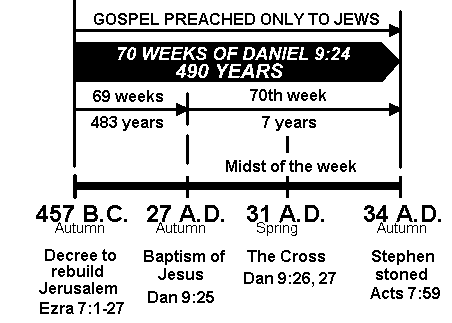
The primary traditional alternative to the more modern, dispensationalist reading of Daniel 9:24-27

A more traditional alternative to the more modern, dispensationalist reading of Daniel 9:24-27.  (Image credit: sdru.org)

If you have been following this series of blog posts (#1, #2, #3, and #4), you will know that the “Seventy Weeks” of Daniel 9:24-27 makes for a very demanding study. So, as we are getting very near to Christmas, I need to wrap this blog series up, even with all of the loose ends still out there.

Thankfully, neither your salvation, nor mine, hangs in the balance with getting Daniel 9:24-27 exactly right. For example, no central doctrine of the faith is at stake, as you ponder the mysterious meaning of Scripture phrases like “the people of the prince who is to come shall destroy the city and the sanctuary” (verse 26). But the study is well worth the effort, as it will spur you on in learning more about Biblical prophecy, just as it has done for me.

At one point in my studies, over the past two years in this passage, I ran into the following statement by Dr. Martyn Lloyd-Jones, one of Britain’s most brilliant and popular expositors of the 20th century. Lloyd-Jones lived in an era when many Christians tended to be very dogmatic in their particular interpretation of Daniel 9. His comments on the debate over Daniel 9’s “Seventy Weeks” are worth savoring:

I am simply trying to put before you some of the various ideas and type of interpretation, while indicating, as anyone who is concerned to teach the Scriptures must do, the interpretation that most commends itself to my mind and to my understanding. I shall continue to repeat this because it seems to me to be the most important point I can make in connection with this whole subject. If I can somehow shake the glibness and the dogmatism that has characterised this matter I shall be most pleased, and I thank God that there are signs and indications that people are prepared to consider this matter anew. It may well betoken a period of blessing in the history of the Church.” (Great Doctrines of the Bible: God the Father, God the Son, God the Holy Spirit, The Church and the Last Things, page 119).

Martyn Lloyd-Jones has the right perspective. We are not talking about the deity of Christ, or salvation alone through Jesus, here. OKAY??? I may hold (and you may hold) to a different interpretation of a difficult passage like Daniel 9. Hopefully, believers can discuss this matter with clarity and charity towards one another, by studying the Scriptures anew. Continue reading


Daniel’s Seventy Weeks #4

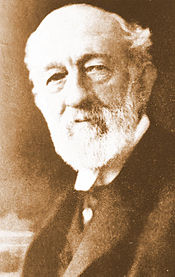
Sir Robert Anderson (1841-1918) is remembered by many Bible students today for his contribution to the interpretation of the book of Daniel. However, in the 19th century he was also known as a high ranking official at Scotland Yard, the second Assistant Commissioner of the London Metropolitan Police.

Sir Robert Anderson (1841-1918) is remembered by many Bible students today for his contribution to the interpretation of the book of Daniel. However, in the 19th century he was also known as a high ranking official at Scotland Yard, the second Assistant Commissioner of the London Metropolitan Police.

Daniel’s “Seventy Weeks” prophecy, as found in Daniel 9:24-27 is often regarded as the key text for understanding the prophecy perspective held by advocates of dispensationalism, as made popular by books and movies associated with Tim Lahaye’s Left Behind. Yet as we noted in a previous post in this series, this passage from Daniel plays actually a limited and somewhat obscure role in the New Testament, especially when compared to passages such as Psalm 110, which is quoted or alluded to some thirty times in the New Testament, as we sought to exposit earlier a few years ago on Veracity.

As I have been digging into the interpretation of Daniel 9:24-27, for nearly two years, inspired by the “astronomical” work of my friend, Ken Petzinger, I have been learning that the controversies surrounding these four verses of the Bible are fascinatingly complex. In this post, I want to lay aside some of the Bible interpretation issues aside, and focus instead on some questions of history:

So, where did the “dispensationalist” approach to Daniel 9:24-27 come from? Why is it that the prophecy of the “Seventy Weeks” has become so important in the minds of so many Christians, over the past hundred or so years?
Continue reading


Daniel’s Seventy Weeks #3

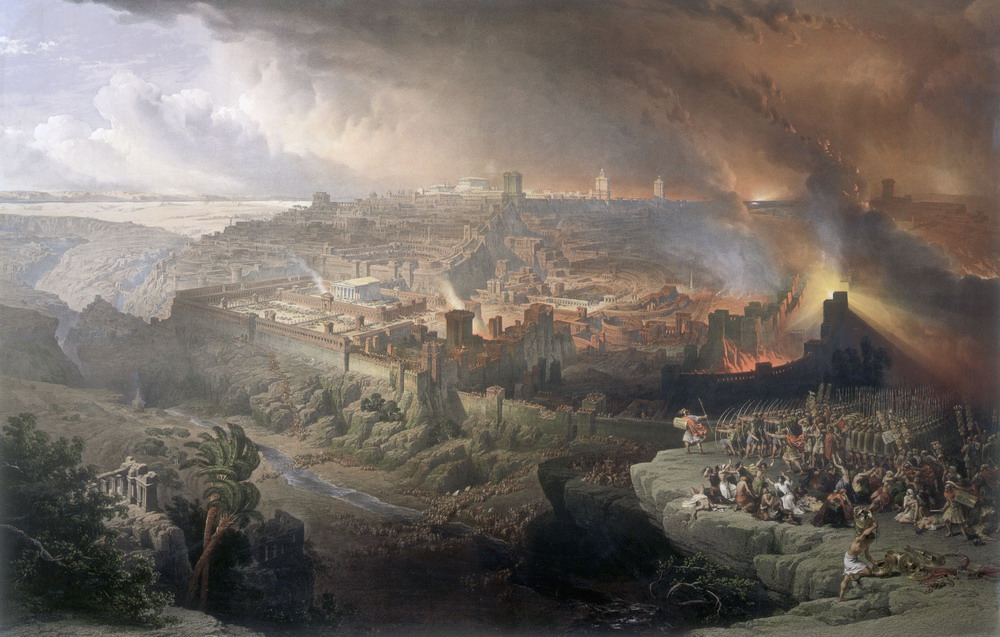
The destruction of Jerusalem by the Romans in 70AD -- a painting by David Roberts (1796-1849).

The Roman army under Titus destroyed Jerusalem and its Temple, by the year 70 AD. Does this catastrophic event in the first century offer any insight into understanding the “Seventy Weeks” prophecy found in Daniel 9:24-27?  
(a painting by David Roberts, 1796-1849).

Up to this point in this series ( post #1, post #2), we have been exploring the dispensationalist approach to the “Seventy Weeks” of Daniel 9:24-27. Let us jump into the text again, first:

“Seventy weeks are decreed about your people and your holy city, to finish the transgression, to put an end to sin, and to atone for iniquity, to bring in everlasting righteousness, to seal both vision and prophet, and to anoint a most holy place. Know therefore and understand that from the going out of the word to restore and build Jerusalem to the coming of an anointed one, a prince, there shall be seven weeks. Then for sixty-two weeks it shall be built again with squares and moat, but in a troubled time. And after the sixty-two weeks, an anointed one shall be cut off and shall have nothing. And the people of the prince who is to come shall destroy the city and the sanctuary. Its end shall come with a flood, and to the end there shall be war. Desolations are decreed. And he shall make a strong covenant with many for one week, and for half of the week he shall put an end to sacrifice and offering. And on the wing of abominations shall come one who makes desolate, until the decreed end is poured out on the desolator” (Daniel 9:24-27 ESV).

So, is the dispensationalist reading of this passage the best way to understand the text?

Let us explore some of the issues in this blog post. Different Bible interpreters over the years have looked at Daniel 9 in very different ways. When you examine each approach, you learn that there are some ambiguities in the text that force the interpreter to make some assumptions as to how a particular ambiguity in the text might be resolved.

So, what are these ambiguities? Have you ever heard of Hank Hanegraaff, known in radio-land as the “Bible Answer Man?” Continue reading