Author Archives: John Paine

About John Paine

Unknown's avatar
This blog is topical and devotional--we post whatever interests us, whenever. If you want to follow in an orderly fashion, please see our Kaqexeß page.

Personal Discipleship

The Life Line

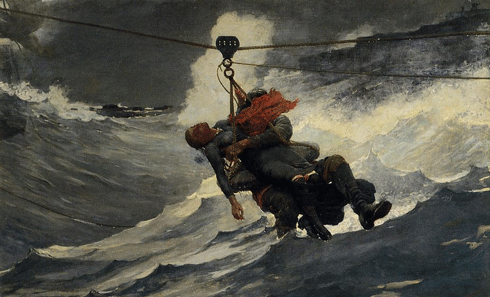
The Life Line by Winslow Homer, 1884

Personal discipleship has been a lifeline for me between what had become a comfortable and complacent Christian experience, and one that became vibrant, exciting, and very real.

If you search for “personal discipleship” on the Internet, you’ll find a variety of  not-very-standardized definitions.  So up front, here’s my homegrown definition: personal discipleship is the process in which a believer or seeker takes personal responsibility for investigating the claims and content of the Bible.

While we all appreciate hearing a well-turned sermon in a moving worship service, sitting in a pew is a passive experience.  None of us would get very far academically if all we ever did was attend lectures.  We have to read, study, work some problems through, write, engage others in discussion, apply ourselves, and prepare to be tested.  And so it is with our faith.

Kierkegaard argued that Christians should take the initiative to work out our own relationship to God.[1]  But this wasn’t Kierkegaard’s original idea, it came from the Apostle Paul.

“Therefore, my beloved, as you have always obeyed, so now, not only as in my presence but much more in my absence, work out your own salvation with fear and trembling, for it is God who works in you, both to will and to work for his good pleasure. Do all things without grumbling or questioning,”
Philippians 2:12-14 (ESV)

Here the more literal ESV translation of the text leads to great doctrine.  This is not the Talmud instructing students to “Find thyself a teacher.”  It’s the author of half the New Testament telling disciples to work out our own salvation with fear and trembling.  Not to make up our ideas of God, but to reverently and humbly work on our relationship with him.  Not to have anyone do the work for us, but to do it ourselves. Continue reading


Cherry Picking Kierkegaard

The Coffee Gathering Pombo

“La tertulia del café de Pombo” by José Gutiérrez Solana, 1920

Generally I’m more apt to hang out with grill-in-the-driveway, figure-it-out-yourself, change-your-own-oil, workaday kind of guys than intellectuals. When I was younger and thought I knew what was important, I developed an anti-intellectual prejudice that continues to the present day. But as Tim Keller says, “You cannot be a Christian without using your brain to its uttermost,” so game on.

Many of us have a tendency to read Bible passages simplistically, without empathizing or thinking beyond the sacred page. Teachers like Michael Card encourage reading “at the level of our imaginations,” but that takes time and work.

Take the story of the testing of Abraham in Genesis 22 for example.  Danish philosopher, theologian, and Lutheran ethicist Søren Kierkegaard thought about the anguish that Abraham felt while walking for three days to Mount Moriah to sacrifice Isaac.  To Kierkegaard this is not a simple story to be read dryly or mechanically from one punctuation mark to the next.  Kierkegaard thought about the huge weight being placed upon Abraham’s conscience, and posited ideas about the teleological suspension of the ethical.  This isn’t (actually) a post about Kierkegaard, but just to help set the background, here are a few of his quotes: Continue reading


Respecting Disagreement

Now we see but a poor reflection as in a mirror; then we shall see face to face. Now I know in part; then I shall know fully, even as I am fully known.
1 Corinthians 13:12 (NIV)

Two Apostles

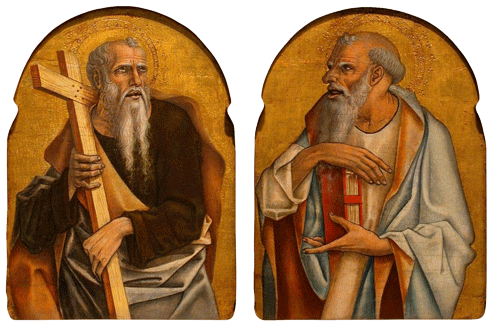
Two Apostles by Carlo Crivelli, 1475

The apostles Peter and Paul had some famous disagreements.  Ultimately however, it was their shared, unswerving love for Christ that propelled their ministries.

I recently attended a lecture by Dr. Ian Hutchinson, a scientist with impressive technical credentials—and a Christian.  His topic addressed science-faith issues, and concluded with his belief that a Christian worldview is consistent with, and complimentary to, a scientific worldview.  I agree and am thankful that there are scientists of Dr. Hutchinson’s caliber who are willing to share their faith in public forums.  (Let’s be real—who am I to disagree?)

The first question from the audience at the end of the lecture involved the age of the earth and the six ‘days’ of creation.  Dr. Hutchinson’s response was along the lines that the universe is very old (13.7 billion years, again I agree), and that he believes we should not take the creation account in Genesis too literally—that the text is ‘figurative’.  And here we have a fork in the road.  I think it is somewhat dangerous to give up on the text in Genesis too easily, and to ascribe a figurative intent on the part of the author (Moses) when in fact there may be more to the inspired text than meets the eye.

In addition to his work at MIT, Dr. Hutchinson is also a lecturer for the BioLogos Foundation, founded in 2007 by another prominent Christian, Dr. Francis Collins.  These brothers and sisters in Christ adhere to the idea of theistic evolution, which—rather than have my take on this topic—you can read about directly from the BioLogos website.  There are many wonderful Christians who ascribe to the ideas of theistic evolution.

I’m just not one of them.  After studying the matter in detail, I have a different understanding.  I ascribe to old-earth creationism.

Hugh RossDr. Hugh Ross and his colleagues at Reasons To Believe have a great deal to share on this topic.  First, Moses never wrote that the universe was created in six days.  Excuse my provocative statement, but I did it to make a point— ‘day’ is an English word.  Moses did not write in English (which has a million or more words), he wrote in Biblical Hebrew (which only had a few thousand words), and the word that was written was ‘Yom’, which clearly has multiple meanings including the idea of an epoch or age. Continue reading


Why Does God Allow Evil and Suffering?

When God gave us His Word, He was not in denial regarding the suffering of His people. Have you discovered the Bible is filled with Scriptures that answer the ‘why’ questions the people of God ask when they are hurting? I have been in a wheelchair since 1983 and have been totally paralyzed for many years. What I have written here is not unproven theory from passages in the Bible. I have personally needed to search the Scriptures and find these “Thirty Biblical Reasons Why God’s People Suffer.” If you are suffering, or you know someone who is, join me as I explore thirty biblical responses of God to people with hurting hearts.
Dick Woodward, 30 Biblical Reasons Why God’s People Suffer

30 Biblical Reasons Why God's People SufferHow can an all-powerful and good god allow evil and suffering?  As William Lane Craig points out, the problem of evil and suffering is the primary argument against the existence of God.  In this presentation he argues that “Christian theism is man’s last, best hope for a solution to the problem of evil,” distinguishing between the intellectual and emotional versions of the problem of evil.

But the question is so profound that it can be particularly difficult to separate emotions from intellect.  It can gnaw at our soul. Even those who accept the existence of God can have a hard time resolving evil and suffering. Continue reading


Veracity’s Top 10 Scorers

Veracity's Top Scorer Award

Do you ever wish there was a blacklist we could use to avoid being blindsided by bad doctrine or theology?  After all, there is so much material out there—who has the time to sort through it all?

When you think about it, a blacklist is a pretty ridiculous idea isn’t it? Not that there aren’t all kinds of names—from the famous to the infamous—that deserve to be called out, but there is a much better way for thinking men and women to attack this problem.  Study the good guys.

Welcome to Veracity’s Top 10 Scorers list. These are the players who consistently “put the puck in the net.” No deking and skating around—just on-target discipleship.

The list includes pastors, philosophers, professors, a historian, theologians, apologists, an astrophysicist, several world-class scholars, and some exceptionally gifted teachers.  (Actually there are 12 winners on our Top 10 Scorers list, because they all deserve the award.) Continue reading