Author Archives: John Paine

About John Paine

Unknown's avatar
This blog is topical and devotional--we post whatever interests us, whenever. If you want to follow in an orderly fashion, please see our Kaqexeß page.

Symposium 2013 Roundup Week Three

Test everything. Hold on to the good.”
1 Thessalonians 5:21 (NIV84)

“Do not conform any longer to the pattern of this world, but be transformed by the renewing of your mind. Then you will be able to test and approve what God’s will is—his good, pleasing and perfect will.”
Romans 12:2 (NIV84)

Among many other distinguishing characteristics, Christianity is all about the truth.  Christian believers do not have the burden of fideism, and can ask any question without fearing that their faith will be overturned by the answer.  In fact, the apostle Paul exhorted us to test everything.

Facts & Faith

We concluded our three-part Facts & Faith Symposium on Sunday night by showing and discussing Hugh Ross’ testimony in the Cosmic Fingerprints DVD, produced by Reasons To Believe.

We recorded the panel discussion and Q&A just as for Week Two, and here is the video:

[vimeo 80690471 w=490]


So What?

Why did we do this?  Doesn’t the topic of Creationism divide the church?  Was it worth it?   Continue reading

Evidence of Transformation

“It is sown a natural body, it is raised a spiritual body. If there is a natural body, there is also a spiritual body.”
(1 Corinthians 15:44, NIV84)

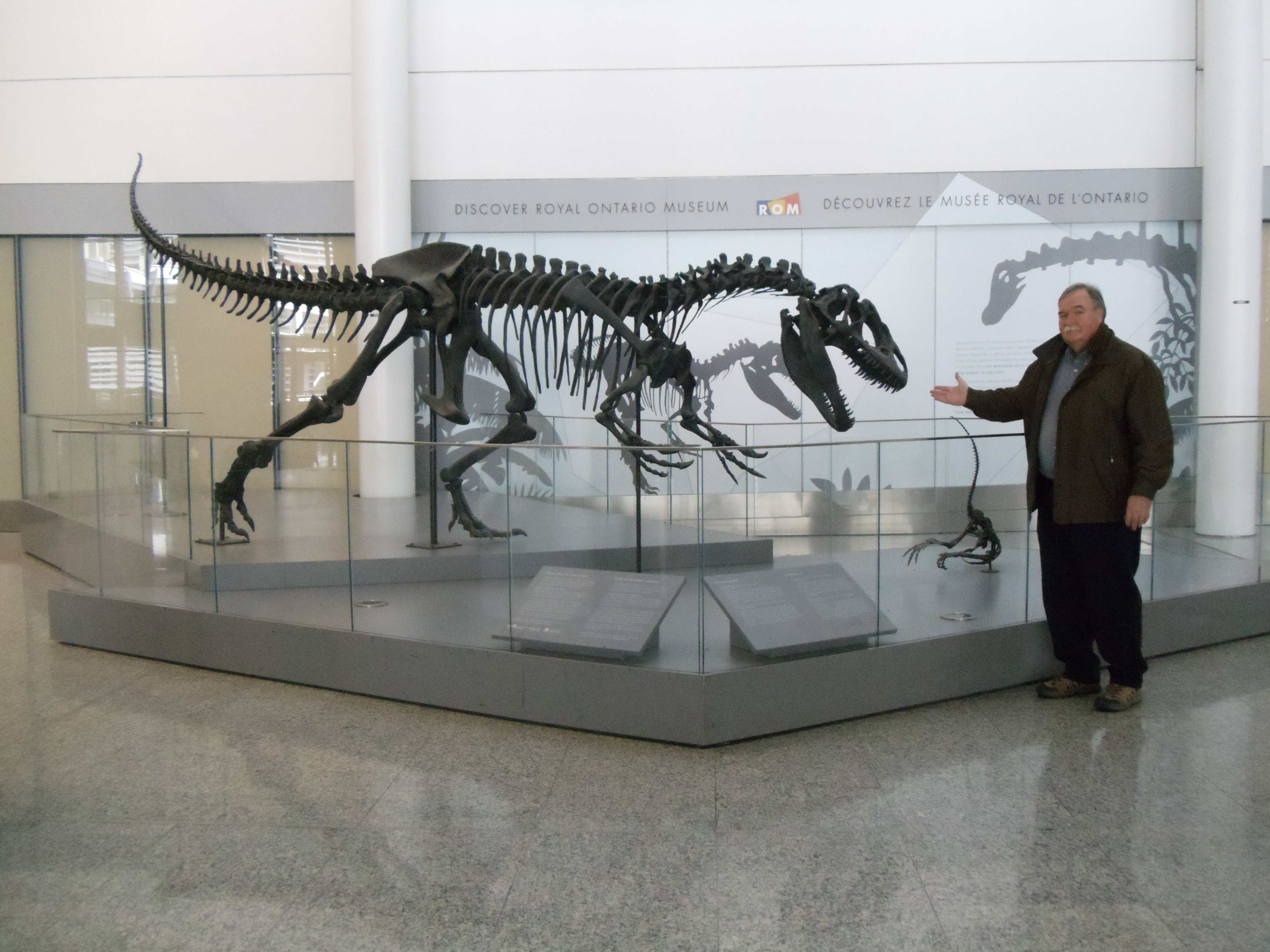
Dinosaur at Toronto Airport

How come there are no dinosaurs in the Bible? I found this one at the Toronto airport.

After all of Clarke’s hard work leading up to our Facts & Faith symposium, I decided to see if I could help out by taking Veracity on the road—to look for evidence of agreement between science and faith. So…

Niagara Falls

Greetings from Niagara, Ontario! It’s very wet (and beautiful) here.

Old earth creationism, young earth creationism, theistic evolution, neo-Darwinism, naturalism, theism, atheism, science versus faith, science and faith—we’ve taken on quite a bit of material in the weeks leading up to the symposium. There seems to be no end to controversies surrounding these topics. Got it. But does any of this stuff really matter?

Bird at Niagara Falls

What are you thinking?

It is ironic that the three intramural Christian positions on creationism (young earth, old earth, and theistic evolution) all agree that the age of the earth is not essential to the salvation of anyone’s soul. So why does it matter? OK, let’s come at the issue from a less Christian perspective.

Suppose you are sharing your faith with someone who is unfamiliar with Christianity, or has doubts about the claims and content of the Bible. (If you’re not encountering people like this, might it be time to leave your monastery or otherwise get out and meet some real people?) Further suppose that your beliefs are not supported by contemporary science or scientific scholarship. Would you be willing to argue that “science is wrong?” It turns out that many Christians do indeed argue that science teaches things that are contrary to the Bible and that science is wrong. Welcome to the Bible versus science, an unnecessary either-or proposition. Continue reading


Life After Death (Part 3)

Lighthouse Stairs

Grays Harbor Lighthouse Stairs, photo by Joe Mabel


Our summary and review of the Life After Death issue of the Areopagus Journal (Fall 2011) concludes with the paranormal.  If this topic makes you uncomfortable, welcome to the club—that’s probably true for the vast majority of rational beings like you and me.  But like it or not, some people do claim to experience things that are beyond the range of our normal experience or scientific explanation.  Should we believe them?  Are there good apologetic arguments to support Life After Death that make sense based upon paranormal claims?

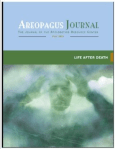
Areopagus Journal

Areopagus Journal, Life After Death, Fall 2011

The Life After Death issue of the Areopagus Journal addressed two paranormal topics: near death experiences (NDEs) and ghosts.  Rather than redact the articles by Dr. Gary Habermas and Dr. Ron Rhodes—as I did in Part 1 and Part 2 of this series—I will link in external material and do more of a paraphrased summary of the points they make (for details get the Areopagus Journal).

Near Death Experiences and Worldview Concerns: Addressing Difficult Questions

Dr. Habermas touched on this topic earlier this month at the 2013 National Conference on Christian Apologetics.  Two things strike me about his approach to apologetics.  First, he makes minimalist arguments—reducing a debate to the minimum number of elements that he needs to make his point, without overreaching.  Secondly, he is very conservative in drawing conclusions—which is a hallmark of credibility.  Here is a quick synopsis of his views on NDEs, from the One Minute Apologist.

After hearing him relate specific cases he has researched, I was enthusiastically thinking those cases would make self-evident apologetic arguments.  After all, a few of them are amazing, and very reliably documented.  But as my co-blogger is quick to point out, we should consider both the affirmative and negative sides of the debate to develop an informed opinion.
Continue reading


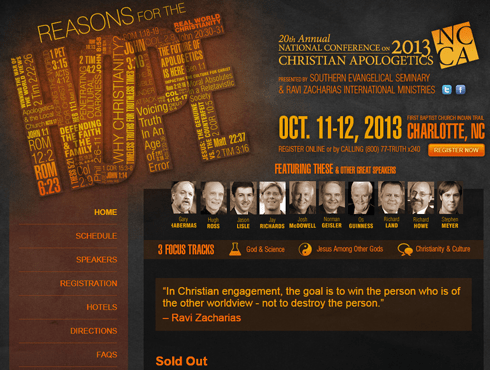
2013 National Conference on Christian Apologetics

“As iron sharpens iron, so one person sharpens another.”
Proverbs 27:17 (NIV)

2013 National Conference on Christian Apologetics

If you want suggestions about how to keep your devotional life fresh, try apologetics. Specifically, try attending an apologetics conference. I just returned from the 2013 National Conference on Christian Apologetics in Charlotte, North Carolina, and thoroughly enjoyed thinking and dialoguing at high levels of reasoning for two days.  As an active blogger, I really don’t have issues with my spiritual life becoming stale, but I have to admit it was a truly uplifting experience.

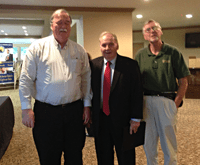
John Paine, Norman Geisler, Ken Petzinger

Dr. Norman Geisler and Dr. Ken Petzinger (a physicist).  Our rocket scientist friend did not wish to contribute to my wife’s embarrassment by posing with us.

I was travelling with some wonderful people, including a rocket scientist (no kidding), a physicist, a lawyer, and a librarian (who is also an interpretive dancer). We had some conversations; wish you could have been there with us.

For whatever reasons there was a doubling of registrations (to 2,000) from the prior year, so we stopped by Thursday evening to see if we could register before the crowd on Friday morning.  We ran into Dr. Norman Geisler roaming the halls, and he graciously agreed to pose for a photo.  After we parted I thought of all the things I should have said to him. You know, like: thanks for architecting the Chicago Statement on Biblical Inerrancy, and thanks for several books that have shaped my thinking (like Making Sense of Bible Difficulties and From God to Us, How We Got our Bible). Continue reading


Life After Death (Part 2)

“Just as we are now like the earthly man, we will someday be like the heavenly man.”
1 Corinthians 15:49 (see Dick Woodward’s post)

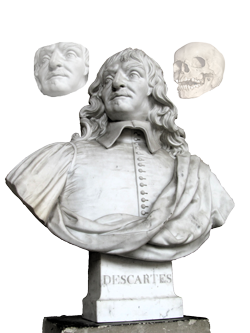
Rene DescartesHave you ever thought about your thoughts? This may seem like a ridiculous question, but it turns out there is a powerful apologetic argument for life after death that derives from simply understanding that humans have a body and a soul, and that the immaterial element (the soul) is spectacularly different from the material element (the body).

Continuing our review of the Areopagus Journal issue dedicated to Life After Death (Fall 2011), in this post we will explore what apologetics can bring to bear on the subject using philosophy, logic, and history.

The blog text below in italics is entirely the writing of Chad V. Meister.  I have edited out quite a bit of material to fit this format, without (I hope) misrepresenting his beliefs and positions.

Mind, Body, and the Possibility of Life After Death

Various conceptions of the human self have been held in the West, the two foremost being dualism and materialism.  Historically, dualism has been the more prominent of the two.  There are different conceptions of dualism as well, but on one main account the human person consists of two substances, one material (the body) and the other immaterial or mental (the soul or mind).  Rene Descartes (1596-1650) is perhaps the most widely recognized defender of substance dualism.  On his account, sometimes called the Cartesian view of the soul, the soul is an unextended, non-spatial substance, and it is contrasted with the body, an extended, spatial substance.  The soul and body are (somehow) connected to one another, but how an immaterial substance can connect to and interact with a physical substance is a bit of a mystery—a mystery which has often been castigated as the problem of the “ghost in the machine.” Continue reading